


Clinical Characteristics and Outcomes of Laboratory-Confirmed SARS-CoV-2 Cases Infected With Omicron Subvariants and the XBB Recombinant Variant
- PMID: 36968876
- PMCID: PMC10035460
- DOI: 10.7759/cureus.35261
Clinical Characteristics and Outcomes of Laboratory-Confirmed SARS-CoV-2 Cases Infected With Omicron Subvariants and the XBB Recombinant Variant
Abstract
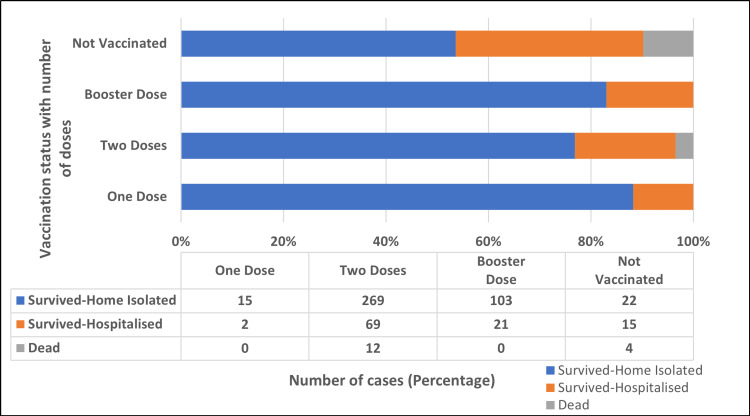
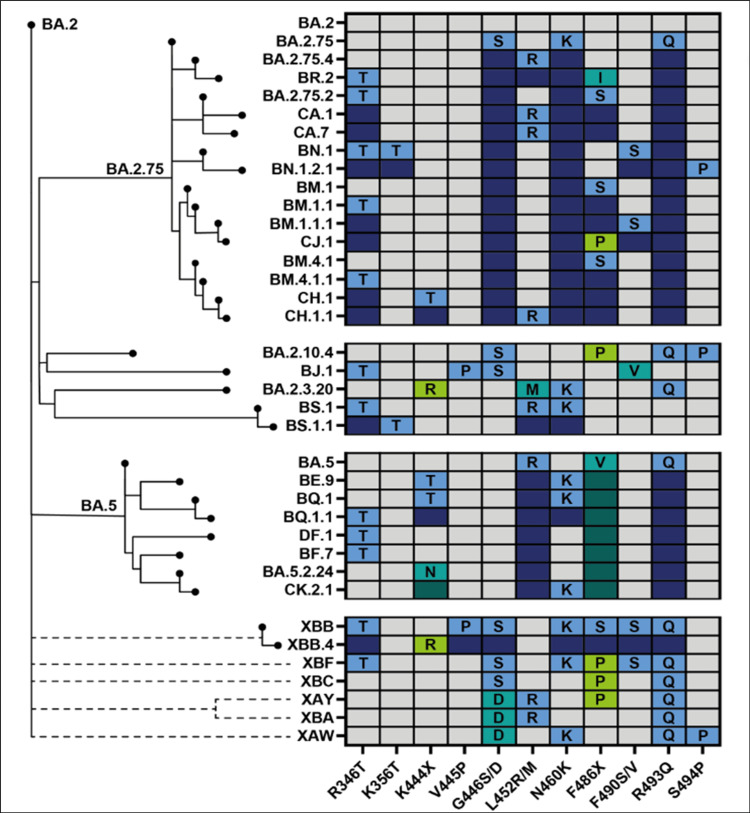
Background SARS-CoV-2 has evolved to produce new variants causing successive waves of infection. Currently, six variants are being monitored by the World Health Organization that are replacing BA.5. These include BF.7 (BA.5 + R346T in spike), BQ.1 (and BQ.1.1, with BA.5 + R346T, K444T, N460K mutations in spike), BA.2.75 (including BA.2.75.2 and CH.1.1), and XBB (including XBB.1.5). BQ.1 and XBB variants are more immune evasive and have spread quickly throughout the world. Concerning the potential severity of infections caused by these variants, the present study describes the clinical characteristics and outcomes of these major variants in Maharashtra. Methodology A total of 1,141 reverse transcriptase-polymerase chain reaction (RT-PCR)-positive SARS-CoV-2 samples, with a cycle threshold (Ct) value of less than 25, were processed for SARS-CoV-2 whole genome sequencing between July 10, 2022, and January 12, 2023. All corresponding demographic and clinical data were recorded and analyzed using Microsoft® Excel and Epi Info™. Results Out of the 1,141 samples sequenced, BA.2.75* (63.78%) was the predominant Omicron variant, followed by the XBB* (18.88%), BA.2.38* (4.94%), BA.5* (4.06%), BA.2.10* (3.51%), and BQ.1* (1.65%). A total of 540 cases were contacted telephonically, of whom 494 (91.48%) were symptomatic with mild symptoms. Fever (77.73%) was the most common symptom, followed by cold (47.98%), cough (42.31%), and myalgia and fatigue (18.83%). Of the 540 cases, 414 (76.67%) cases recovered at home, and 126 (23.33%) were institutionally quarantined/hospitalized. Among the home-isolated and hospitalized cases, 416 (99.76%) and 108 (87.80%), respectively, recovered with symptomatic treatment, while one (0.24%) and 15 (12.20%), respectively, succumbed to the disease. Out of the 540 cases, 491 (90.93%) were vaccinated with at least one dose of the COVID-19 vaccine, 41 (7.59%) were unvaccinated, and for eight (1.48%) cases, vaccination data was not available. Conclusions The current study indicates that the XBB* variant is causing mild disease in India. However, as XBB* possesses both immune-escape and infectivity-enhancing mutations, it has the potential to spread to other parts of the world rapidly. Further, anti-SARS-CoV-2 vaccination improves survival rates in COVID-19.
Keywords: ba.2.10*; ba.2.38*; ba.2.75*; ba.5*; bq.1*; covid-19; sars-cov-2; xbb*; xbb.1.5.
Copyright © 2023, Karyakarte et al.
Conflict of interest statement
The authors have declared that no competing interests exist.
Figures

References
-
- Low neutralization of SARS-CoV-2 Omicron BA.2.75.2, BQ.1.1 and XBB.1 by parental mRNA vaccine or a BA.5 bivalent booster. Kurhade C, Zou J, Xia H, et al. Nat Med. 2022;29:344–347. - PubMed
-
- Weekly epidemiological update on COVID-19 - 19 January 2023. [ Jan; 2023 ]. 2023. https://www.who.int/publications/m/item/weekly-epidemiological-update-on... https://www.who.int/publications/m/item/weekly-epidemiological-update-on...
-
- COVID 'variant soup' is making winter surges hard to predict. Callaway E. Nature. 2022;611:213–214. - PubMed
-
- Proposal for a sublineage of BA.5.2.1 with S:R346T and N:S33F (originally proposed by @FedeGueli) #827 . [ Feb; 2023 ]. 2022. https://github.com/cov-lineages/pango-designation/issues/827 https://github.com/cov-lineages/pango-designation/issues/827
-
- BQ.1* Omicron (BQ.1.X) variant report. [ Jan; 2023 ]. 2023. https://outbreak.info/situation-reports/BQ.1*%20%5BOmicron%20(BQ.1.X)%5D... https://outbreak.info/situation-reports/BQ.1*%20%5BOmicron%20(BQ.1.X)%5D...
LinkOut - more resources
Full Text Sources
Other Literature Sources
Miscellaneous