


Trends in Streptococcus pneumoniae Antimicrobial Resistance in US Children: A Multicenter Evaluation
- PMID: 36968964
- PMCID: PMC10034583
- DOI: 10.1093/ofid/ofad098
Trends in Streptococcus pneumoniae Antimicrobial Resistance in US Children: A Multicenter Evaluation
Abstract
Background: Antimicrobial resistance (AMR) poses a significant challenge for treating pneumococcal disease. This study assessed AMR trends in Streptococcus pneumoniae from US children.
Methods: We evaluated antibiotic resistance, defined as facility antimicrobial susceptibility reports of intermediate/resistant, in 30-day nonduplicate S pneumoniae isolates from children (<18 years of age) with invasive (blood or cerebrospinal fluid/neurological) or noninvasive (respiratory or ear/nose/throat) isolates at 219 US hospital inpatient/outpatient settings in the BD Insights Research Database (January 2011-February 2020). We used descriptive statistics to characterize the percentage of antimicrobial-resistant isolates and generalized estimating equations to assess variations in resistance over time.
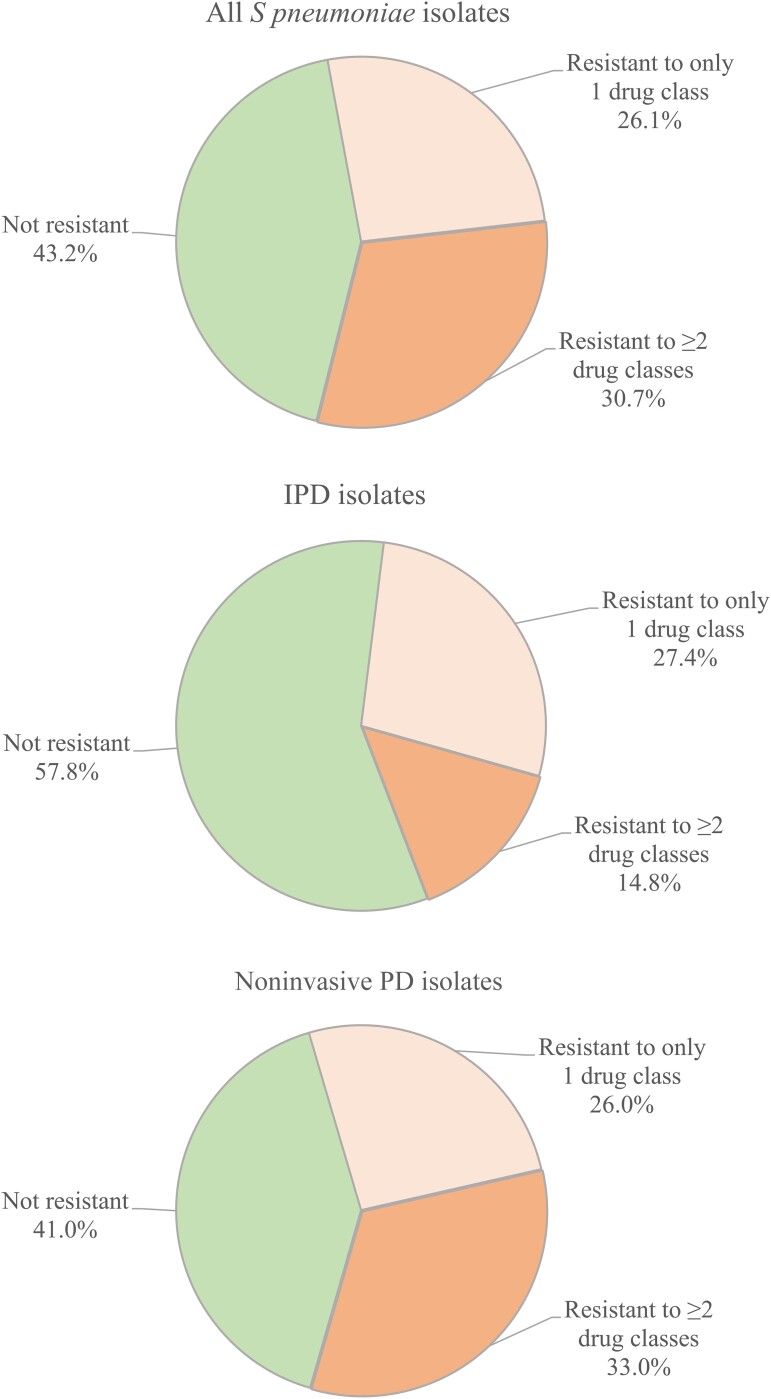
Results: Of 7605 S pneumoniae isolates analyzed, 6641 (87.3%) were from noninvasive sources. Resistance rates were higher in noninvasive versus invasive isolates. Isolates showed high observed rates of resistance to ≥1 drug class (56.8%), ≥2 drug classes (30.7%), macrolides (39.9%), and penicillin (39.6%) and significant annual increases in resistance to ≥1 drug class (+0.9%), ≥2 drug classes (+1.8%), and macrolides (+5.0%).
Conclusions: Among US children over the last decade, S pneumoniae isolates showed persistently high rates of resistance to antibiotics and significant increases in ≥1 drug class, ≥2 drug classes, and macrolide resistance rates. Efforts to address AMR in S pneumoniae may require vaccines targeting resistant serotypes and antimicrobial stewardship efforts.
Keywords: Streptococcus pneumoniae; antibiotic resistance; children; invasive pneumococcal vaccines; pneumococcal disease.
© The Author(s) 2023. Published by Oxford University Press on behalf of Infectious Diseases Society of America.
Conflict of interest statement
Potential conflicts of interest. S. M. and K. F. are employees of MSD and may own stock/stock options in Merck & Co, Inc. J. A. W., K. C. Y., and V. G. are employees of BD, which was contracted by MSD to conduct the study. K. C. Y. and V. G. also own stock in BD.
Figures
References
-
- Bajema KL, Gierke R, Farley MM, et al. Impact of pneumococcal conjugate vaccines on antibiotic-nonsusceptible invasive pneumococcal disease in the United States. J Infect Dis 2022; 226:342–51. - PubMed
-
- Moore MR, Ling-Gelles R, Schaffner W, et al. Effectiveness of 13-valent pneumococcal conjugate vaccine for prevention of invasive pneumococcal disease in children in the USA: a matched case-control study. Lancet Respir Med 2016; 4:399–406. - PubMed
-
- Tomczyk S, Lynfield R, Schaffner W, et al. Prevention of antibiotic-nonsusceptible invasive pneumococcal disease with the 13-valent pneumococcal conjugate vaccine. Clin Infect Dis 2016; 62:1119–25. - PubMed
