Review
. 2023 Mar;13(3):916-941.
doi: 10.1016/j.apsb.2022.10.019. Epub 2022 Oct 27.

Nucleic acid nanoassembly-enhanced RNA therapeutics and diagnosis

Affiliations
Review

Nucleic acid nanoassembly-enhanced RNA therapeutics and diagnosis

Mengnan Zhao et al. Acta Pharm Sin B. 2023 Mar.

Abstract

RNAs are involved in the crucial processes of disease progression and have emerged as powerful therapeutic targets and diagnostic biomarkers. However, efficient delivery of therapeutic RNA to the targeted location and precise detection of RNA markers remains challenging. Recently, more and more attention has been paid to applying nucleic acid nanoassemblies in diagnosing and treating. Due to the flexibility and deformability of nucleic acids, the nanoassemblies could be fabricated with different shapes and structures. With hybridization, nucleic acid nanoassemblies, including DNA and RNA nanostructures, can be applied to enhance RNA therapeutics and diagnosis. This review briefly introduces the construction and properties of different nucleic acid nanoassemblies and their applications for RNA therapy and diagnosis and makes further prospects for their development.

Keywords: DNA nanotechnology; DNA origami; DNA tetrahedron; Nucleic acid nanoassembly; RNA detection; RNA interference; RNA nanotechnology; RNA therapy.


Conflict of interest statement

The authors declare no conflicts of interest.

Figures
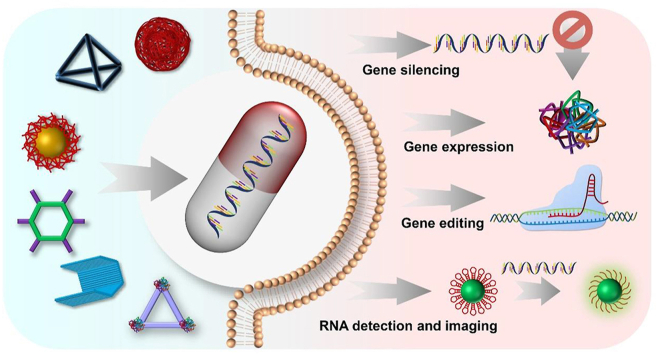
Image 1
Graphical abstract
Figure 1
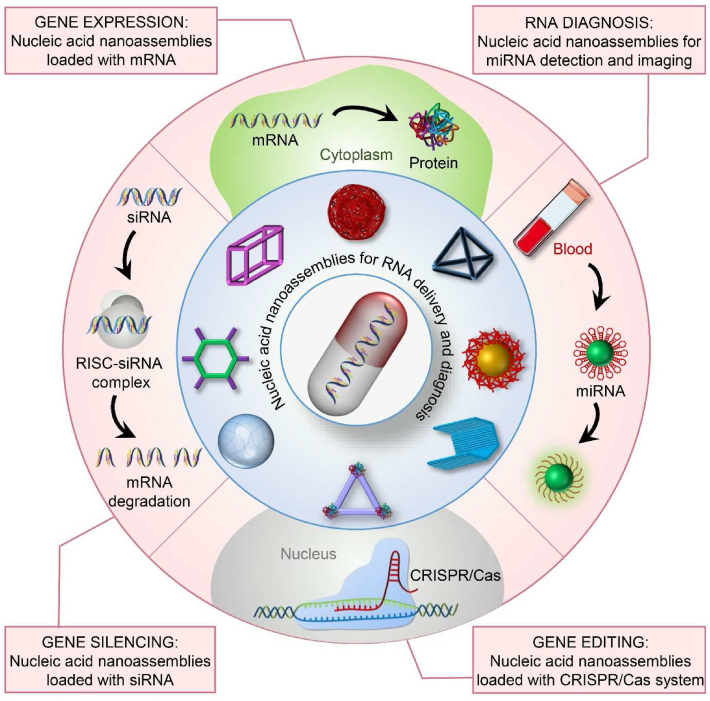
Figure 1
Nucleic acid nanoassembly-enhanced RNA theranostics.
Figure 2
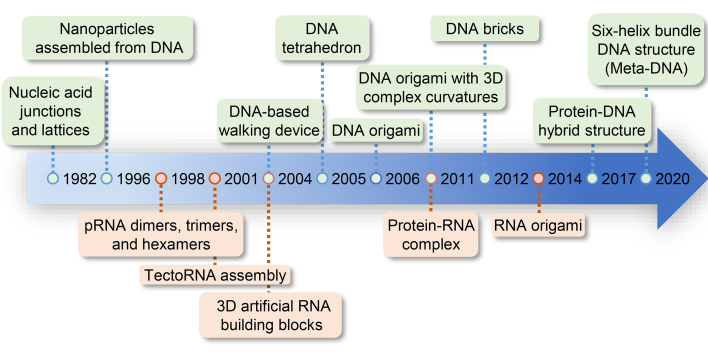
Figure 2
Discoveries and major development of nucleic acid nanoassemblies.
Figure 3
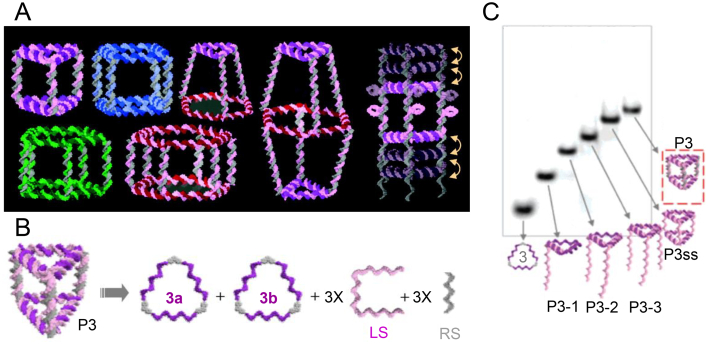
Figure 3
3D DNA polyhedrons. (A) Structurally switchable 3D discrete DNA assemblies. (B) Scheme of general assembly concept used in constructing discrete DNA prism (P3). (C) PAGE analysis of all possible intermediates for P3. Reproduced with permission from Ref. . Copyright © 2007, American Chemical Society.
Figure 4
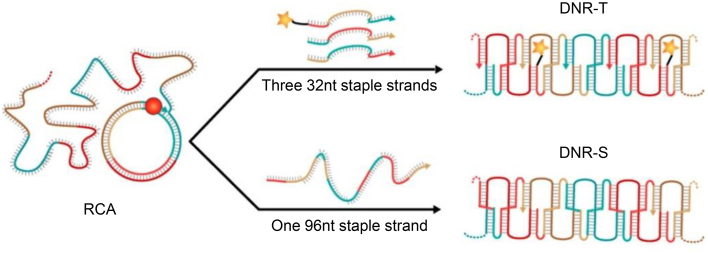
Figure 4
DNA nanoribbon fabricated by RCA process for gene silencing. Reproduced with permission from Ref. . Copyright © 2015, American Chemical Society.
Figure 5
Figure 5
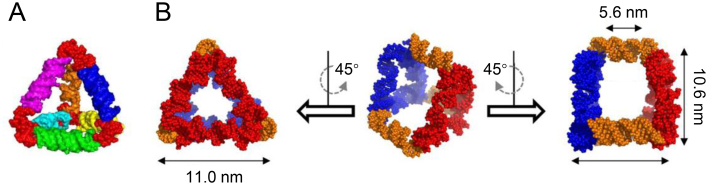
phi29 pRNA-3WJ-based RNA nanoassemblies. (A) 3D computational model of RNA tetrahedrons. Reproduced with permission from Ref. . Copyright © 2016, John Wiley & Sons. (B) Computer model structure of RNA triangular nanoprism. Reproduced with permission from Ref. . Copyright © 2016, John Wiley & Sons.
Figure 6
Figure 6
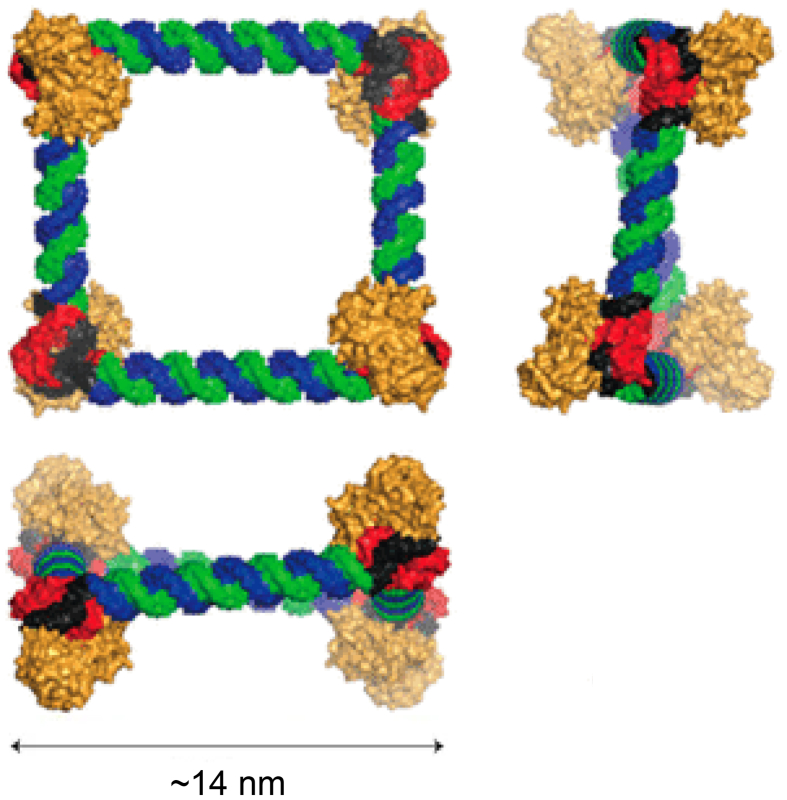
RNA–protein nanostructures. 3D model of square-shaped RNP nanostructure composed of RNA strand and Li protein. Reproduced with permission from Ref. . Copyright © 2015, American Chemical Society.
Figure 7
Figure 7
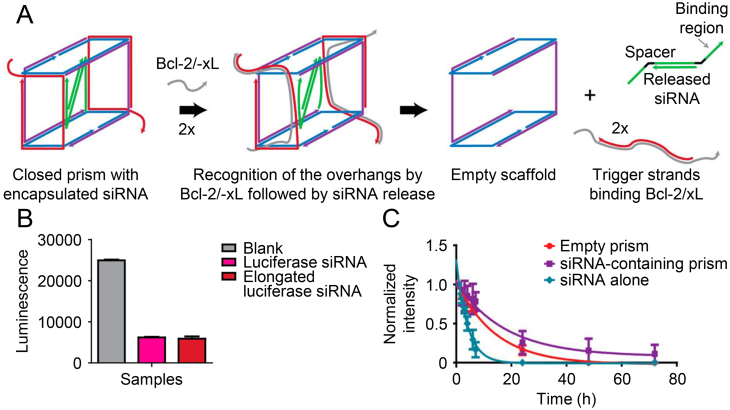
DNA “nanosuitcases” encapsulated with trigger-responsive siRNA. (A) Scheme illustrating self-assembly of “nanosuitcases” and siRNA release mechanism. (B) Potency of elongated luciferase siRNA. (C) Serum stability of siRNA-containing prism in biological conditions. Reproduced with permission from Ref. . Copyright © 2016, American Chemical Society.
Figure 8
Figure 8
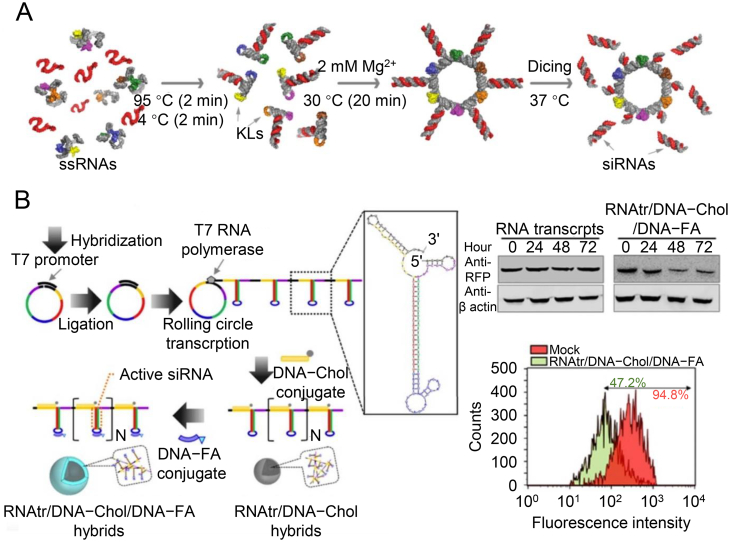
RNA nanotechnology for siRNA delivery. (A) RNA nanorings functionalized with multiple siRNAs, promoting cell transfection and gene knockdown. Reproduced with permission from Ref. . Copyright © 2014, American Chemical Society. (B) Polymerized RNAs via RCT and hybridized with DNA–Chol and DNA–FA conjugates, silencing RFP gene. Reproduced with permission from Ref. . Copyright © 2015, Nature Publishing Group.
Figure 9
Figure 9
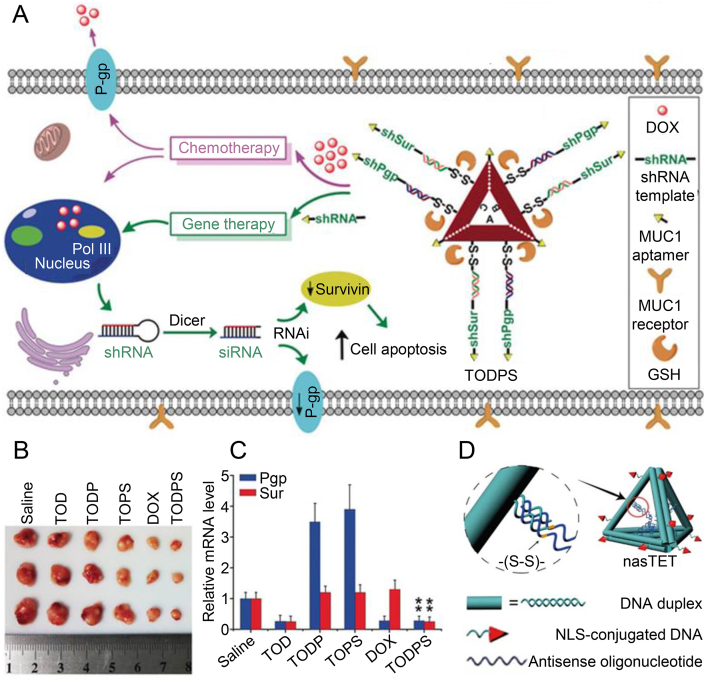
DNA nanoassembly for shRNA and DOX delivery. (A) DNA origami-based nanostructure for shRNA and chemotherapeutic drug delivery against a multidrug-resistant tumor. (B) Tumor inhibition by DNA origami-based nanostructure. (C) Relative mRNA levels (down expression) of P-gp and surviving genes in mice treated with DNA origami-based nanostructure. (A–C) Reproduced with permission from Ref. . Copyright © 2018, John Wiley & Sons. (D) Multifunctional double-bundle DNA tetrahedron for ASOs delivery. Reproduced with permission from Ref. . Copyright © 2018, American Chemical Society.
Figure 10
Figure 10
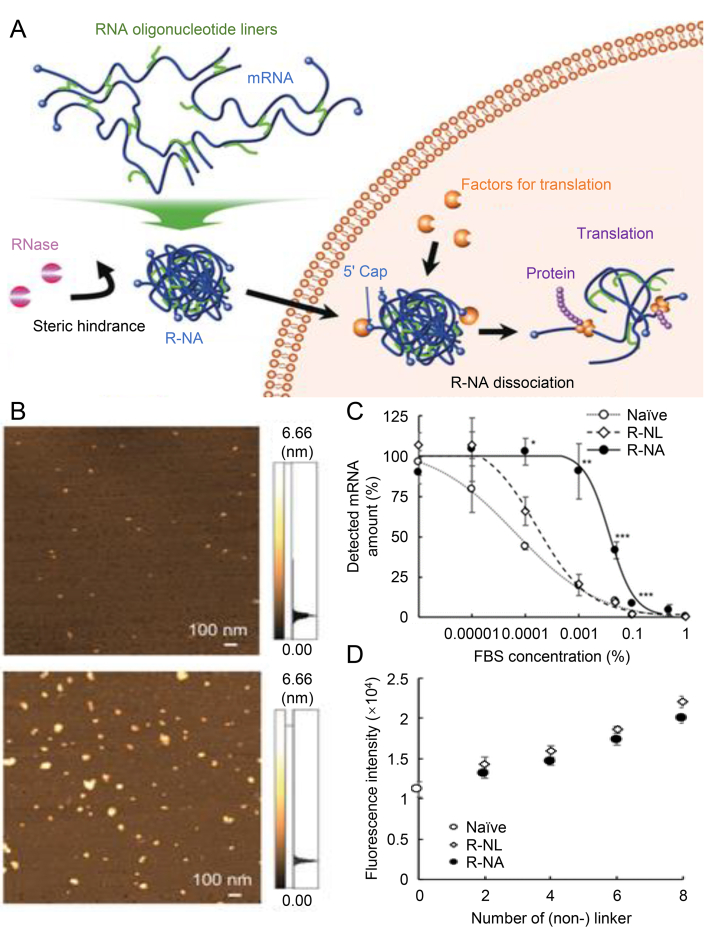
DNA nanoassembly for mRNA delivery. (A) Schematically illustrating a strategy for mRNA delivery by binding mRNA into nanoassembly. (B) AFM images of naïve mRNA (top) and R-NAs (bottom). (C) Serum stability of mRNA toward RNase. (D) Quantification of dsRNA amount using ethidium bromide. Reproduced with permission from Ref. . Copyright © 2019, John Wiley & Sons.

References

    1. Sullenger B.A., Nair S. From the RNA world to the clinic. Science. 2016;352:1417–1420. - PMC - PubMed
    1. Lu D., Thum T. RNA-based diagnostic and therapeutic strategies for cardiovascular disease. Nat Rev Cardiol. 2019;16:661–674. - PubMed
    1. Hu B., Zhong L., Weng Y., Peng L., Huang Y., Zhao Y., et al. Therapeutic siRNA: State of the art. Signal Transduct Target Ther. 2020;5:101. - PMC - PubMed
    1. Weng Y., Xiao H., Zhang J., Liang X.J., Huang Y. RNAi therapeutic and its innovative biotechnological evolution. Biotechnol Adv. 2019;37:801–825. - PubMed
    1. Weng Y., Li C., Yang T., Hu B., Zhang M., Guo S., et al. The challenge and prospect of mRNA therapeutics landscape. Biotechnol Adv. 2020;40 - PubMed

LinkOut - more resources