. 2023 May;241(5):1251-1261.
doi: 10.1007/s00221-023-06596-8. Epub 2023 Mar 27.

The (in)effectiveness of anticipatory vibrotactile cues in mitigating motion sickness

Affiliations

The (in)effectiveness of anticipatory vibrotactile cues in mitigating motion sickness

A J C Reuten et al. Exp Brain Res. 2023 May.

Abstract

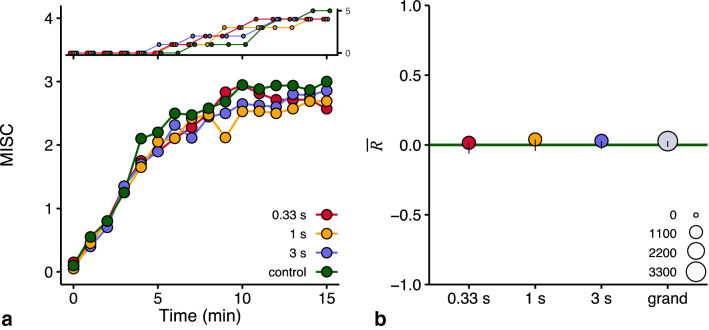
The introduction of (fully) automated vehicles has generated a re-interest in motion sickness, given that passengers suffer much more from motion sickness compared to car drivers. A suggested solution is to improve the anticipation of passive self-motion via cues that alert passengers of changes in the upcoming motion trajectory. We already know that auditory or visual cues can mitigate motion sickness. In this study, we used anticipatory vibrotactile cues that do not interfere with the (audio)visual tasks passengers may want to perform. We wanted to investigate (1) whether anticipatory vibrotactile cues mitigate motion sickness, and (2) whether the timing of the cue is of influence. We therefore exposed participants to four sessions on a linear sled with displacements unpredictable in motion onset. In three sessions, an anticipatory cue was presented 0.33, 1, or 3 s prior to the onset of forward motion. Using a new pre-registered measure, we quantified the reduction in motion sickness across multiple sickness scores in these sessions relative to a control session. Under the chosen experimental conditions, our results did not show a significant mitigation of motion sickness by the anticipatory vibrotactile cues, irrespective of their timing. Participants yet indicated that the cues were helpful. Considering that motion sickness is influenced by the unpredictability of displacements, vibrotactile cues may mitigate sickness when motions have more (unpredictable) variability than those studied here.

Keywords: Car sickness; Internal model; Neural mismatch theory; Self-driving cars; Time-dependence.


Conflict of interest statement

We declare to have no conflicts of interest.

Figures
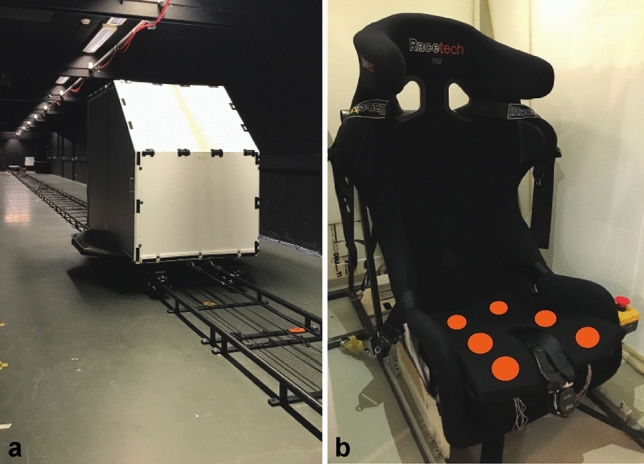
Fig. 1
Fig. 1
a The linear sled that was used in this study. The illuminated cabin offered an enclosed space that removed external visual and airflow cues. b Interior view of the cabin where the participants were seated. The stationary visual frame of reference provided by the cabin resembles the context of a car ride without looking outside. A printed version of the used motion sickness scale was taped onto the wall in front of the participants. Participants could also see a webcam which was used for observation. The rally seat offered a head rest and a five-point seat belt for safety. The orange dots indicate the position of the six vibrotactile actuators
Fig. 2
Fig. 2
Schematic overview of the timing of vibrotactile stimulation relative to the onset of motion in the four sessions
Fig. 3
Fig. 3
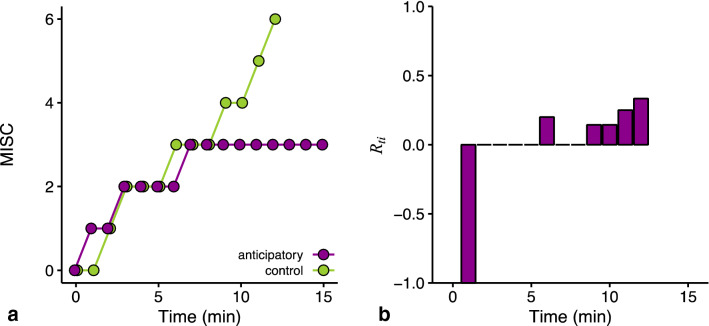
The initial steps of our method illustrated using data from participant 12 of Kuiper et al. (2020a). a The development of MISC scores. b The reduction Rti that results from the MISC scores in a). Rti has a low resolution for the first time points, with values either being −1 or 0
Fig. 4
Fig. 4
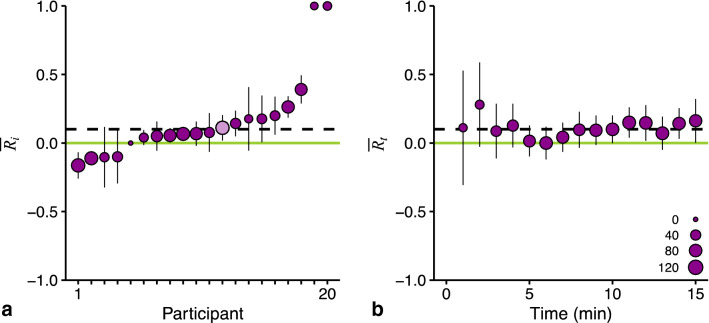
Our method to determine the reduction (R) of motion sickness illustrated with data from Kuiper et al. (2020a). a The average for individual participants (i), who are ordered based on the size of Ri¯. Participant 12 (data point in light purple) was the example participant whose data we presented in Fig. 3. b The average for each time point (t). For both panels, the averages are weighted based on the sum of MISC scores underlying the data. The size of the points reflects the sum of these weights (see legend in panel b). The line in light green corresponds to no reduction (i.e., R=0). The dashed line represents the overall reduction R¯ in this experiment. The error bars are 95% confidence intervals calculated with bootstrapping of Rti and corresponding weights
Fig. 5
Fig. 5
a The development of raw MISC scores averaged across participants for each of the four sessions. To enable a better comparison to Fig. 5b, we excluded data on those time points where participants reached the stop-criterion of MISC ≥ 6 in the control session. The inset figure displays the number of participants reaching the stop-criterion per time point. b The overall reduction (R¯) in motion sickness generated by each anticipatory cue and their combined grand mean in gray. The line in dark green corresponds to no reduction. The size of the data points reflects the sum of MISC scores underlying the data (the overall weight, see legend). The error bars are one-sided 95% confidence intervals (coherent with our one-sided analysis) calculated with bootstrapping of R¯i and corresponding weights
Fig. 6
Fig. 6
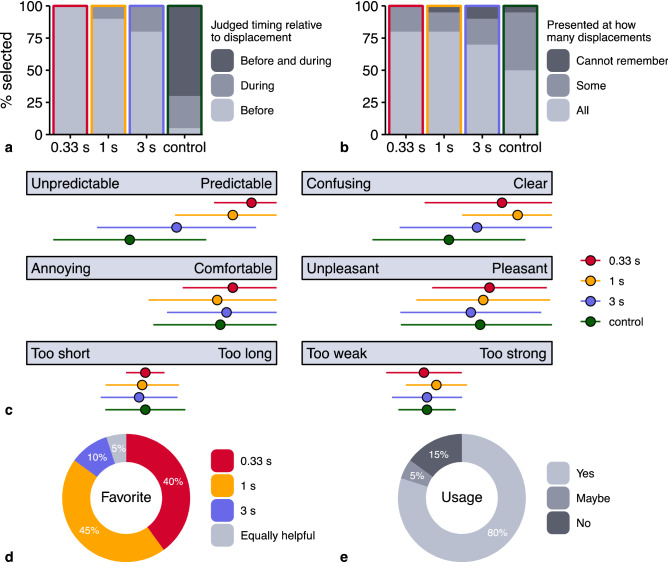
Results of the user experience questionnaire. Participants indicated a when they thought the cues were presented (the answer option “Not at all” not being selected), b how often they felt the cues, c how they evaluated the cues along a range of user dimensions (error bars indicate standard deviations), d which type of cue they preferred in announcing upcoming displacements (the answer options “None” and “Cannot remember” not being selected), and e if they would want to use the cue of their preference in their (autonomous) car

References

    1. Bos JE, MacKinnon SN, Patterson A. Motion sickness symptoms in a ship motion simulator: effects of inside, outside, and no view. Aviat Space Environ Med. 2005;76:1111–1118. - PubMed
    1. Bos JE, van Erp JBF, Groen EL, van Veen H-J. Vestibulo-tactile interactions regarding motion perception and eye movements in yaw. J Vestib Res. 2005;15:149–160. doi: 10.3233/VES-2005-15303. - DOI - PubMed
    1. Brandt T, Bauer M, Benson J, Huppert D. Motion sickness in ancient China: seasickness and cart-sickness. Neurology. 2016;87:331–335. doi: 10.1212/WNL.0000000000002871. - DOI - PubMed
    1. de Winkel KN, Pretto P, Nooij SA, Cohen I, Bülthoff HH. Efficacy of augmented visual environments for reducing sickness in autonomous vehicles. Appl Ergon. 2021;90:103282. doi: 10.1016/j.apergo.2020.103282. - DOI - PubMed
    1. Diels C, Bos JE. Great expectations: on the design of predictive motion cues to alleviate carsickness. In: Krömker H, editor. HCI in mobility, transport, and automotive systems. Cham: Springer Nature Switzerland AG; 2021. pp. 240–251.