


Epidemiology of epilepsy and relationship with onchocerciasis prevalence in villages of the Ntui Health District of Cameroon
- PMID: 36972641
- PMCID: PMC7614422
- DOI: 10.1016/j.yebeh.2023.109184
Epidemiology of epilepsy and relationship with onchocerciasis prevalence in villages of the Ntui Health District of Cameroon
Abstract
Background: A strong association between epilepsy and onchocerciasis endemicity has been reported. We sought to document the epidemiology of epilepsy in onchocerciasis-endemic villages of the Ntui Health District in Cameroon and investigate how this relates to the prevalence of onchocerciasis.
Methods: In March 2022, door-to-door epilepsy surveys were conducted in four villages (Essougli, Nachtigal, Ndjame, and Ndowe). Ivermectin intake during the 2021 session of community-directed treatment with ivermectin (CDTI) was investigated in all participating village residents. Persons with epilepsy (PWE) were identified through a two-step approach: administration of a 5-item epilepsy screening questionnaire followed by clinical confirmation by a neurologist. Epilepsy findings were analyzed together with onchocerciasis epidemiological data previously obtained in the study villages.
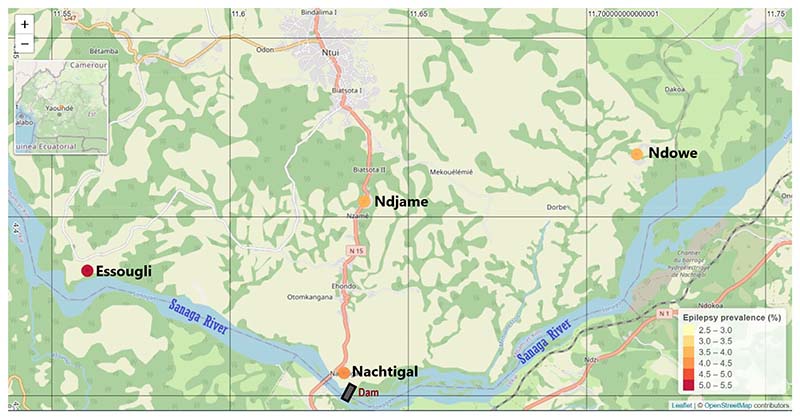
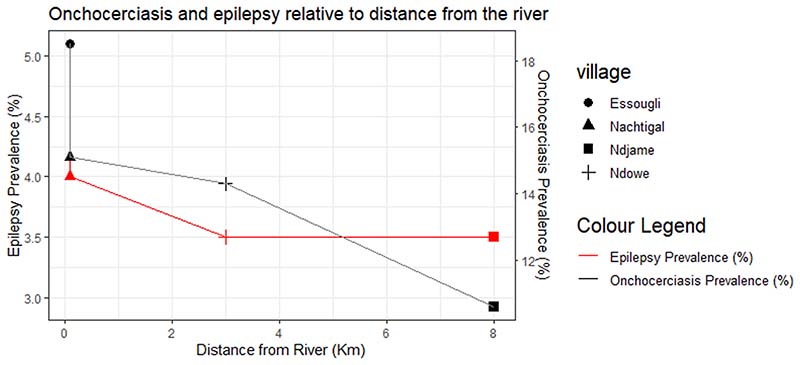
Results: We surveyed 1663 persons in the four study villages. The 2021 CDTI coverage for all study sites was 50.9%. Overall, 67 PWE were identified (prevalence of 4.0% (IQR: 3.2-5.1) with one new-onset case during the past 12 months (annual incidence of 60.1 per 100,000 persons). The median age of PWE was 32 years (IQR: 25-40), with 41 (61.2%) being females. The majority (78.3%) of PWE met the previously published criteria for onchocerciasis-associated epilepsy (OAE). Persons with a history of nodding seizures were found in all villages and represented 19.4% of the 67 PWE. Epilepsy prevalence was positively correlated with onchocerciasis prevalence (Spearman Rho = 0.949, p = 0.051). Meanwhile, an inverse relationship was observed between distance from the Sanaga river (blackfly breeding site) and the prevalence of both epilepsy and onchocerciasis.
Conclusion: The high epilepsy prevalence in Ntui appears to be driven by onchocerciasis. It is likely that decades of CDTI have likely contributed to a gradual decrease in epilepsy incidence, as only one new case occurred in the past year. Therefore, more effective elimination measures are urgently needed in such endemic areas to curb the OAE burden.
Keywords: Cameroon; Epilepsy; Ivermectin coverage; Nodding syndrome; Onchocerciasis; Sanaga River.
Copyright © 2023 The Author(s). Published by Elsevier Inc. All rights reserved.
Conflict of interest statement
Declaration of Competing Interest The authors declare that they have no known competing financial interests or personal relationships that could have appeared to influence the work reported in this paper.
Figures
References
-
- WHO. World Health Assembly Adopts the Intersectoral Global Action Plan on Epilepsy and Other Neurological Disorders 2022-2031 [Internet] [cited 2023 Jan 16]. Available from: https://worldneurologyonline.com/article/who-world-health-assembly-adopt...
-
- Beghi E. The Epidemiology of Epilepsy. Neuroepidemiology. 2020;54:185–91. - PubMed
Publication types
MeSH terms
Substances
LinkOut - more resources
Full Text Sources
Medical
Miscellaneous
