. 2023 Aug;26(3):463-475.
doi: 10.1007/s10456-023-09875-8. Epub 2023 Mar 27.

Design and preclinical evaluation of a novel apelin-based PET radiotracer targeting APJ receptor for molecular imaging of angiogenesis

Affiliations

Design and preclinical evaluation of a novel apelin-based PET radiotracer targeting APJ receptor for molecular imaging of angiogenesis

Béatrice Louis et al. Angiogenesis. 2023 Aug.

Abstract

APJ has been extensively described in the pathophysiology of angiogenesis and cell proliferation. The prognostic value of APJ overexpression in many diseases is now established. This study aimed to design a PET radiotracer that specifically binds to APJ. Apelin-F13A-NODAGA (AP747) was synthesized and radiolabeled with gallium-68 ([68Ga]Ga-AP747). Radiolabeling purity was excellent (> 95%) and stable up to 2 h. Affinity constant of [67Ga]Ga-AP747 was measured on APJ-overexpressing colon adenocarcinoma cells and was in nanomolar range. Specificity of [68Ga]Ga-AP747 for APJ was evaluated in vitro by autoradiography and in vivo by small animal PET/CT in both colon adenocarcinoma mouse model and Matrigel plug mouse model. Dynamic of [68Ga]Ga-AP747 PET/CT biodistributions was realized on healthy mice and pigs for two hours, and quantification of signal in organs showed a suitable pharmacokinetic profile for PET imaging, largely excreted by urinary route. Matrigel mice and hindlimb ischemic mice were submitted to a 21-day longitudinal follow-up with [68Ga]Ga-AP747 and [68Ga]Ga-RGD2 small animal PET/CT. [68Ga]Ga-AP747 PET signal in Matrigel was significantly more intense than that of [68Ga]Ga-RGD2. Revascularization of the ischemic hind limb was followed by LASER Doppler. In the hindlimb, [68Ga]Ga-AP747 PET signal was more than twice higher than that of [68Ga]Ga-RGD2 on day 7, and significantly superior over the 21-day follow-up. A significant, positive correlation was found between the [68Ga]Ga-AP747 PET signal on day 7 and late hindlimb perfusion on day 21. We developed a new PET radiotracer that specifically binds to APJ, [68Ga]Ga-AP747 that showed more efficient imaging properties than the most clinically advanced tracer of angiogenesis, [68Ga]Ga-RGD2.

Keywords: APJ; Angiogenesis; Apelin; PET imaging; Theranostics.


Conflict of interest statement

The authors have no relevant financial or non-financial interests to disclose.

Figures
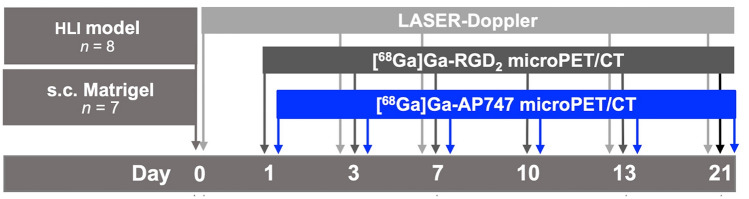
Fig. 1
Fig. 1
In vivo longitudinal study using [68Ga]Ga-AP747 PET compared with [68Ga]Ga-RGD2 PET on Matrigel and HLI mouse models
Fig. 2
Fig. 2
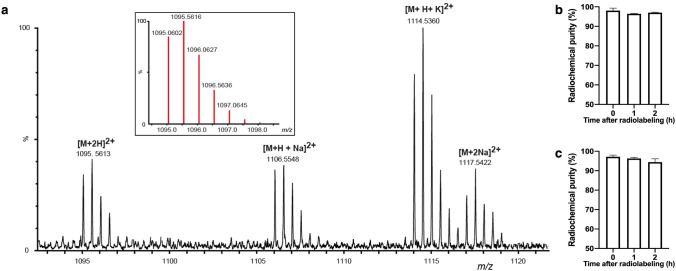
ESI (+) MS spectrum showing the different doubly charged adducts of AP747 (insert: calculated isotopic pattern of [M + 2H]2 + species) (a). [68 Ga]Ga-AP747 radiochemical purity and stability in physiological serum (b) and in human serum (c) for two hours
Fig. 3
Fig. 3
Semi-quantifications of APJ-to-GAPDH expression ratios by Western blot on human adenocarcinoma T84 cells and HUVECs with or without TNF-alpha activation (a). Saturation binding curve of [67Ga]Ga-AP747 towards APJ receptor on T84 cells (b). Representative maximum intensity projections (MIP) images of small animal [68Ga]Ga-AP747 PET/CT in an ectopic mice model of human colon adenocarcinoma, in baseline or APJ-blocking conditions (c). Representative MIP of small animal [68Ga]Ga-AP747 PET/CT images of in a Matrigel plug mice model, in baseline or APJ-blocking conditions (d). [68Ga]Ga-AP747 PET signal quantifications in a mouse model of ectopic human colon adenocarcinoma in baseline or APJ-blocking conditions (n = 3) (e). [68Ga]Ga-AP747 PET signal quantifications in a Matrigel plug mouse model in baseline or APJ-blocking conditions (n = 5) (f). c/b standing for cell-to-background; t/b standing for tumor-to-background, mean. *P ≤ 0.05; **P ≤ 0.01; ***P ≤ 0.001
Fig. 4
Fig. 4
Representative MIP PET images of [68Ga]Ga-AP747 biodistribution (a) and associated organ quantifications (b) in healthy mice (n = 3). Blood kinetics of [68Ga]Ga-AP747 during 120 min (c) and ex vivo gamma counting at 120 min post-injection (d) in healthy mice (n = 3). Representative [68Ga]Ga-AP747 biodistribution MIP PET images (e) and associated organ PET quantifications (f) in healthy swine (n = 3)
Fig. 5
Fig. 5
Representative [68Ga]Ga-RGD2 PET and [68Ga]Ga-AP747 MIP PET images (a) and related quantifications (b) in the Matrigel mouse model over 21 days (n = 7). m/m standing for Matrigel-to-muscle. *P ≤ 0.05; **P ≤ 0.01
Fig. 6
Fig. 6
[68Ga]Ga-RGD2 and [68Ga]Ga-AP747 in a hindlimb ischemia model representative MIP PET images a [68Ga]Ga-RGD2 small animal PET/CT and [68 Ga]Ga-AP747 small animal PET/CT quantifications (n = 8) b. LASER Doppler quantifications of hindlimb blood perfusion c and correlation studies (d, e). Representative images of anti-APJ immunofluorescence on day 7 in contralateral hindlimb and ischemic hindlimb of an HLI mouse (f). i/c standing for ipsi-to-contralateral. D standing for day. *P < 0.05

References

    1. Ma H, Liu S, Zhang Z, et al. Preliminary biological evaluation of 68Ga-labeled cyclic RGD dimer as an integrin αvβ3-targeting radiotracer for tumor PET imaging. J Radioanal Nucl Chem. 2019;321:857–865. doi: 10.1007/s10967-019-06654-y. - DOI
    1. Xiao Y, Wang T, Song X, Yang D, Chu Q, Kang YJ. Copper promotion of myocardial regeneration. Exp Biol Med. 2020;245:911–921. doi: 10.1177/1535370220911604. - DOI - PMC - PubMed
    1. Viallard C, Larrivée B. Tumor angiogenesis and vascular normalization: alternative therapeutic targets. Angiogenesis. 2017;20:409–426. doi: 10.1007/s10456-017-9562-9. - DOI - PubMed
    1. Armani G, Pozzi E, Pagani A, et al. The heterogeneity of cancer endothelium: the relevance of angiogenesis and endothelial progenitor cells in cancer microenvironment. Microvasc Res. 2021;138:104189. doi: 10.1016/j.mvr.2021.104189. - DOI - PubMed
    1. Man F, Lammers T, de Rosales TMR. Imaging Nanomedicine-based drug delivery: a review of clinical studies. Mol Imaging Biol. 2018;20:683–695. doi: 10.1007/s11307-018-1255-2. - DOI - PMC - PubMed

Publication types

LinkOut - more resources