Review
. 2023 Jun;20(6):558-569.
doi: 10.1038/s41423-023-00998-y. Epub 2023 Mar 27.

Immunomodulatory properties of mesenchymal stem cells/dental stem cells and their therapeutic applications

Affiliations
Review

Immunomodulatory properties of mesenchymal stem cells/dental stem cells and their therapeutic applications

Peishan Li et al. Cell Mol Immunol. 2023 Jun.

Abstract

Mesenchymal stem/stromal cells (MSCs) are widely distributed in the body and play essential roles in tissue regeneration and homeostasis. MSCs can be isolated from discarded tissues, expanded in vitro and used as therapeutics for autoimmune diseases and other chronic disorders. MSCs promote tissue regeneration and homeostasis by primarily acting on immune cells. At least six different types of MSCs have been isolated from postnatal dental tissues and have remarkable immunomodulatory properties. Dental stem cells (DSCs) have been demonstrated to have therapeutic effects on several systemic inflammatory diseases. Conversely, MSCs derived from nondental tissues such as the umbilical cord exhibit great benefits in the management of periodontitis in preclinical studies. Here, we discuss the main therapeutic uses of MSCs/DSCs, their mechanisms, extrinsic inflammatory cues and the intrinsic metabolic circuitries that govern the immunomodulatory functions of MSCs/DSCs. Increased understanding of the mechanisms underpinning the immunomodulatory functions of MSCs/DSCs is expected to aid in the development of more potent and precise MSC/DSC-based therapeutics.

Keywords: Dental stem cells; Immunoregulation; Inflammation; Mesenchymal stem cells.


Conflict of interest statement

The authors declare no competing interests.

Figures
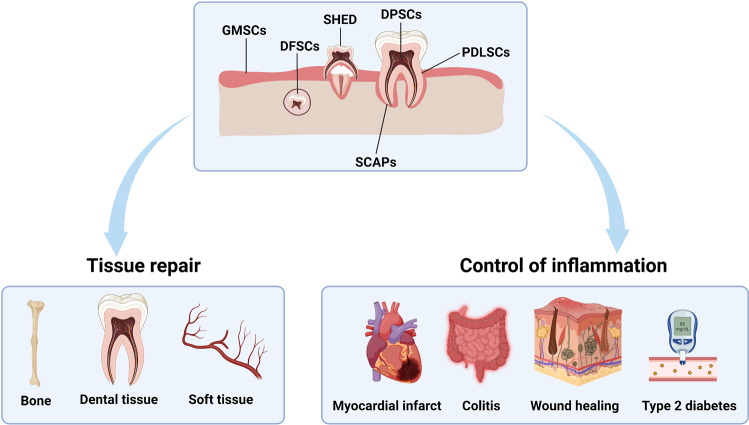
Fig. 1
Fig. 1
The classification and therapeutic applications of DSCs. Six different types of DSCs have been isolated and characterized, including stem cells from dental pulp (DPSCs), periodontal ligament (PDLSCs), deciduous teeth (SHED), apical papilla (SCAPs), dental follicles (DFSCs), and gingiva (GMSCs). DSCs have therapeutic potential for tissue repair (bone regeneration, dental tissue regeneration and soft tissue reconstruction) and inflammatory diseases (myocardial infarct, colitis, wound healing and type 2 diabetes)
Fig. 2
Fig. 2
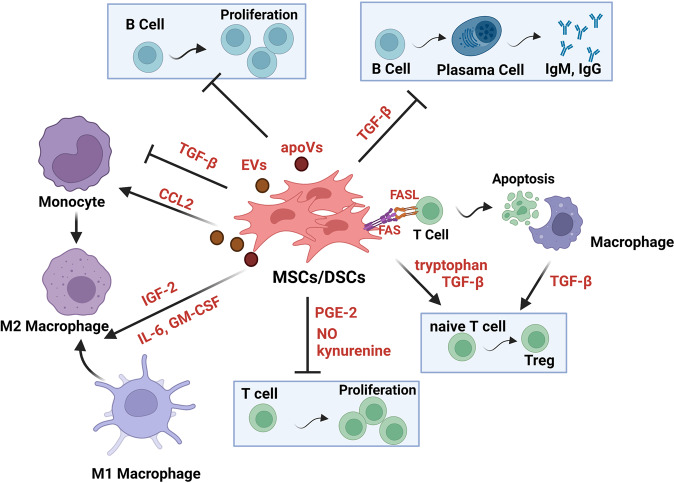
The main routes through which MSCs/DSCs exert their immunoregulatory effects. MSCs/DSCs exert their immunomodulatory effects by producing metabolites, cytokines, growth factors, chemokines, extracellular vesicles, and apoptotic vesicles and T-cell death-mediated immunoregulation. MSCs/DSCs can suppress T-cell and B-cell proliferation, promote naive CD4+ T cells to differentiate into Treg cells, instruct macrophages to acquire an immunosuppressive phenotype, or inhibit the production of IgM and IgG. In addition, MSCs/DSCs induce T-cell apoptosis and subsequently trigger macrophages to produce TGFβ, which induces the differentiation of Tregs and immune tolerance
Fig. 3
Fig. 3
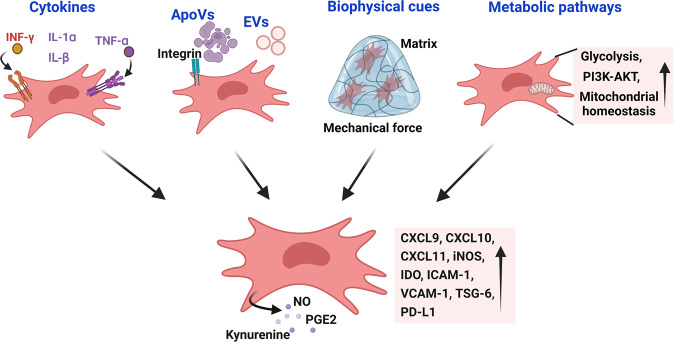
The mechanisms by which MSCs/DSCs acquire and maintain their immunomodulatory properties. The immunomodulatory properties of MSCs/DSCs are not constitutive but are induced by proinflammatory cytokines. Cytokines activate PI3K and AKT to initiate glycolysis, which is critically required for MSCs/DSCs to produce high levels of chemokines, adhesion molecules and effector molecules. Apoptotic bodies can endow MSCs/DSCs with enhanced immunomodulatory properties. The extracellular matrix and scaffold also support the immunomodulatory functions of MSCs/DSCs. MSCs/DSCs could also sacrifice themselves to fulfill their mission of immunosuppression

References

    1. Crisan M, Yap S, Casteilla L, Chen CW, Corselli M, Park TS, et al. A perivascular origin for mesenchymal stem cells in multiple human organs. Cell Stem Cell. 2008;3:301–13. doi: 10.1016/j.stem.2008.07.003. - DOI - PubMed
    1. Liu H, Li P, Zhang S, Xiang J, Yang R, Liu J, et al. Prrx1 marks stem cells for bone, white adipose tissue and dermis in adult mice. Nat Genet. 2022 doi: 10.1038/s41588-022-01227-4. - DOI - PubMed
    1. Sharpe PT. Dental mesenchymal stem cells. Development. 2016;143:2273–80. doi: 10.1242/dev.134189. - DOI - PubMed
    1. Bianco P. “Mesenchymal” stem cells. Annu Rev Cell Dev Biol. 2014;30:677–704. doi: 10.1146/annurev-cellbio-100913-013132. - DOI - PubMed
    1. Wang Y, Fang J, Liu B, Shao C, Shi Y. Reciprocal regulation of mesenchymal stem cells and immune responses. Cell Stem Cell. 2022;29:1515–30. doi: 10.1016/j.stem.2022.10.001. - DOI - PubMed

Publication types