Review
. 2023 Mar 28;24(1):51.
doi: 10.1186/s13059-023-02888-y.

Ageing as a software design flaw

Affiliations
Review

Ageing as a software design flaw

João Pedro de Magalhães. Genome Biol. .

Abstract

Ageing is inherent to all human beings, yet why we age remains a hotly contested topic. Most mechanistic explanations of ageing posit that ageing is caused by the accumulation of one or more forms of molecular damage. Here, I propose that we age not because of inevitable damage to the hardware but rather because of intrinsic design flaws in the software, defined as the DNA code that orchestrates how a single cell develops into an adult organism. As the developmental software runs, its sequence of events is reflected in shifting cellular epigenetic states. Overall, I suggest that to understand ageing we need to decode our software and the flow of epigenetic information throughout the life course.

Keywords: Antagonistic pleiotropy; Genome; Information theory; Longevity; Programmed ageing.


Conflict of interest statement

JPM is CSO of YouthBio Therapeutics, a company developing rejuvenation gene therapies based on partial reprogramming, an advisor/consultant for the Longevity Vision Fund and NOVOS, and the founder of Magellan Science Ltd, a company providing consulting services in longevity science.

Figures
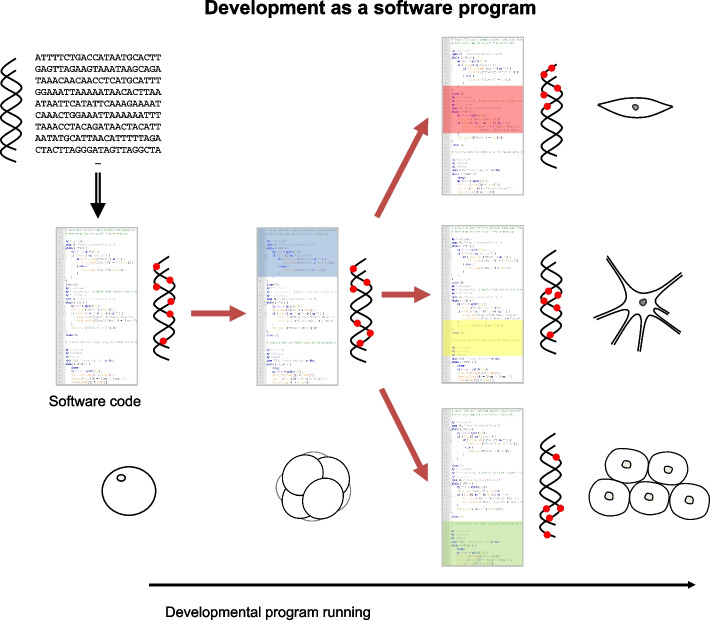
Fig. 1
Fig. 1
Ontogeny as a software program encoded in the genome and running in the epigenome. The developmental software program is encoded in the DNA sequence. As the program runs, numerous subroutines are called and operate in different spatial and temporal contexts. The epigenome, at the level of DNA methylation (shown), histone modifications, chromatin structure and noncoding RNAs (not shown), acts in cells as the software’s data area. Differences in space and time in the running of the developmental software program (represented by different colours in the code) are also embedded in the epigenome/data area that is read and written by the software and dictates when and which subroutines are run—e.g. different gene expression programs, transcription factors, signalling pathways and protein levels (not shown)—and ultimately determines cellular phenotypes
Fig. 2
Fig. 2
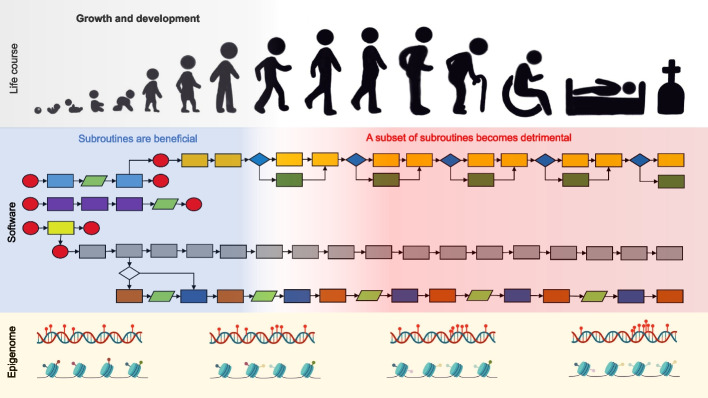
Ageing as the result of software design flaws. The developmental software program is a set of instructions or interconnected subroutines with numerous inputs and outputs that trigger a complicated cascade of events that drive growth and development. Because this software program is optimized for reproduction, however, it fails to deactivate a subset of its subroutines which are beneficial during development (blue shading) but then become detrimental later in life (red shading). With age, such subroutines could gradually lead to the inappropriate activation or inactivation of genes, pathways, and processes that drive ageing phenotypes. The running of the developmental software program is reflected in the epigenome, the software’s data area. Human life course drawing by Alice C Magalhaes. Epigenome figure created with BioRender.com
Fig. 3
Fig. 3
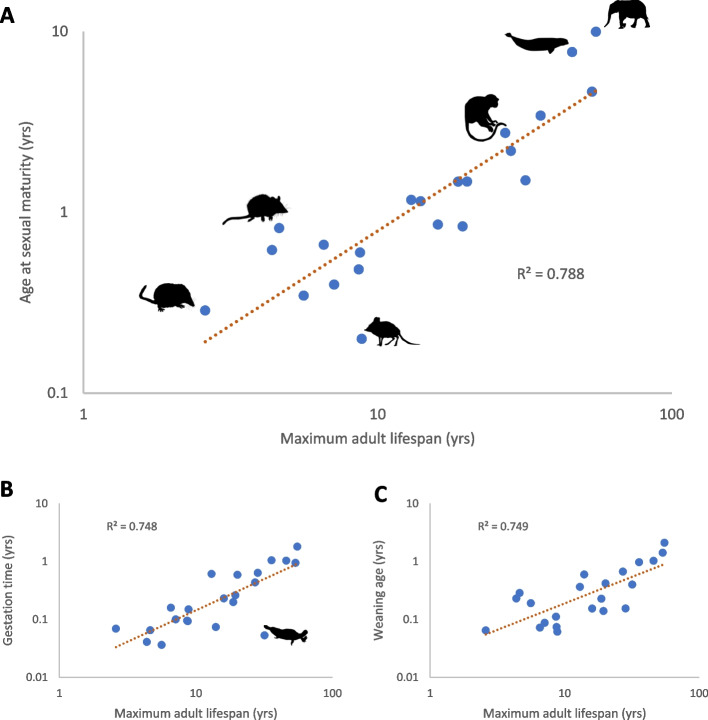
Strong correlation between longevity and developmental traits in mammalian families. A Correlation between maximum adult lifespan and age at sexual maturity (r2 = 0.788). B Correlation between maximum adult lifespan and gestation time (r2 = 0.748); monotremes, the only egg-laying clade of mammals, are an outlier. C Correlation between maximum adult lifespan and weaning age (r2 = 0.749). Only families with at least three species are shown (n = 22). Maximum adult lifespan = maximum lifespan minus age at sexual maturity. Data from AnAge build 14 [15]. Silhouettes from phylopic.org
Fig. 4
Fig. 4
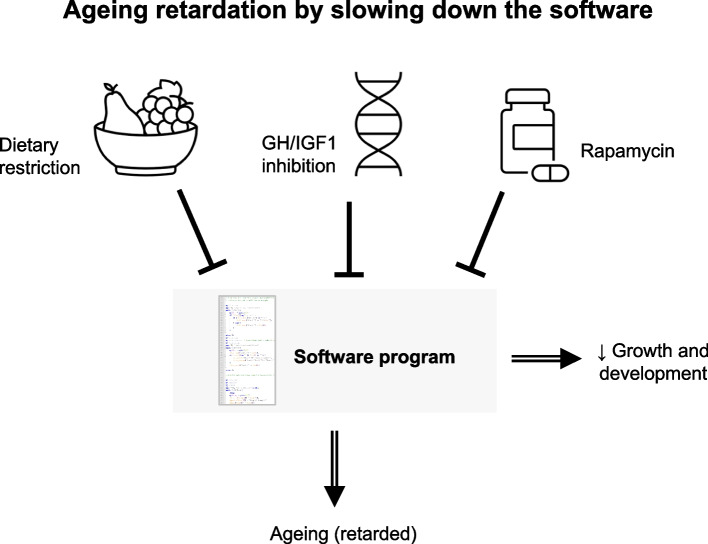
The most well-established longevity manipulations in mice may retard ageing by slowing down the developmental software program. Dietary restriction, GH/IGF1 inhibition, and rapamycin are, respectively, the major dietary, genetic, and pharmacological life-extending interventions. All these manipulations also regulate growth and development and hence may slow down the running of the developmental software program which in turn retards ageing, supporting the idea of ageing as a software design flaw
Fig. 5
Fig. 5
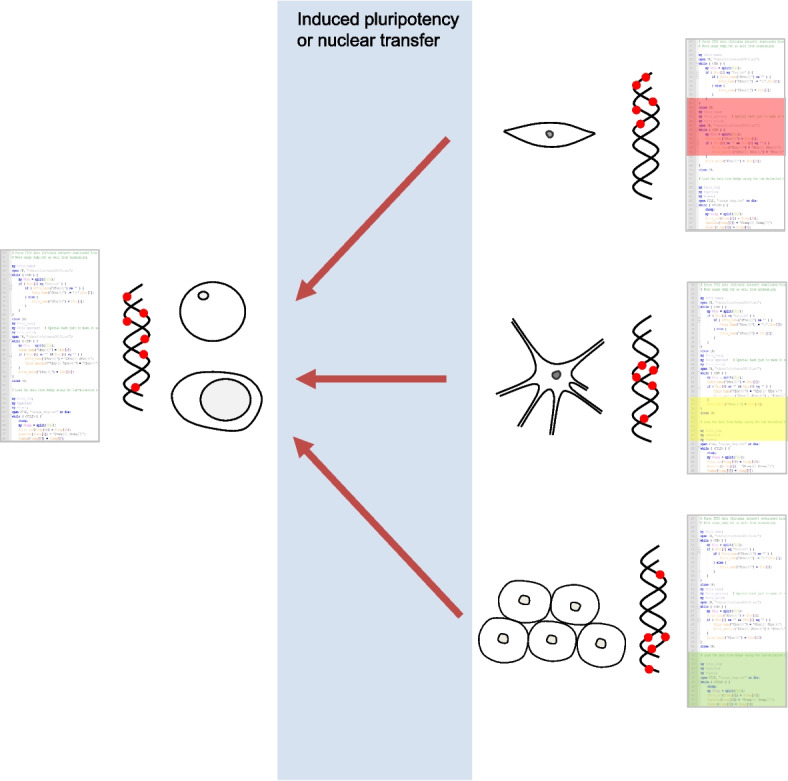
Nuclear transfer or induced pluripotency restart the developmental software program and reset the epigenome

References

    1. de Magalhaes JP. The biology of ageing: a primer. In: Stuart-Hamilton I, editor. An Introduction to Gerontology. Cambridge: Cambridge University Press; 2011. pp. 21–47.
    1. Partridge L, Deelen J, Slagboom PE. Facing up to the global challenges of ageing. Nature. 2018;561:45–56. doi: 10.1038/s41586-018-0457-8. - DOI - PubMed
    1. Kirkwood TB, Melov S. On the programmed/non-programmed nature of ageing within the life history. Curr Biol. 2011;21:R701–R707. doi: 10.1016/j.cub.2011.07.020. - DOI - PubMed
    1. Kirkwood TB, Austad SN. Why do we age? Nature. 2000;408:233–238. doi: 10.1038/35041682. - DOI - PubMed
    1. Lopez-Otin C, Blasco MA, Partridge L, Serrano M, Kroemer G. Hallmarks of aging: an expanding universe. Cell. 2023;186:243–278. doi: 10.1016/j.cell.2022.11.001. - DOI - PubMed

Publication types