


Scoping review of sexual and reproductive healthcare for men in the MENA (Middle East and North Africa) region: a handful of paradoxes?
- PMID: 36973770
- PMCID: PMC10040932
- DOI: 10.1186/s12889-022-14716-2
Scoping review of sexual and reproductive healthcare for men in the MENA (Middle East and North Africa) region: a handful of paradoxes?
Abstract
Background: No study appraised the knowledge gaps and factors impacting men's sexual and reproductive health (SRH) in MENA (Middle East and North Africa). The current scoping review undertook this task.
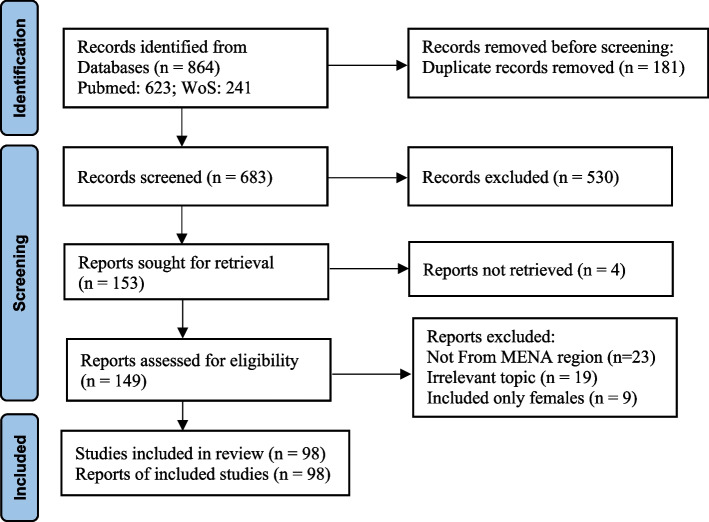
Methods: We searched PubMed and Web of Science (WoS) electronic databases for original articles on men's SRH published from MENA. Data was extracted from the selected articles and mapped out employing the WHO framework for operationalising SRH. Analyses and data synthesis identified the factors impacting on men's experiences of and access to SRH.
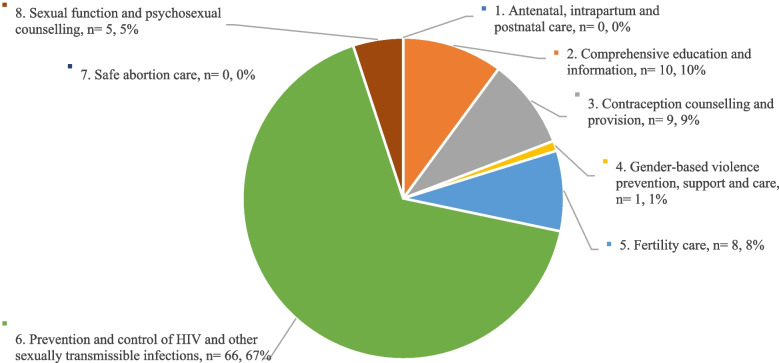
Results: A total of 98 articles met the inclusion criteria and were included in the analysis. The majority of studies focused on HIV and other sexually transmissible infections (67%); followed by comprehensive education and information (10%); contraception counselling/provision (9%); sexual function and psychosexual counselling (5%); fertility care (8%); and gender-based violence prevention, support/care (1%). There were no studies on antenatal/intrapartum/postnatal care and on safe abortion care (0% for both). Conceptually, there was lack of knowledge of the different domains of men's SRH, with negative attitudes, and many misconceptions; as well as a deficiency of health system policies, strategies and interventions for SRH.
Conclusion: Men's SRH is not sufficiently prioritized. We observed five 'paradoxes': strong focus on HIV/AIDS, when MENA has low prevalence of HIV; weak focus on both fertility and sexual dysfunctions, despite their high prevalence in MENA; no publications on men's involvement in sexual gender-based violence, despite its frequency across MENA; no studies of men's involvement in antenatal/intrapartum/postnatal care, despite the international literature valuing such involvement; and, many studies identifying lack of SRH knowledge, but no publications on policies and strategies addressing such shortcoming. These 'mismatches' suggest the necessity for efforts to enhance the education of the general population and healthcare workers, as well as improvements across MENA health systems, with future research examining their effects on men's SRH.
Keywords: Middle East and North Africa; Public health; Reproductive healthcare; Sexual dysfunction; Sexual medicine.
© 2023. The Author(s).
Conflict of interest statement
The authors declare that they have no competing interests.
Figures
References
-
- Grandahl M, Bodin M, Stern J. In everybody’s interest but no one’s assigned responsibility: midwives’ thoughts and experiences of preventive work for men’s sexual and reproductive health and rights within primary care. BMC Public Health. 2019;19(1):1423. doi: 10.1186/s12889-019-7792-z. - DOI - PMC - PubMed
-
- Report of the International Conference on Population and Development (Cairo, 5–13. September 1994). New York (NY): United Nations; 1994 available at https://www.un.org/en/development/desa/population/migration/generalassem.... Accessed 1 July 2022.
-
- Makarow M, Hojgaard L. Male reproductive health: Its impacts in relation to general well-being and low European fertility rates. 2010. Retrieved from http://www.esf.org/fileadmin/Public_documents/Publications/SPB40_MaleRep....
-
- Burns JC, Reeves J, Calvert WJ, Adams M, Ozuna-Harrison R, Smith MJ, Baranwal S, Johnson K, Rodgers CRR, Watkins DC. Engaging young black males in sexual and Reproductive Health Care: a review of the literature. Am J Mens Health. 2021;15(6):15579883211062024. doi: 10.1177/15579883211062024. - DOI - PMC - PubMed
Publication types
MeSH terms
LinkOut - more resources
Full Text Sources
Medical
Research Materials
Miscellaneous
