


Progressive Ulnar Neuropathy due to anomalous Distal Forearm Muscle: Distal Forearm Decompression
- PMID: 36974287
- PMCID: PMC10039304
- DOI: 10.1016/j.jhsg.2023.01.001
Progressive Ulnar Neuropathy due to anomalous Distal Forearm Muscle: Distal Forearm Decompression
Abstract
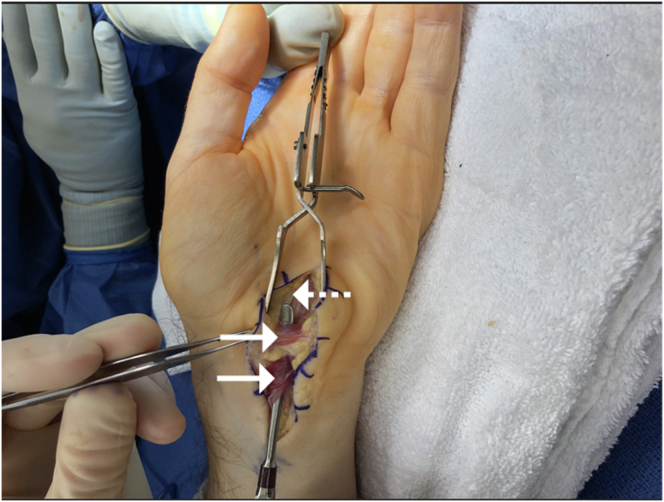
This case study examines a 45-year-old man who presented with advanced ulnar innervated intrinsic muscle atrophy in the hand, and clawing of the ring and little fingers. This case is unique due to discovery of an anomalous distal forearm muscle with the spontaneous onset and rapid nature of progressive neuropathic symptoms. Further, this patient demonstrated primarily intrinsic motor deficits and denied any sensory deficits on presentation. At surgery, an anomalous distal forearm muscle was found to be compressing the ulnar nerve. This muscle crossed in an oblique fashion, originating from the volar forearm fascia and inserted into the pisiform and proximal abductor digiti minimi fascia. At 5 months after surgery, the patient's ulnar innervated intrinsic muscle strength was improved but still not normal. This case study details the patient's presentation, assessment, surgical management, and postoperative outcome.
Keywords: Anomalous forearm muscle; Compression neuropathy; Progressive neuropathy; Surgical decompression; Ulnar neuropathy.
© 2023 The Authors.
Figures
References
-
- Bozkurt M.C., Tağil S.M., Ozçakar L., Ersoy M., Tekdemir I. Anatomical variations as potential risk factors for ulnar tunnel syndrome: a cadaveric study. Clin Anat. 2005;18(4):274–280. - PubMed
-
- Dodds G.A., Hale D., Jackson W.T. Incidence of anatomic variants in Guyon’s canal. J Hand Surg Am. 1990;15(2):352–355. - PubMed
Publication types
LinkOut - more resources
Full Text Sources
