


State Anxiety and Procrastination: The Moderating Role of Neuroendocrine Factors
- PMID: 36975229
- PMCID: PMC10045520
- DOI: 10.3390/bs13030204
State Anxiety and Procrastination: The Moderating Role of Neuroendocrine Factors
Abstract
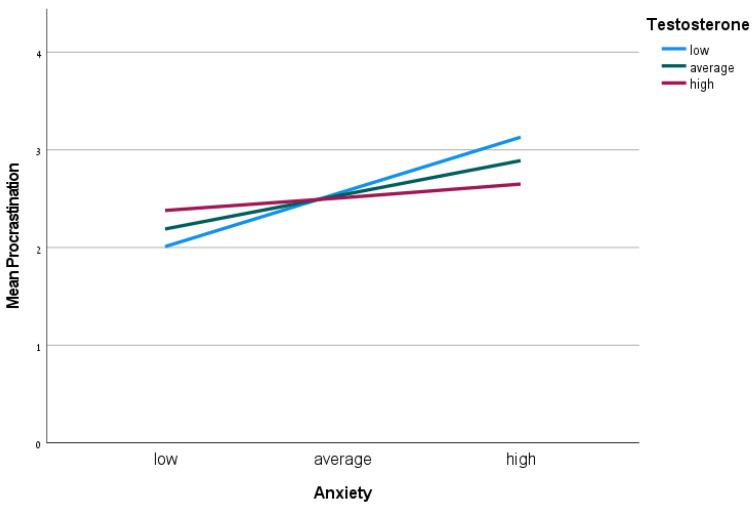
Procrastination is prevalent among students, as well as the general population, and has negative impacts on various domains. Several models aimed to understand factors associated with procrastination, with some suggesting that anxiety plays a significant role. Biological factors have been shown to contribute to individual differences in procrastination; however, little attention has been paid to the role of neuroendocrine factors on procrastination. The primary question addressed in the present study is whether neuroendocrine factors (testosterone and cortisol) moderate the association between state anxiety and procrastination. Eighty-eight participants (29 men; 32 women using oral contraceptives; and 27 women not using oral contraceptives and in their luteal phase) were tested for biomarkers and completed questionnaires. Results show that state anxiety is positively correlated with procrastination. Furthermore, testosterone levels moderate the correlation between state anxiety and procrastination. As testosterone levels drop, the positive correlation between state anxiety and procrastination becomes stronger, but when testosterone levels are higher, no significant association between state anxiety and procrastination is found. Cortisol levels do not moderate the relationship between state anxiety and procrastination. The role of neuroendocrine factors for psychological outcomes is discussed.
Keywords: cortisol; procrastination; state anxiety; testosterone.
Conflict of interest statement
The authors declare no conflict of interest.
Figures
References
-
- Ferrari J.R., Johnson J.L., McCown W.G. Procrastination and Task Avoidance: Theory, Research, and Treatment. Springer Science & Business Media; New York, NY, USA: 1995.
-
- Sirois F.M. Procrastination and intentions to perform health behaviors: The role of self-efficacy and the consideration of future consequences. Pers. Individ. Differ. 2004;37:115–128. doi: 10.1016/j.paid.2003.08.005. - DOI
-
- O’donoghue T., Rabin M. Incentives for procrastinators. Q. J. Econ. 1999;114:769–816. doi: 10.1162/003355399556142. - DOI
LinkOut - more resources
Full Text Sources
Research Materials
