


Genetic rescue remains underused for aiding recovery of federally listed vertebrates in the United States
- PMID: 36975379
- PMCID: PMC10287150
- DOI: 10.1093/jhered/esad002
Genetic rescue remains underused for aiding recovery of federally listed vertebrates in the United States
Abstract
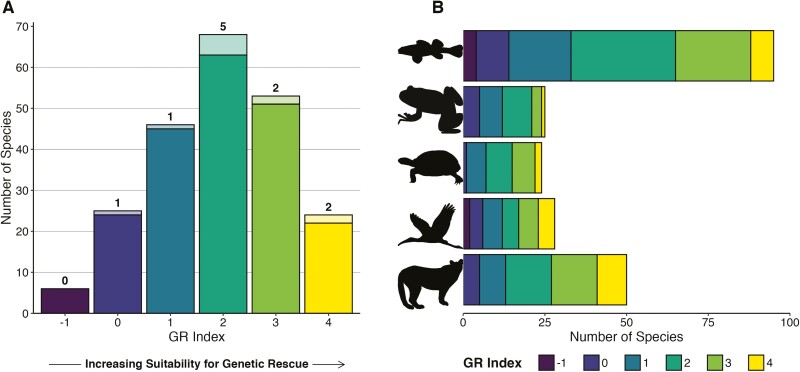
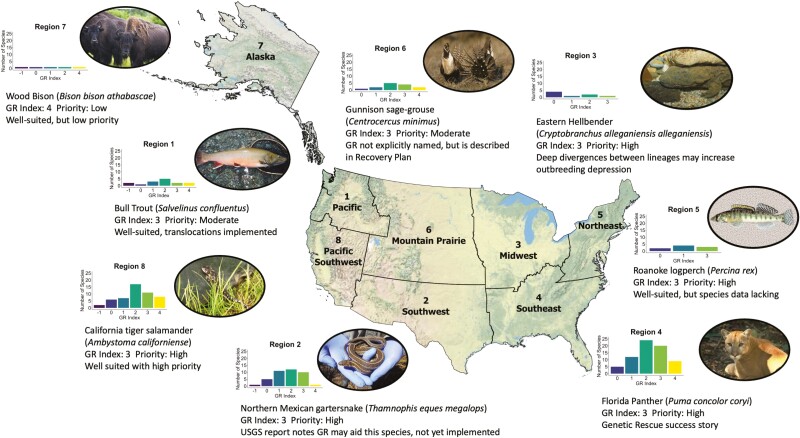
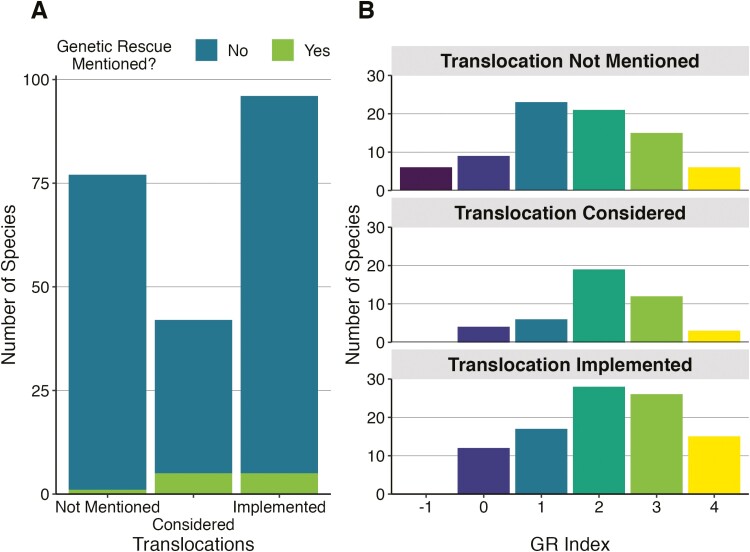
Restoring gene flow among fragmented populations is discussed as a potentially powerful management strategy that could reduce inbreeding depression and cause genetic rescue. Yet, examples of assisted migration for genetic rescue remain sparse in conservation, prompting several outspoken calls for its increased use in genetic management of fragmented populations. We set out to evaluate the extent to which this strategy is underused and to determine how many imperiled species would realistically stand to benefit from genetic rescue, focusing on federally threatened or endangered vertebrate species in the United States. We developed a "genetic rescue suitability index (GR index)" based on concerns about small population problems relative to risks associated with outbreeding depression and surveyed the literature for 222 species. We found that two-thirds of these species were good candidates for consideration of assisted migration for the purpose of genetic rescue according to our suitability index. Good candidate species spanned all taxonomic groups and geographic regions, though species with more missing data tended to score lower on the suitability index. While we do not recommend a prescriptive interpretation of our GR index, we used it here to establish that assisted migration for genetic rescue is an underused strategy. For example, we found in total, "genetic rescue" was only mentioned in 11 recovery plans and has only been implemented in 3 of the species we surveyed. A potential way forward for implementation of this strategy is incorporating genetic rescue as a priority in USFWS recovery documentation. In general, our results suggest that although not appropriate for all imperiled species, many more species stand to benefit from a conservation strategy of assisted migration for genetic rescue than those for which it has previously been considered or implemented.
Keywords: assisted migration; gene flow; Endangered Species List; conservation; translocation.
© The American Genetic Association. 2023.
Figures
References
-
- Aitken SN, Whitlock MC.. Assisted gene flow to facilitate local adaptation to climate change. Annu Rev Ecol. 2013;44:367–388.
-
- Allendorf FW, Hohenlohe PA, Luikart G.. Genomics and the future of conservation genetics. Nat Rev Genet. 2010;11:697–709. - PubMed
-
- Bell DA, Robinson ZL, Funk WC, Fitzpatrick SW, Allendorf FW, Tallmon DA, Whiteley AR.. The exciting potential and remaining uncertainties of genetic rescue. Trends Ecol Evol. 2019;34:1070–1079. - PubMed
-
- Berger-Tal O, Blumstein DT, Swaisgood RR.. Conservation translocations: a review of common difficulties and promising directions. Anim Conserv. 2020;23:121–131.
-
- Bertorelle G, Raffini F, Bosse M, Bortoluzzi C, Iannucci A, Trucchi E, Morales E, Oosterhout C.. Genetic load: genomic estimates and applications in non-model animals. Nat Rev Genet. 2022;23:1–12. - PubMed
Publication types
MeSH terms
Associated data
Grants and funding
LinkOut - more resources
Full Text Sources
