


Artificial Intelligence in Brain Tumor Imaging: A Step toward Personalized Medicine
- PMID: 36975416
- PMCID: PMC10047107
- DOI: 10.3390/curroncol30030203
Artificial Intelligence in Brain Tumor Imaging: A Step toward Personalized Medicine
Abstract
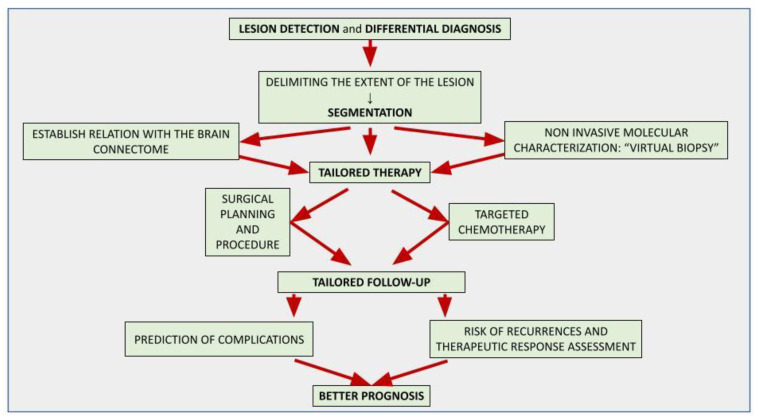
The application of artificial intelligence (AI) is accelerating the paradigm shift towards patient-tailored brain tumor management, achieving optimal onco-functional balance for each individual. AI-based models can positively impact different stages of the diagnostic and therapeutic process. Although the histological investigation will remain difficult to replace, in the near future the radiomic approach will allow a complementary, repeatable and non-invasive characterization of the lesion, assisting oncologists and neurosurgeons in selecting the best therapeutic option and the correct molecular target in chemotherapy. AI-driven tools are already playing an important role in surgical planning, delimiting the extent of the lesion (segmentation) and its relationships with the brain structures, thus allowing precision brain surgery as radical as reasonably acceptable to preserve the quality of life. Finally, AI-assisted models allow the prediction of complications, recurrences and therapeutic response, suggesting the most appropriate follow-up. Looking to the future, AI-powered models promise to integrate biochemical and clinical data to stratify risk and direct patients to personalized screening protocols.
Keywords: artificial intelligence; brain tumors; deep learning; glioblastoma; prognosis prediction.
Conflict of interest statement
The authors declare no conflict of interest.
Figures
References
-
- Jiang H., Cui Y., Wang J., Lin S. Impact of Epidemiological Characteristics of Supratentorial Gliomas in Adults Brought about by the 2016 World Health Organization Classification of Tumors of the Central Nervous System. Oncotarget. 2017;8:20354–20361. doi: 10.18632/oncotarget.13555. - DOI - PMC - PubMed
Publication types
MeSH terms
LinkOut - more resources
Full Text Sources
Other Literature Sources
Medical
