. 2023 Mar 7;13(6):958.
doi: 10.3390/ani13060958.

Giardia duodenalis Colonization Slightly Affects Gut Microbiota and Hematological Parameters in Clinically Healthy Dogs

Affiliations

Giardia duodenalis Colonization Slightly Affects Gut Microbiota and Hematological Parameters in Clinically Healthy Dogs

Arianna Peruzzo et al. Animals (Basel). .

Abstract

Giardia duodenalis (Giardia) is a worldwide cause of acute diarrheal disease both in humans and animals. The primary aim of this study was to investigate possible variations in gut microbiota in a population of asymptomatic dogs (n = 31), naturally infected or not by Giardia. Gut microbiota and the hematological, biochemical, and fecal parameters related to intestinal function were investigated. Giardia infection was associated with a significant shift of beta diversity, showing a relevant reduction of Gammaproteobacteria and an increase of Fusobacteria in male-positive dogs if compared with negatives. A significant imbalance of different bacterial taxa, with particular reference to the Erysipelotrichales, Lactobacillales, Clostridiales, and Burkholderiales orders, was observed, with the first two being higher in Giardia-positive dogs. Giardia-positive males displayed significantly higher values of cCRP than negative males as well as positive females, supporting the presence of a pro-inflammatory state. Taken together, these results indicate that the presence of Giardia does not substantially modify the microbial ecology of the intestine nor the hematological markers of disease. Thus treatments against Giardia should be considered with caution in asymptomatic subjects.

Keywords: Giardia duodenalis; dogs; gut; lipid metabolism; microbiota.


Conflict of interest statement

The authors declare no conflict of interest.

Figures
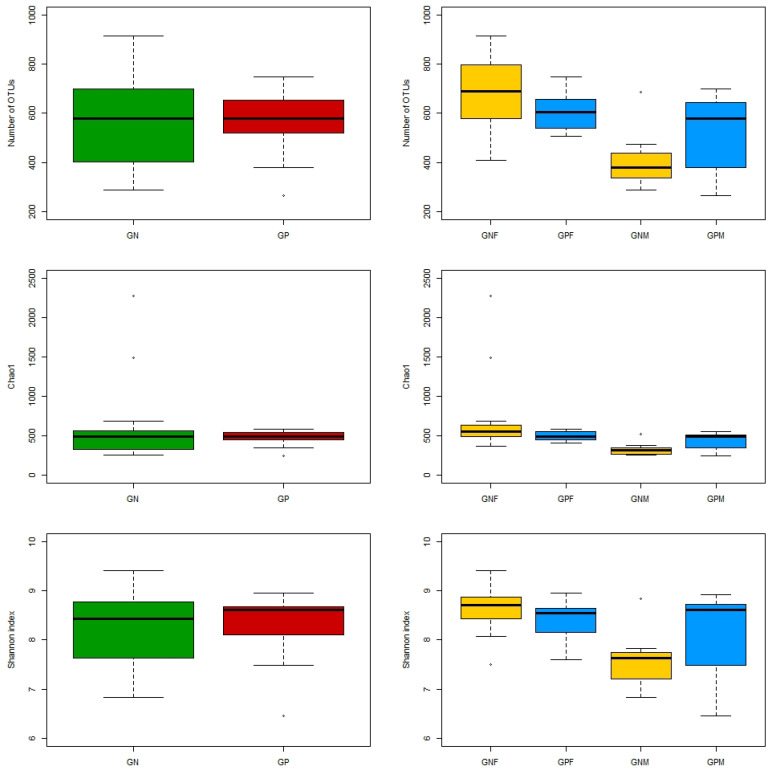
Figure 1
Figure 1
Box plot of the number of identified OTUs and Alpha-diversity (Chao1 and Shannon indices) by groups of study: GP and GN; GPF, GPM, GNF, and GNM. The box plot synthesize the data, providing the principal measures of central tendency and dispersion. Specifically, the diagram comprises a box with horizontal limits defining the upper and lower quantiles representing the interquartile range, with the median marked by a horizontal line within the box. The whiskers are vertical lines extending from the box as low as the 2.5th percentile and as high as the 97.5th percentile. Extreme values are indicated by dots.
Figure 2
Figure 2
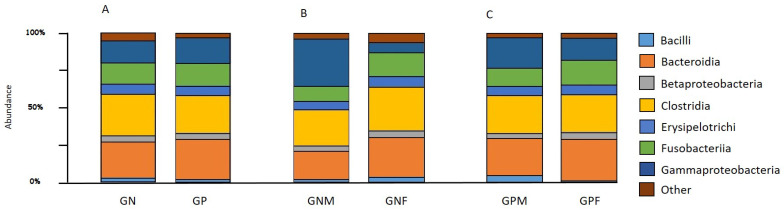
Barplots showing the average abundance of bacterial taxa at the order level between (A) GN and GP dogs, (B) GNM and GNF, and (C) GPM and GPF.
Figure 3
Figure 3
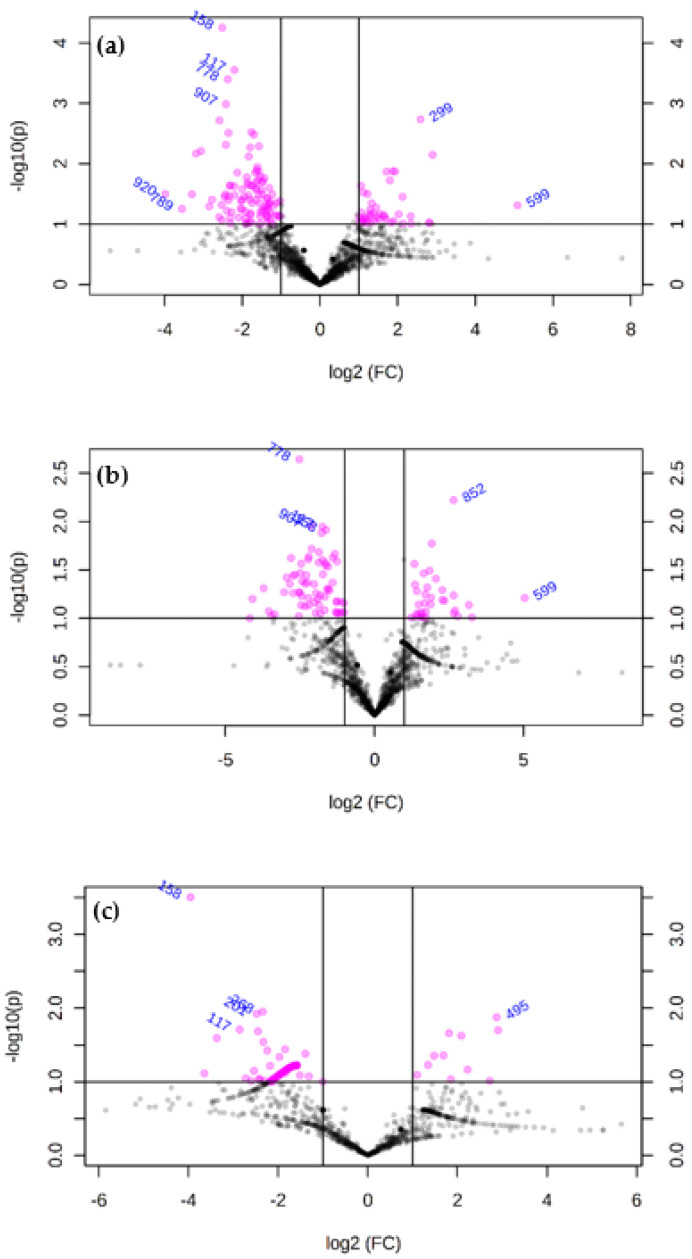
Volcano plot showing the OTUs that differ significantly between groups of study: (a) GP and GN, (b) GPF and GNF, and (c) GPM and GNM. The pink points indicate variables of interest that display both large-magnitude fold changes (x-axis) as well as high statistical significance (−log10 of p-value Wilcoxon test, y-axis). The horizontal line shows the p-value cut-off (p-value = 0.10), with points above the line having a p-value < 0.10 and points below the line having a p-value > 0.1. The vertical lines show 2-fold changes.
Figure 4
Figure 4
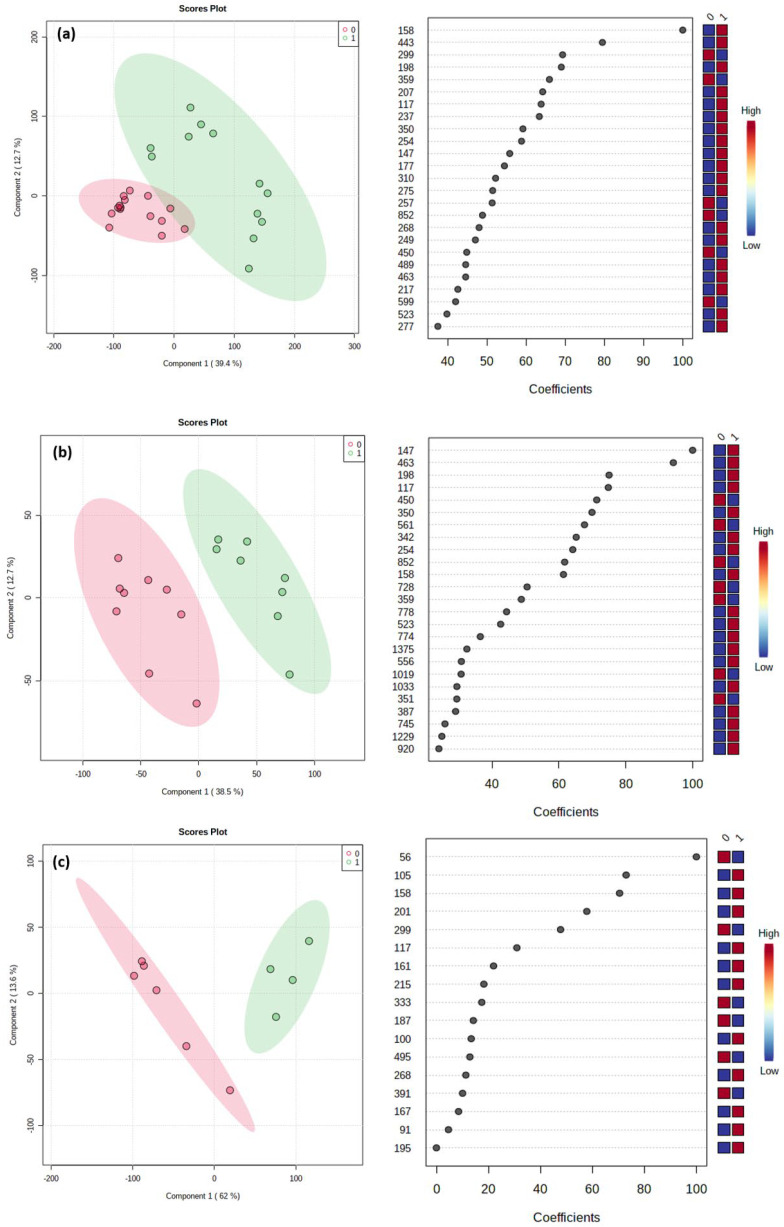
Partial least squares discriminant analysis (PLS-DA) results showing the comparison between OTU data acquired for (a) GP vs. GN, (b) GPF vs. GNF, and (c) GPM vs. GNM. On the left, the 2-D PLS-DA scores plots; on the right, the variable importance in projection plots. The most discriminating OTUs are shown in descending order of their coefficient scores. The color boxes indicate whether OTU is increased (red) or decreased (blue) in positive (1) vs. negative (0).
Figure 5
Figure 5
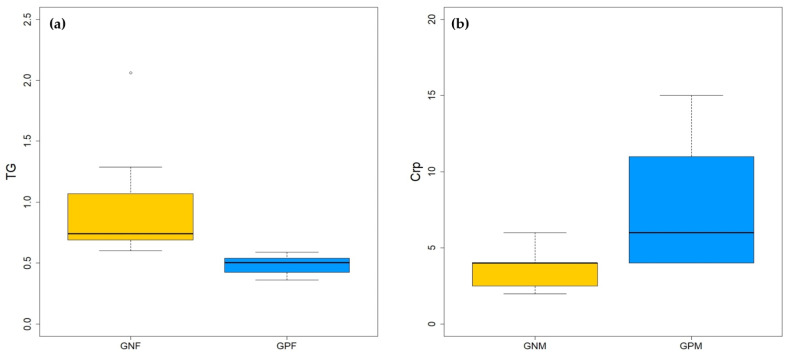
Box plot of the significant hematological and biochemical parameters in (a) female and (b) male dogs. TG is expressed in mmol/L, CRP in mg/L.

References

    1. Palmer C.S., Traub R.J., Robertson I.D., Devlin G., Rees R., Thompson R.A. Determining the zoonotic significance of Giardia and Cryptosporidium in Australian dogs and cats. Vet. Parasitol. 2008;154:142–147. doi: 10.1016/j.vetpar.2008.02.031. - DOI - PubMed
    1. Epe C., Rehkter G., Schnieder T., Lorentzen L., Kreienbrock L. Giardia in symptomatic dogs and cats in Europe—Results of a European study. Vet. Parasitol. 2010;173:32–38. doi: 10.1016/j.vetpar.2010.06.015. - DOI - PubMed
    1. Halliez M.C.M., Buret A.G. Extra-intestinal and long term consequences of Giardia duodenalis infections. World J. Gastro-enterol. 2013;19:8974–8985. doi: 10.3748/wjg.v19.i47.8974. - DOI - PMC - PubMed
    1. Capelli G., di Regalbono A.F., Iorio R., Pietrobelli M., Paoletti B., Giangaspero A. Giardia species and other intestinal parasites in dogs in north-east and central Italy. Vet. Rec. 2006;159:422–424. doi: 10.1136/vr.159.13.422. - DOI - PubMed
    1. Paoletti B., Iorio R., Capelli G., Sparagano O.A.E., Giangaspero A. Epidemiological Scenario of Giardiosis in Dogs from Central Italy. Ann. N. Y. Acad. Sci. 2008;1149:371–374. doi: 10.1196/annals.1428.005. - DOI - PubMed

LinkOut - more resources