Review
. 2023 Feb 21;12(3):548.
doi: 10.3390/antiox12030548.

Oxidative Stress and Inflammation in Acute and Chronic Lung Injuries

Affiliations
Review

Oxidative Stress and Inflammation in Acute and Chronic Lung Injuries

Frank Silva Bezerra et al. Antioxidants (Basel). .

Abstract

Acute and chronic lung injuries are among the leading causes of mortality worldwide. Lung injury can affect several components of the respiratory system, including the airways, parenchyma, and pulmonary vasculature. Although acute and chronic lung injuries represent an enormous economic and clinical burden, currently available therapies primarily focus on alleviating disease symptoms rather than reversing and/or preventing lung pathology. Moreover, some supportive interventions, such as oxygen and mechanical ventilation, can lead to (further) deterioration of lung function and even the development of permanent injuries. Lastly, sepsis, which can originate extrapulmonary or in the respiratory system itself, contributes to many cases of lung-associated deaths. Considering these challenges, we aim to summarize molecular and cellular mechanisms, with a particular focus on airway inflammation and oxidative stress that lead to the characteristic pathophysiology of acute and chronic lung injuries. In addition, we will highlight the limitations of current therapeutic strategies and explore new antioxidant-based drug options that could potentially be effective in managing acute and chronic lung injuries.

Keywords: asthma; chronic obstructive pulmonary disease; emphysema; hyperoxia; pulmonary fibrosis; sepsis; ventilator-induced lung injury.


Conflict of interest statement

The authors declare no conflict of interest.

Figures
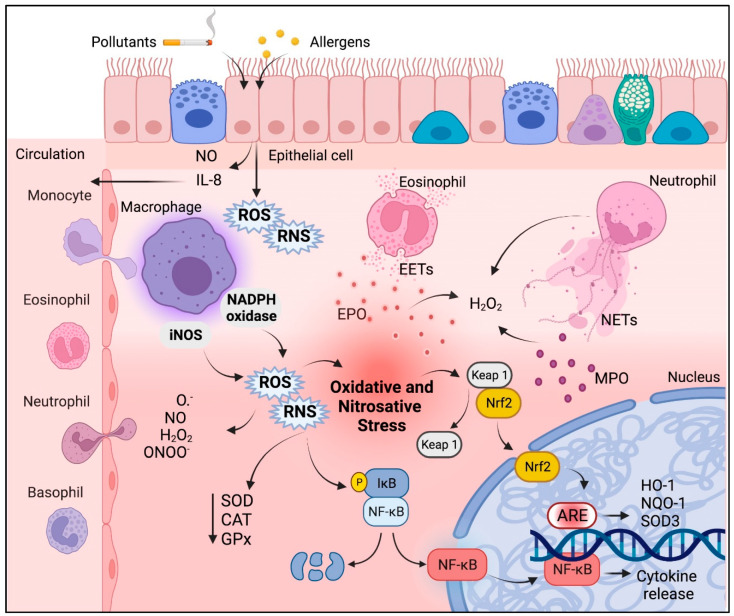
Figure 1
Figure 1
Schematic representation of oxidative and nitrosative stress in the pathophysiology of asthma. Recruitment (e.g., via IL-8) and activation of inflammatory cells such as neutrophils, macrophages, and eosinophils result in the release of ROS and RNS as well as NETs + MPO (from neutrophils) and EETs + EPO (from eosinophils), which cumulatively increase H2O2 levels. Macrophages induce the activity of iNOS and NADPH oxidase, resulting in increased release of ROS and RNS, thereby promoting oxidative/nitrosative stress and reducing the activity of antioxidant enzymes. In an attempt to counteract oxidative/nitrosative stress, cells respond to these conditions by activating the transcription factors Nrf2 and NF-κB, which will translocate to the nucleus and transcribe antioxidant enzymes and cytokines, respectively. Heme oxygenase (HO-1); hydrogen peroxide (H2O2); inducible nitric oxide synthase (iNOS); inhibitor of kB (ikB); kelch-like ECH-associated protein 1 (Keap 1); eosinophil peroxidase (EPO); myeloperoxidase (MPO); nicotinamide adenine dinucleotide phosphate (NADPH); nuclear factor erythroid 2-related factor 2 (Nrf2); nuclear factor-κB (NF-κB); nitric oxide (NO); peroxynitrite (ONOO); quinone oxidoreductase (NQO1); reactive nitrogen species (RNS); reactive oxygen species (ROS); superoxide (O•−); superoxide dismutase (SOD), and superoxide dismutase 3 (SOD3).
Figure 2
Figure 2
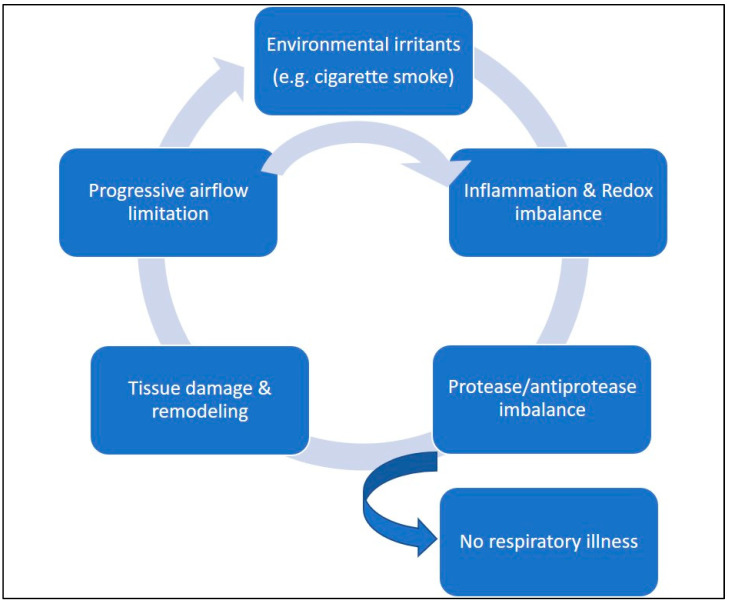
The progressive loop in COPD pathophysiology. Oxidative and toxic substances (e.g., cigarette smoke) trigger cellular and molecular changes in the lung environment—presenting as chronic inflammation—potentially leading to an insufficient repair response, disintegration of the lung parenchyma (emphysema), and a dysregulated functional response in the small airways (bronchitis). Inflammation may persist even after cigarette smoke exposure cessation. The majority of smokers escape this cycle due to largely unknown reasons, but probably resulting from a complex interaction between genes and the environment [149].
Figure 3
Figure 3
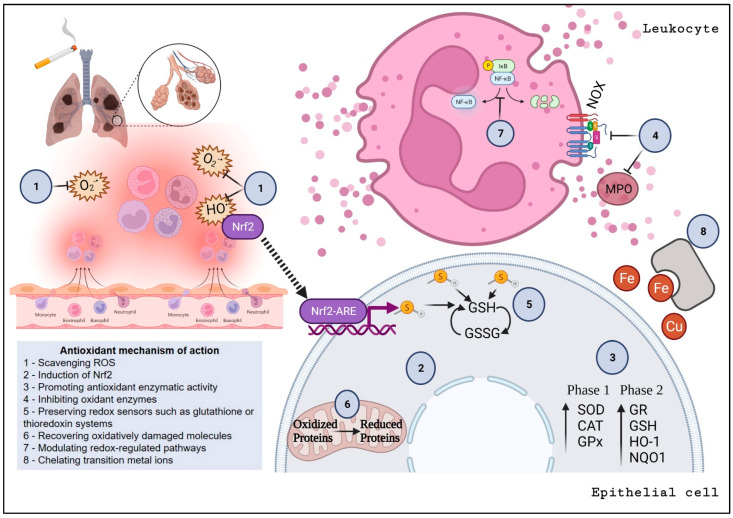
Schematic representation of various antioxidant mechanisms of action. Top left shows induction of oxidative stress and inflammation of the lung microenvironment by cigarette smoke inhalation. On the right, the roles of leukocytes and epithelial cells as well as associated signaling events are outlined. Grey circles numbered from 1 to 8 represent the pathways impacted by exogenous antioxidants and are detailed in the grey box (bottom left).
Figure 4
Figure 4
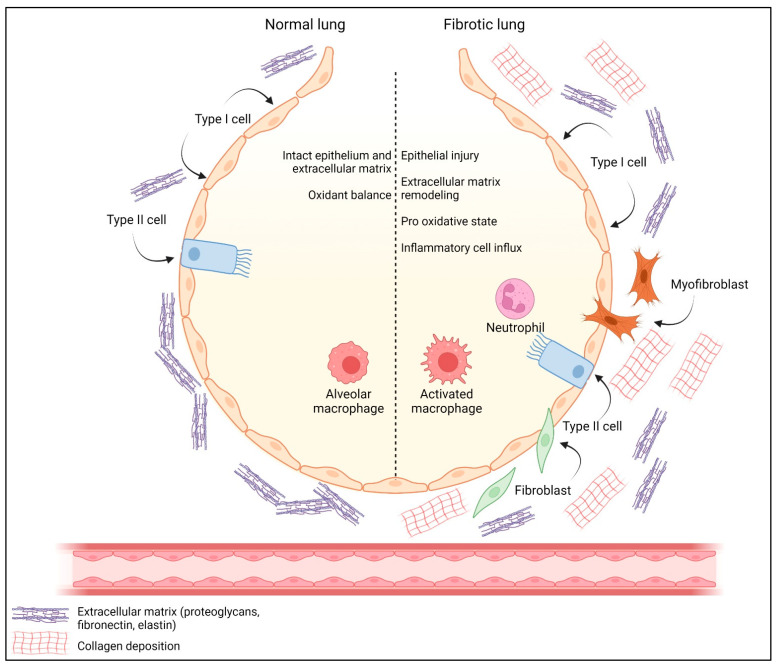
Pathogenesis of idiopathic pulmonary fibrosis (IPF). Aging, environmental, and occupational factors are associated with the development of pulmonary fibrosis. Injury to alveolar epithelial cells leads to abnormal tissue repair and extracellular matrix remodeling. Alveolar epithelial cells (type II cells) undergo epithelial-to-mesenchymal transition (EMT), promoting the accumulation, proliferation, and migration of fibroblasts and myofibroblasts. Collectively, oxidative stress and inflammation play an important role in the progression of IPF.
Figure 5
Figure 5
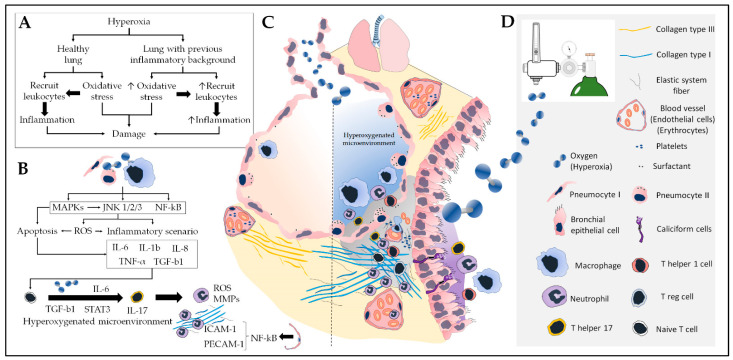
The early phase of hyperoxia-induced oxidative stress and inflammation. (A) Hyperoxia in healthy lungs results in oxidative stress-induced lung damage and inflammation. When hyperoxia is superimposed on lungs with pre-existing inflammation, oxidative stress-induced lung damage and inflammation are amplified. (B) Hyperoxia activates MAPK, JNK, and NF-κB pathways in macrophages and lung epithelial cells, leading to apoptosis, oxygen-free radical formation, and an inflammatory microenvironment with a cytokine repertoire (IL-6, IL-1β, IL-8, TNF-α, TGF-β1, and STAT3) that favors polarization of naïve T cells to Th1 and Th17, and promotes neutrophil attraction. Endothelial cells express ICAM-1 and PECAM-1 for neutrophil adhesion. (C) Hyperoxia-induced oxidative stress as well as damage to macrophages and lung epithelial cells lead to increased vascular permeability, elevated mucus production, and robust recruitment of lymphocytes, neutrophils, and macrophages to the inflammatory site. Endothelial damage scatters erythrocytes and promotes platelet aggregation on extracellular matrix proteins. (D) An example of supraphysiological oxygen delivery by Thorpe and Bourdon tubes.
Figure 6
Figure 6
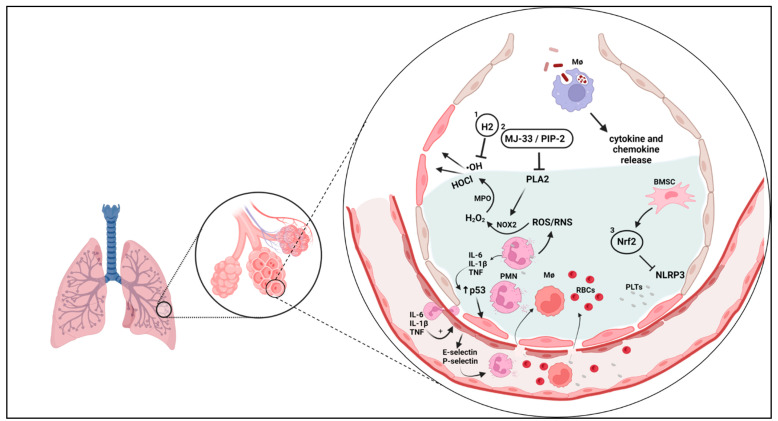
Schematic representation of a damaged alveolus—lung tissue can be damaged either directly or indirectly through exacerbated inflammation in other organs. In direct injury, resident alveolar macrophages recognize invading pathogens through pattern recognition receptors (not shown) present on their surfaces, producing cytokines and chemokines. Neutrophils are recruited to alveolar spaces, where they produce more cytokines and ROS/RNS, leading to endothelial and epithelial damage. Increased epithelial cell apoptosis through augmented expression of p53 also occurs and will disrupt the tight barriers, resulting in an increase in edematous fluid and RBCs, as well as neutrophil infiltration into alveolar tissue. Neutrophils migrate towards increased expression of selectins (on endothelial cells) and can form aggregates with platelets. Many neutrophils will produce excessive reactive oxygen metabolites through the expression of NOX2, and MPO will ultimately convert H2O2 into its final products. Antioxidant strategies are thought to decrease excessive ROS production through (1) the neutralization of oxygen metabolites, (2) inhibiting PLA2, leading to NOX2 inhibition, or (3) inducing Nrf2 activation (using BMSC). Abbreviations: RBCs, red blood cells; NOX2, NADPH oxidase 2; MPO, myeloperoxidase; H2O2, hydrogen peroxide; PLA2, phospholipase A2; Nrf2, nuclear factor erythroid 2-related factor 2; BMSC, bone marrow-derived mesenchymal stem cells.
Figure 7
Figure 7
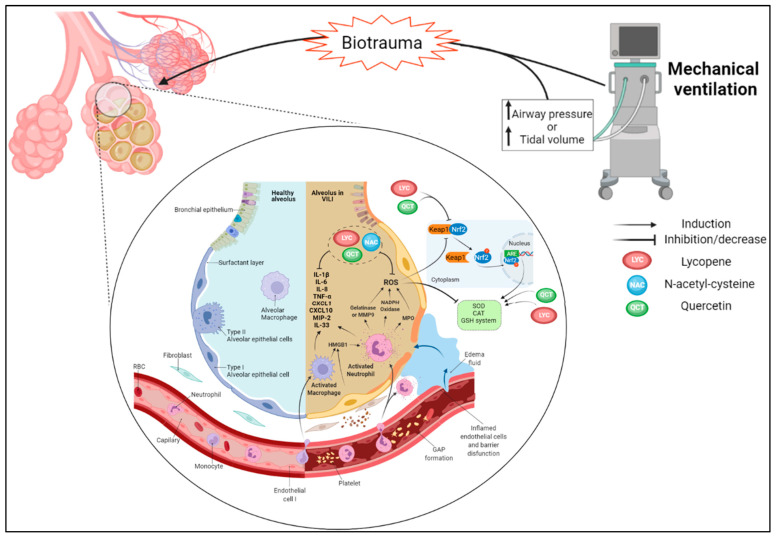
Overview of the mechanisms associated with ventilator-induced lung injury (VILI) and proposed bioactive compounds that may prevent or treat VILI caused by mechanical ventilation (MV). Abbreviations: antioxidant response element (ARE); catalase (CAT); C-X-C motif ligand 1 (CXCL1); CXCL10; glutathione system (GSH system)); high mobility group box 1 (HMGB1); interleukin (IL) 1β; IL-6; IL-8; IL-33; Kelch-like ECH-associated protein 1 (keap1); macrophage inflammatory protein 2 (MIP-2); matrix metalloproteinase 9 (MMP9); myeloperoxidase (MPO); nuclear factor erythroid 2-related factor 2 (Nfr2); reactive oxygen species (ROS); red blood cell (RBC); superoxide dismutase (SOD); tumor-necrosis factor (TNF)-α.

References

    1. Schluger N.W., Koppaka R. Lung disease in a global context. A call for public health action. Ann. Am. Thorac. Soc. 2014;11:407–416. doi: 10.1513/AnnalsATS.201312-420PS. - DOI - PubMed
    1. Bousquet J., Kiley J., Bateman E.D., Viegi G., Cruz A.A., Khaltaev N., Ait Khaled N., Baena-Cagnani C.E., Barreto M.L., Billo N., et al. Prioritised research agenda for prevention and control of chronic respiratory diseases. Eur. Respir. J. 2010;36:995–1001. doi: 10.1183/09031936.00012610. - DOI - PubMed
    1. Andersen Z.J., Hoffmann B., Morawska L., Adams M., Furman E., Yorgancioglu A., Greenbaum D., Neira M., Brunekreef B., Forastiere F., et al. Air pollution and COVID-19: Clearing the air and charting a post-pandemic course: A joint workshop report of ERS, ISEE, HEI and WHO. Eur. Respir. J. 2021;58:2101063. doi: 10.1183/13993003.01063-2021. - DOI - PMC - PubMed
    1. Hu Y., Ciminieri C., Hu Q., Lehmann M., Konigshoff M., Gosens R. WNT Signalling in Lung Physiology and Pathology. Handb. Exp. Pharmacol. 2021;269:305–336. doi: 10.1007/164_2021_521. - DOI - PMC - PubMed
    1. Lammi M.R., Baughman R.P., Birring S.S., Russell A.M., Ryu J.H., Scholand M., Distler O., LeSage D., Sarver C., Antoniou K., et al. Outcome Measures for Clinical Trials in Interstitial Lung Diseases. Curr. Respir. Med. Rev. 2015;11:163–174. doi: 10.2174/1573398X11666150619183527. - DOI - PMC - PubMed

LinkOut - more resources