Review
. 2023 Mar 6;12(3):651.
doi: 10.3390/antiox12030651.

Aging Hallmarks and the Role of Oxidative Stress

Affiliations
Review

Aging Hallmarks and the Role of Oxidative Stress

Edio Maldonado et al. Antioxidants (Basel). .

Abstract

Aging is a complex biological process accompanied by a progressive decline in the physical function of the organism and an increased risk of age-related chronic diseases such as cardiovascular diseases, cancer, and neurodegenerative diseases. Studies have established that there exist nine hallmarks of the aging process, including (i) telomere shortening, (ii) genomic instability, (iii) epigenetic modifications, (iv) mitochondrial dysfunction, (v) loss of proteostasis, (vi) dysregulated nutrient sensing, (vii) stem cell exhaustion, (viii) cellular senescence, and (ix) altered cellular communication. All these alterations have been linked to sustained systemic inflammation, and these mechanisms contribute to the aging process in timing not clearly determined yet. Nevertheless, mitochondrial dysfunction is one of the most important mechanisms contributing to the aging process. Mitochondria is the primary endogenous source of reactive oxygen species (ROS). During the aging process, there is a decline in ATP production and elevated ROS production together with a decline in the antioxidant defense. Elevated ROS levels can cause oxidative stress and severe damage to the cell, organelle membranes, DNA, lipids, and proteins. This damage contributes to the aging phenotype. In this review, we summarize recent advances in the mechanisms of aging with an emphasis on mitochondrial dysfunction and ROS production.

Keywords: ROS; aging; mitochondrial dysfunction; oxidative stress.


Conflict of interest statement

The authors declare no conflict of interest. The funders had no role in the design of the study; in the collection, analyses, or interpretation of data; in the writing of the manuscript; or in the decision to publish the results.

Figures
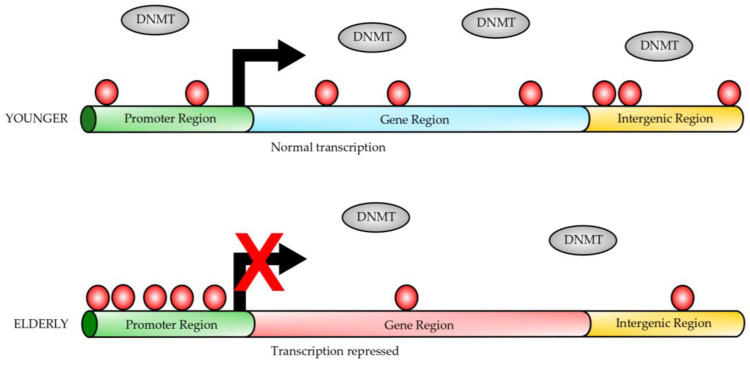
Figure 1
Figure 1
Gene DNA methylation during aging. In younger individuals, the gene promoters have a lower degree of DNA methylation (red circles) than in elderly individuals, while the gene bodies are highly methylated (red circles). On the contrary, elderly individuals have gene promoters heavily methylated (red circles); however, the gene bodies are hypomethylated. Transcription initiation is inhibited by DNA methylation at the gene promoters from elderly individuals. Dynamic DNA methylation occurs at CpG sites on the gene promoters or gene bodies. DNA methylases (DNMTs) carry out methylation of CpG sites, which protein factors or non-coding RNAs can regulate. This figure was modified from reference [21].
Figure 2
Figure 2
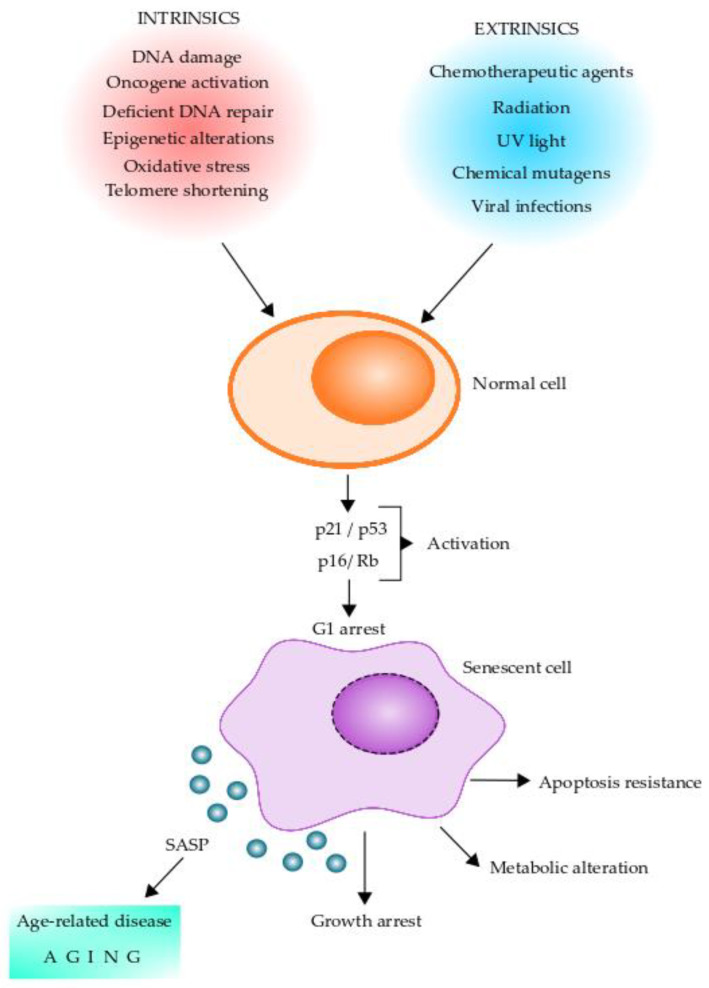
Stress stimuli leading to cellular senescence. Senescent cells can play pleiotropic roles in normal physiology, pathology, and aging. Diverse factors (intrinsic and extrinsic) can act on normal cells and induce a senescent phenotype. Senescent cells initiate the senescent cellular program by activating the p16/Rb and/or p21/p53 tumor suppressor pathways, which can arrest the cells in G1. Senescent cells undergo several intracellular changes, which are shown in the figure. One of the main features of senescent cells is the production of the senescence-associated secretory phenotype (SASP), which contains a series of molecules that can alter neighboring cells leading to age-related diseases and aging. Intracellular changes of senescent cells include DNA-SCARS (DNA segments with chromatin alterations reinforcing senescence), CCF (cytoplasm chromatin fragments), SADF (senescent-associated DNA damaged foci), SAHF (senescent-associated chromatin foci), SAMD (senescent-associated mitochondrial dysfunction), mtDNA (mitochondrial DNA), and TAF (telomere-associated foci).
Figure 3
Figure 3
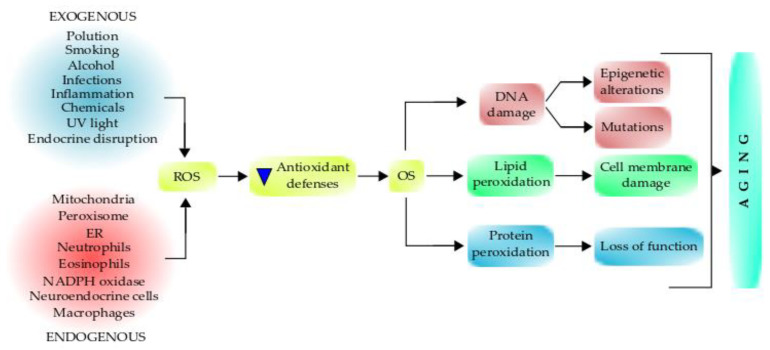
Role of free radicals on oxidative stress and the aging process. Various endogenous and exogenous factors can generate free radicals/oxidants, affecting the antioxidant defenses, which promote oxidative stress that can damage different biomolecules. The damaged biomolecules affect inter and intracellular signaling and gene expression pathways, causing several cell alterations. The interplay between these events can lead to aging, which increases aging-associated syndromes and aging-related diseases. Antioxidant supplementation can retard the aging process.
Figure 4
Figure 4
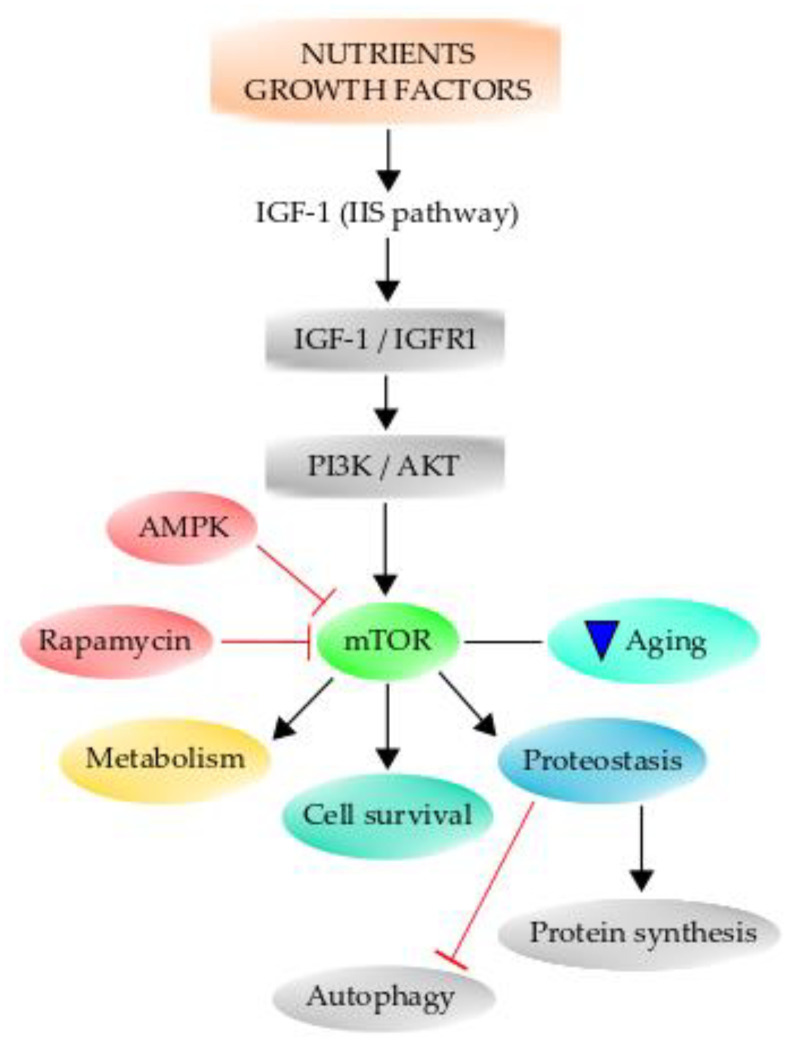
The mammalian TOR pathway (mTOR) can regulate several hallmarks of aging. Growth factors and nutrient availability can activate the IIS pathway to regulate mTOR, which acts on downstream targets, regulating metabolism, cell survival, and proteostasis, among several others. mTOR inhibition by rapamycin or by AMPK can decrease aging. Further, mTOR is able to negatively regulate autophagy and positively regulate protein synthesis.
Figure 5
Figure 5
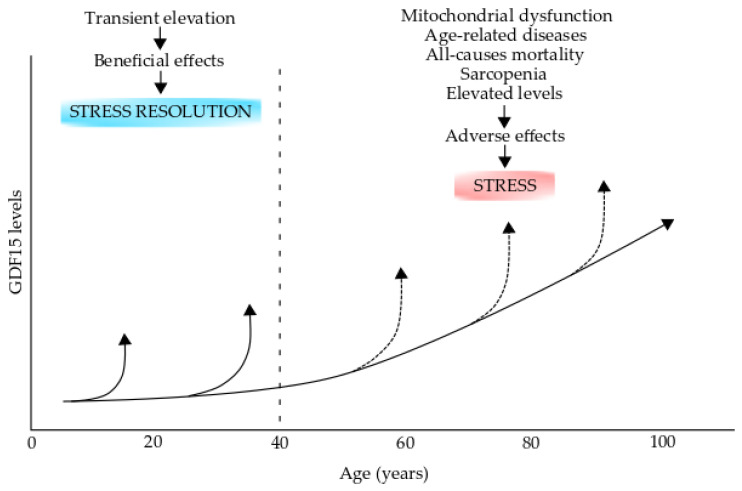
Growth differentiation factor 15 (GDF15) levels in aging and aging-related diseases. The GDF15 levels increase during the process of normal aging. GDF15 transient elevations during early life (up to 40 years old) could have beneficial effects on stress resolution However, these levels can increase over the normal levels (broken arrows) in individuals over 40 years old and could have adverse effects and produce stress. Elevated levels are produced during mitochondrial dysfunction, age-related diseases, all-cause mortality, and sarcopenia. This figure was modified from reference [269].

References

    1. Sen P., Shah P.P., Nativio R., Berger S.L. Epigenetic mechanisms of longevity and aging. Cell. 2016;166:822–839. doi: 10.1016/j.cell.2016.07.050. - DOI - PMC - PubMed
    1. Kennedy B.K., Berger S.L., Brunet A., Campisi J., Cuervo A.M., Epel E.S., Franceschi C., Lithgow G.J., Morimoto R.I., Pessin J.E., et al. Aging: A common driver of chronic diseases and a target for novel interventions. Cell. 2014;159:709. doi: 10.1016/j.cell.2014.10.039. - DOI - PMC - PubMed
    1. Nichols M., Townsend N., Scarborough P., Rayner M. Cardiovascular disease in Europe 2014: Epidemiological update. Eur. Heart J. 2014;35:2950–2959. doi: 10.1093/eurheartj/ehu299. - DOI - PubMed
    1. Fabbri E., Zoli M., Gonzalez-Freire M., Salive M.E., Studenski S.A., Ferrucci L. Aging and multimorbidity: New tasks, priorities, and frontiers for integrated gerontological and clinical research. J. Am. Med. Dir. Assoc. 2015;16:640–647. doi: 10.1016/j.jamda.2015.03.013. - DOI - PMC - PubMed
    1. Marioni R.E., Harris S.E., Shah S., McRae A.F., von Zglinicki T., Martin-Ruiz C., Wray N.R., Visscher P.M., Deary I.J. The epigenetic clock and telomere length are independently associated with chronological age and mortality. Int. J. Epidemiol. 2016;45:424–432. doi: 10.1093/ije/dyw041. - DOI - PMC - PubMed

LinkOut - more resources