


Role of Mesenchymal Stem/Stromal Cells in Modulating Ischemia/Reperfusion Injury: Current State of the Art and Future Perspectives
- PMID: 36979668
- PMCID: PMC10045387
- DOI: 10.3390/biomedicines11030689
Role of Mesenchymal Stem/Stromal Cells in Modulating Ischemia/Reperfusion Injury: Current State of the Art and Future Perspectives
Abstract
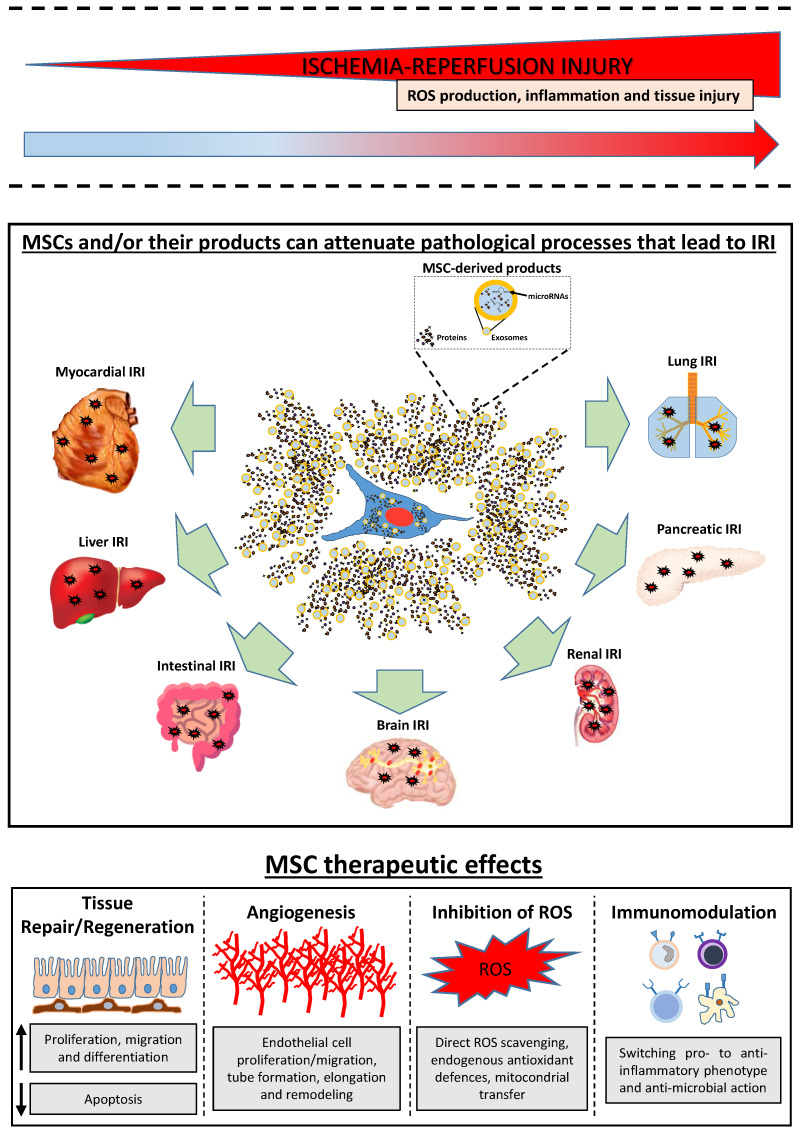
Ischemia/reperfusion injury (IRI) is a multistep damage that occurs in several tissues when a blood flow interruption is inevitable, such as during organ surgery or transplantation. It is responsible for cell death and tissue dysfunction, thus leading, in the case of transplantation, to organ rejection. IRI takes place during reperfusion, i.e., when blood flow is restored, by activating inflammation and reactive oxygen species (ROS) production, causing mitochondrial damage and apoptosis of parenchymal cells. Unfortunately, none of the therapies currently in use are definitive, prompting the need for new therapeutic approaches. Scientific evidence has proven that mesenchymal stem/stromal cells (MSCs) can reduce inflammation and ROS, prompting this cellular therapy to also be investigated for treatment of IRI. Moreover, it has been shown that MSC therapeutic effects were mediated in part by their secretome, which appears to be involved in immune regulation and tissue repair. For these reasons, mediated MSC paracrine function might be key for injury amelioration upon IRI damage. In this review, we highlight the scientific literature on the potential beneficial use of MSCs and their products for improving IRI outcomes in different tissues/organs, focusing in particular on the paracrine effects mediated by MSCs, and on the molecular mechanisms behind these effects.
Keywords: MSC pre-conditioning; apoptosis; inflammation; ischemia/reperfusion injury; mesenchymal stem/stromal cells; organ transplantation; secretome.
Conflict of interest statement
The authors declare no conflict of interest.
Figures
References
-
- Ito T., Naini B.V., Markovic D., Aziz A., Younan S., Lu M., Hirao H., Kadono K., Kojima H., DiNorcia J., 3rd, et al. Ischemia-reperfusion injury and its relationship with early allograft dysfunction in liver transplant patients. Am. J. Transplant. Off. J. Am. Soc. Transplant. Am. Soc. Transpl. Surg. 2021;21:614–625. doi: 10.1111/ajt.16219. - DOI - PubMed
Publication types
Grants and funding
LinkOut - more resources
Full Text Sources
