


From NAFLD to MAFLD: Definition, Pathophysiological Basis and Cardiovascular Implications
- PMID: 36979861
- PMCID: PMC10046146
- DOI: 10.3390/biomedicines11030883
From NAFLD to MAFLD: Definition, Pathophysiological Basis and Cardiovascular Implications
Abstract
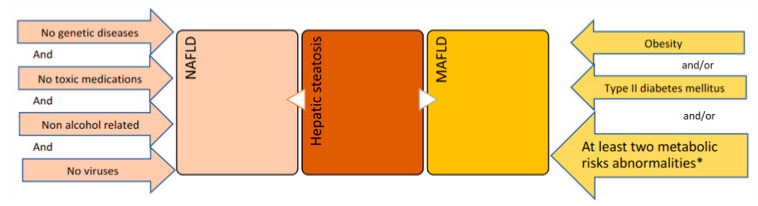
Non-alcoholic fatty liver disease (NAFLD) is defined as a chronic liver disease characterized by excessive fat accumulation in the liver without another obvious cause (no excessive alcohol consumption, hepatotoxic medications, toxins, viral infections, genetic hepatic diseases), therefore it is an exclusion diagnosis. The term NAFLD literally refers to non-alcohol related hepatopathy and does not adequately correlate with metabolic dysfunction and related cardiovascular risks. Therefore, researchers and scientific societies have moved towards changing the terminology. The novel nomenclature for a metabolic-associated fatty liver disease (MAFLD) has been proposed in 2020 by a group of experts to overcome the issues related to the old terminology. The diagnosis of MAFLD is based on the presence of hepatic steatosis and at least one between these three conditions: type 2 diabetes mellitus (T2DM), obesity or metabolic dysregulation. MAFLD has been shown to be an independent risk factor for cardiovascular diseases and atherosclerosis. It is better related to the main risk factors for atherosclerosis and cardiovascular diseases than NAFLD, such as dyslipidemia, T2DM and hypertension. The aim of this review is to highlight the reasons why the term NAFLD is moving to the term MAFLD, what are the conceptual basis of this choice and its clinical implications, particularly in the cardiovascular field.
Keywords: MAFLD; NAFLD; NASH; cardiovascular; diabetes.
Conflict of interest statement
The authors declare no conflict of interest.
Figures
References
-
- Kim Y.S., Jung E.S., Hur W., Bae S.H., Choi J.Y., Song M.J., Kim C.W., Jo S.H., Lee C.D., Lee Y.S., et al. Noninvasive predictors of nonalcoholic steatohepatitis in Korean patients with histologically proven nonalcoholic fatty liver disease. Clin. Mol. Hepatol. 2013;19:120–130. doi: 10.3350/cmh.2013.19.2.120. - DOI - PMC - PubMed
-
- Williams C.D., Stengel J., Asike M.I., Torres D.M., Shaw J., Contreras M., Landt C.L., Harrison S.A. Prevalence of nonalcoholic fatty liver disease and nonalcoholic steatohepatitis among a largely middle-aged population utilizing ultrasound and liver biopsy: A prospective study. Gastroenterology. 2011;140:124–131. doi: 10.1053/j.gastro.2010.09.038. - DOI - PubMed
-
- Estes C., Anstee Q.M., Arias-Loste M.T., Bantel H., Bellentani S., Caballeria J., Colombo M., Craxi A., Crespo J., Day C.P., et al. Modeling NAFLD disease burden in China, France, Germany, Italy, Japan, Spain, United Kingdom, and United States for the period 2016–2030. J. Hepatol. 2018;69:896–904. doi: 10.1016/j.jhep.2018.05.036. - DOI - PubMed
Publication types
LinkOut - more resources
Full Text Sources
Medical
