Review
. 2023 Mar 18;12(6):935.
doi: 10.3390/cells12060935.

Shifting the Cancer Screening Paradigm: The Rising Potential of Blood-Based Multi-Cancer Early Detection Tests

Affiliations
Review

Shifting the Cancer Screening Paradigm: The Rising Potential of Blood-Based Multi-Cancer Early Detection Tests

Tiago Brito-Rocha et al. Cells. .

Abstract

Cancer remains a leading cause of death worldwide, partly owing to late detection which entails limited and often ineffective therapeutic options. Most cancers lack validated screening procedures, and the ones available disclose several drawbacks, leading to low patient compliance and unnecessary workups, adding up the costs to healthcare systems. Hence, there is a great need for innovative, accurate, and minimally invasive tools for early cancer detection. In recent years, multi-cancer early detection (MCED) tests emerged as a promising screening tool, combining molecular analysis of tumor-related markers present in body fluids with artificial intelligence to simultaneously detect a variety of cancers and further discriminate the underlying cancer type. Herein, we aim to provide a highlight of the variety of strategies currently under development concerning MCED, as well as the major factors which are preventing clinical implementation. Although MCED tests depict great potential for clinical application, large-scale clinical validation studies are still lacking.

Keywords: MCED; biomarkers; cancer screening; liquid biopsy; multi-cancer early detection.


Conflict of interest statement

The authors declare no conflict of interest.

Figures
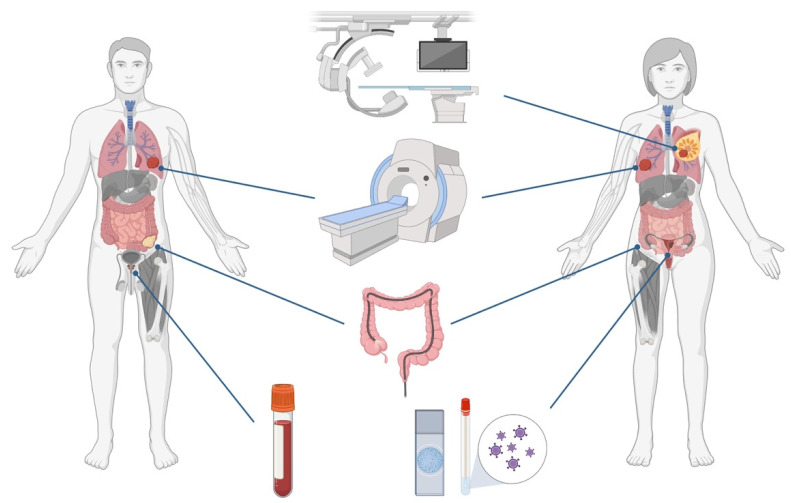
Figure 1
Figure 1
Currently available cancer screening options: mammography for breast cancer; low-dose CT for lung cancer; colonoscopy for colorectal cancer; cytology and HPV testing for cervical cancer; serum PSA testing for prostate cancer. Colored organs represent those with available screening; grey organs represent those without any current screening option (not all cancer types are represented). Created with Biorender.com.
Figure 2
Figure 2
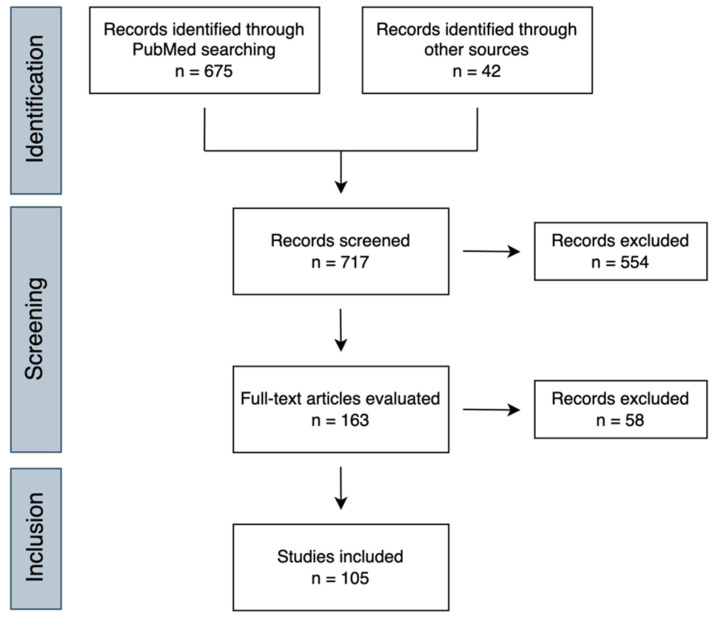
Flow diagram of the conducted search methodology for this review.
Figure 3
Figure 3
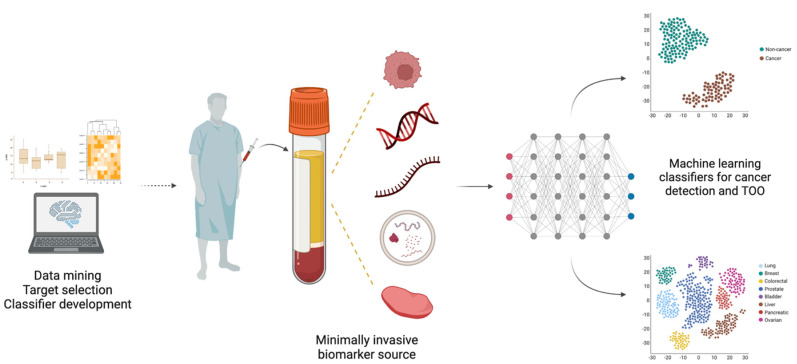
Schematic representation of the workflow for developing multi-cancer early detection tests. Data mining of big datasets, such as TCGA, are great tools for selecting biomarkers with utility for cancer detection. Liquid biopsies provide a minimally invasive way to obtain cancer-related information, namely, circulating tumor cells (CTCs), circulating nucleic acids (cfDNA and cfRNA), extracellular vesicles (EVs), and tumor-educated platelets (TEPs). The molecular analysis of these biomarkers combined with machine learning classifiers shows great potential for detecting multiple cancers simultaneously and discriminating tissue of origin (TOO). Created with BioRender.com.

References

    1. Sung H., Ferlay J., Siegel R.L., Laversanne M., Soerjomataram I., Jemal A., Bray F. Global Cancer Statistics 2020: GLOBOCAN Estimates of Incidence and Mortality Worldwide for 36 Cancers in 185 Countries. CA Cancer J. Clin. 2021;71:209–249. doi: 10.3322/caac.21660. - DOI - PubMed
    1. Clarke C.A., Hubbell E., Kurian A.W., Colditz G.A., Hartman A.R., Gomez S.L. Projected Reductions in Absolute Cancer-Related Deaths from Diagnosing Cancers Before Metastasis, 2006-2015. Cancer Epidemiol. Biomark. Prev. 2020;29:895–902. doi: 10.1158/1055-9965.EPI-19-1366. - DOI - PubMed
    1. Smith R.A., Oeffinger K.C. The Importance of Cancer Screening. Med. Clin. N. Am. 2020;104:919–938. doi: 10.1016/j.mcna.2020.08.008. - DOI - PubMed
    1. WHO . Guide to Cancer Early Aiagnosis. World Health Organization; Geneva, Switzerland: 2017.
    1. Barsouk A., Saginala K., Aluru J.S., Rawla P., Barsouk A. US Cancer Screening Recommendations: Developments and the Impact of COVID-19. Med. Sci. 2022;10:16. doi: 10.3390/medsci10010016. - DOI - PMC - PubMed

Publication types

Substances