


What Is Known about Breast Cancer in Young Women?
- PMID: 36980802
- PMCID: PMC10047861
- DOI: 10.3390/cancers15061917
What Is Known about Breast Cancer in Young Women?
Abstract
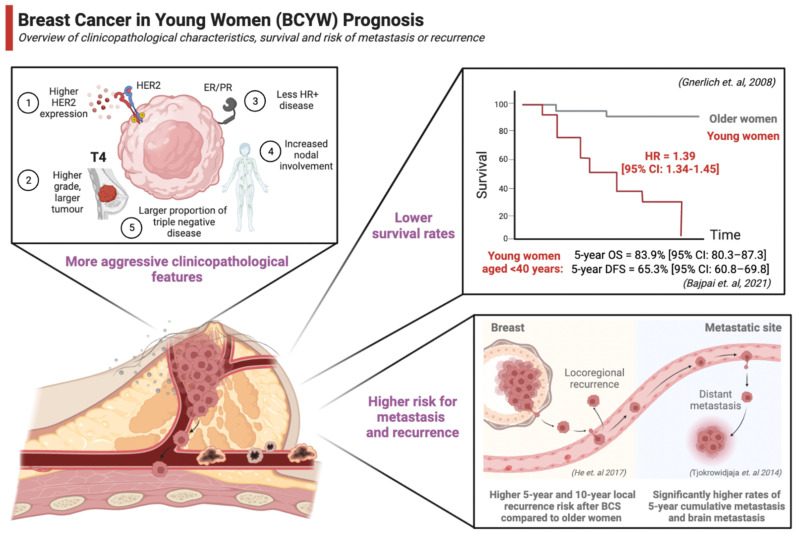
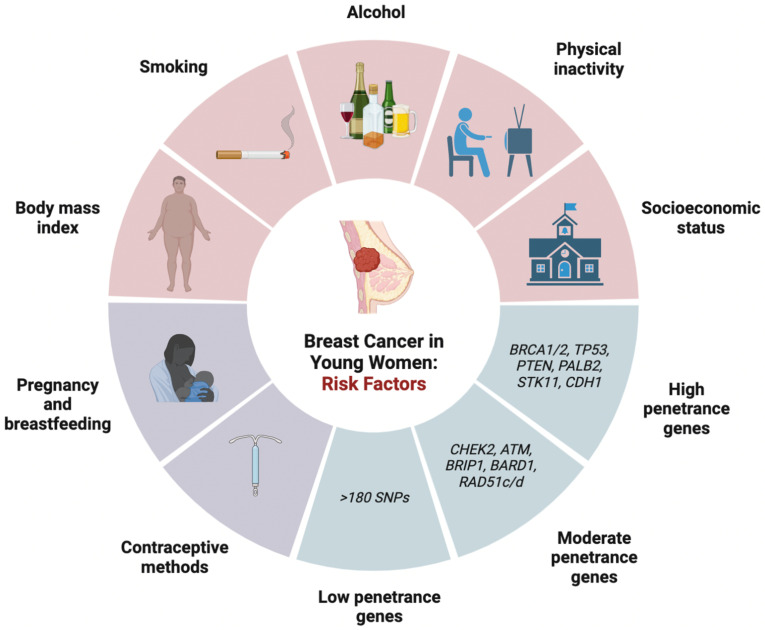
Breast cancer (BC) is the second leading cause of cancer-related death in women under the age of 40 years worldwide. In addition, the incidence of breast cancer in young women (BCYW) has been rising. Young women are not the focus of screening programs and BC in younger women tends to be diagnosed in more advanced stages. Such patients have worse clinical outcomes and treatment complications compared to older patients. BCYW has been associated with distinct tumour biology that confers a worse prognosis, including poor tumour differentiation, increased Ki-67 expression, and more hormone-receptor negative tumours compared to women >50 years of age. Pathogenic variants in cancer predisposition genes such as BRCA1/2 are more common in early-onset BC compared to late-onset BC. Despite all these differences, BCYW remains poorly understood with a gap in research regarding the risk factors, diagnosis, prognosis, and treatment. Age-specific clinical characteristics or outcomes data for young women are lacking, and most of the standard treatments used in this subpopulation currently are derived from older patients. More age-specific clinical data and treatment options are required. In this review, we discuss the epidemiology, clinicopathologic characteristics, outcomes, treatments, and special considerations of breast cancer in young women. We also underline future directions and highlight areas that require more attention in future studies.
Keywords: breast cancer; young women.
Conflict of interest statement
The authors declare no conflict of interest.
Figures
References
-
- Shah A.N., Carroll K.J., Gerratana L., Lin C., Davis A.A., Zhang Q., Jacob S., Finkelman B., Zhang Y., Qiang W., et al. Circulating tumor cells, circulating tumor DNA, and disease characteristics in young women with metastatic breast cancer. Breast Cancer Res. Treat. 2021;187:397–405. doi: 10.1007/s10549-021-06236-1. - DOI - PubMed
-
- Anders C.K., Hsu D.S., Broadwater G., Acharya C.R., Foekens J.A., Zhang Y., Wang Y., Marcom P.K., Marks J.R., Febbo P.G., et al. Young Age at Diagnosis Correlates With Worse Prognosis and Defines a Subset of Breast Cancers With Shared Patterns of Gene Expression. J. Clin. Oncol. 2008;26:3324–3330. doi: 10.1200/JCO.2007.14.2471. - DOI - PubMed
-
- Kataoka A., Iwamoto T., Tokunaga E., Tomotaki A., Kumamaru H., Miyata H., Niikura N., Kawai M., Anan K., Hayashi N., et al. Young adult breast cancer patients have a poor prognosis independent of prognostic clinicopathological factors: A study from the Japanese Breast Cancer Registry. Breast Cancer Res. Treat. 2016;160:163–172. doi: 10.1007/s10549-016-3984-8. - DOI - PMC - PubMed
Publication types
LinkOut - more resources
Full Text Sources
Miscellaneous
