


Novel Variants in the VCP Gene Causing Multisystem Proteinopathy 1
- PMID: 36980948
- PMCID: PMC10048343
- DOI: 10.3390/genes14030676
Novel Variants in the VCP Gene Causing Multisystem Proteinopathy 1
Abstract
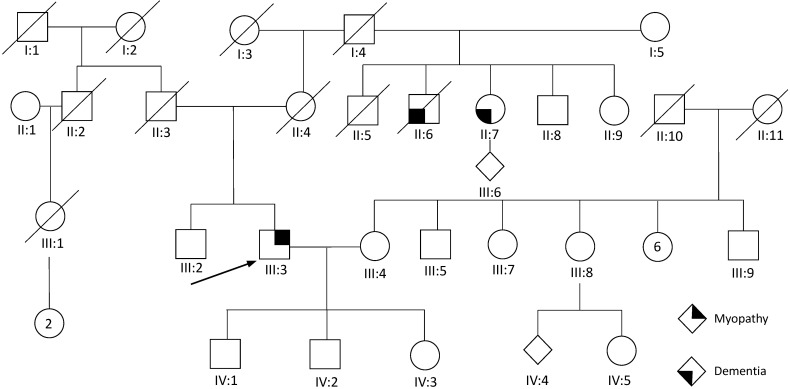
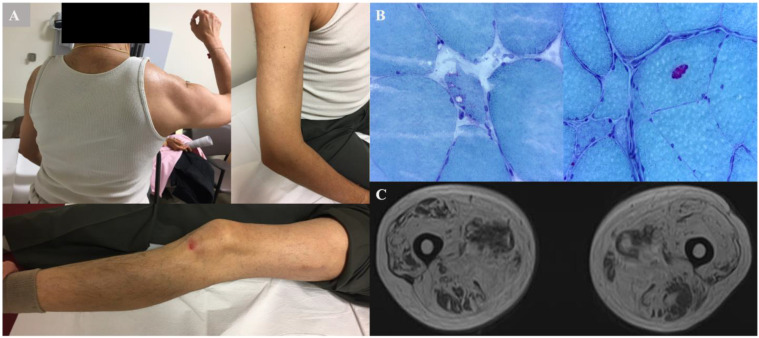
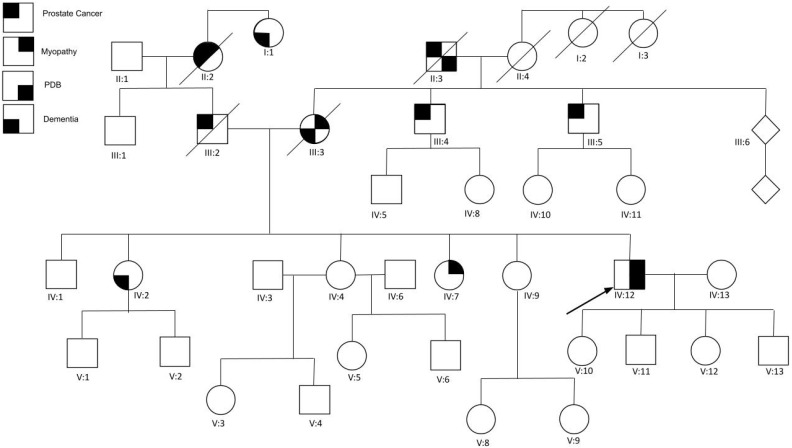
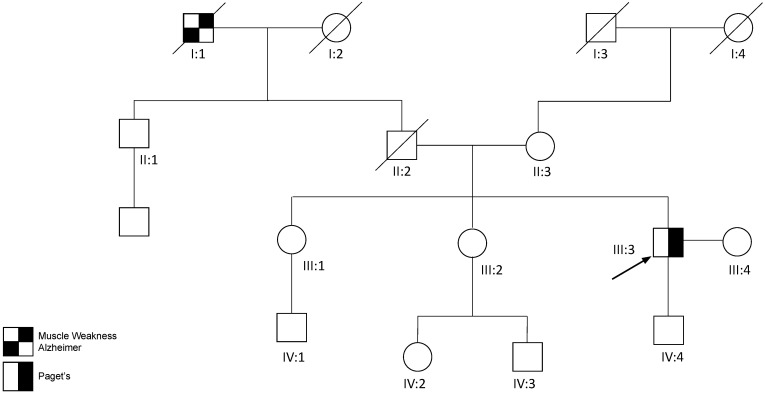
Valosin-containing protein (VCP) gene mutations have been associated with a rare autosomal dominant, adult-onset progressive disease known as multisystem proteinopathy 1 (MSP1), or inclusion body myopathy (IBM), Paget's disease of bone (PDB), frontotemporal dementia (FTD), (IBMPFD), and amyotrophic lateral sclerosis (ALS). We report the clinical and genetic analysis findings in five patients, three from the same family, with novel VCP gene variants: NM_007126.5 c.1106T>C (p.I369T), c.478G>A (p.A160T), and c.760A>T (p.I254F), associated with cardinal MSP1 manifestations including myopathy, PDB, and FTD. Our report adds to the spectrum of heterozygous pathogenic variants found in the VCP gene and the high degree of clinical heterogeneity. This case series prompts increased awareness and early consideration of MSP1 in the differential diagnosis of myopathies and/or PDB, dementia, or ALS to improve the diagnosis and early management of clinical symptoms.
Keywords: ALS; IBMPFD; MSP1; VCP; multisystem proteinopathy-1; valosin-containing protein.
Conflict of interest statement
The authors declare no conflict of interest.
Figures
References
-
- Kimonis V.E., Kovach M.J., Waggoner B., Leal S., Salam A., Rimer L., Davis K., Khardori R., Gelber D. Clinical and molecular studies in a unique family with autosomal dominant limb-girdle muscular dystrophy and Paget disease of bone. Genet. Med. 2000;2:232–241. doi: 10.1097/00125817-200007000-00006. - DOI - PMC - PubMed
-
- Kimonis V.E., Mehta S.G., Fulchiero E.C., Thomasova D., Pasquali M., Boycott K., Neilan E.G., Kartashov A., Forman M.S., Tucker S., et al. Clinical studies in familial VCP myopathy associated with Paget disease of bone and frontotemporal dementia. Am. J. Med. Genet. Part A. 2008;146:745–757. doi: 10.1002/ajmg.a.31862. - DOI - PMC - PubMed
-
- Korb M., Peck A., Alfano L.N., Berger K.I., James M.K., Ghoshal N., Healzer E., Henchcliffe C., Khan S., Mammen P.P.A., et al. Development of a standard of care for patients with valosin-containing protein associated multisystem proteinopathy. Orphanet J. Rare Dis. 2022;17:23. doi: 10.1186/s13023-022-02172-5. - DOI - PMC - PubMed
-
- Schiava M., Ikenaga C., Villar-Quiles R.N., Caballero-Ávila M., Topf A., Nishino I., Kimonis V., Udd B., Schoser B., Zanoteli E., et al. Genotype-phenotype correlations in valosin-containing protein disease: A retrospective muticentre study. J. Neurol. Neurosurg. Psychiatry. 2022;93:1099–1111. doi: 10.1136/jnnp-2022-328921. - DOI - PMC - PubMed
-
- Al-Obeidi E., Al-Tahan S., Surampalli A., Goyal N., Wang A., Hermann A., Omizo M., Smith C., Mozaffar T., Kimonis V. Genotype-phenotype study in patients with valosin-containing protein mutations associated with multisystem proteinopathy. Clin. Genet. 2018;93:119–125. doi: 10.1111/cge.13095. - DOI - PMC - PubMed
Publication types
MeSH terms
Substances
Supplementary concepts
LinkOut - more resources
Full Text Sources
Medical
Molecular Biology Databases
Miscellaneous
