


Genetic Characterization of Listeria from Food of Non-Animal Origin Products and from Producing and Processing Companies in Bavaria, Germany
- PMID: 36981047
- PMCID: PMC10048318
- DOI: 10.3390/foods12061120
Genetic Characterization of Listeria from Food of Non-Animal Origin Products and from Producing and Processing Companies in Bavaria, Germany
Abstract
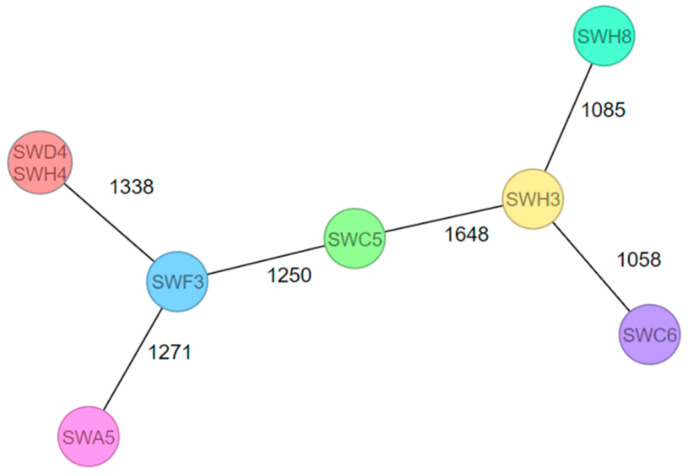
Reported cases of listeriosis from food of non-animal origin (FNAO) are increasing. In order to assess the risk of exposure to Listeria monocytogenes from FNAO, the genetic characterization of the pathogen in FNAO products and in primary production and processing plants needs to be investigated. For this, 123 samples of fresh and frozen soft fruit and 407 samples of 39 plants in Bavaria, Germany that produce and process FNAO were investigated for Listeria contamination. As a result, 64 Listeria spp. isolates were detected using ISO 11290-1:2017. Environmental swabs and water and food samples were investigated. L. seeligeri (36/64, 56.25%) was the most frequently identified species, followed by L. monocytogenes (8/64, 12.50%), L. innocua (8/64, 12.50%), L. ivanovii (6/64, 9.38%), L. newyorkensis (5/64, 7.81%), and L. grayi (1/64, 1.56%). Those isolates were subsequently sequenced by whole-genome sequencing and subjected to pangenome analysis to retrieve data on the genotype, serotype, antimicrobial resistance (AMR), and virulence markers. Eight out of sixty-four Listeria spp. isolates were identified as L. monocytogenes. The serogroup analysis detected that 62.5% of the L. monocytogenes isolates belonged to serogroup IIa (1/2a and 3a) and 37.5% to serogroup IVb (4b, 4d, and 4e). Furthermore, the MLST (multilocus sequence typing) analysis of the eight detected L. monocytogenes isolates identified seven different sequence types (STs) and clonal complexes (CCs), i.e., ST1/CC1, ST2/CC2, ST6/CC6, ST7/CC7, ST21/CC21, ST504/CC475, and ST1413/CC739. The core genome MLST analysis also showed high allelic differences and suggests plant-specific isolates. Regarding the AMR, we detected phenotypic resistance against benzylpenicillin, fosfomycin, and moxifloxacin in all eight L. monocytogenes isolates. Moreover, virulence factors, such as prfA, hly, plcA, plcB, hpt, actA, inlA, inlB, and mpl, were identified in pathogenic and nonpathogenic Listeria species. The significance of L. monocytogenes in FNAO is growing and should receive increasing levels of attention.
Keywords: Listeria monocytogenes; antimicrobial resistance; soft fruit; virulence factors; whole-genome sequencing.
Conflict of interest statement
The authors declare no conflict of interest.
Figures
References
-
- Newell D.G., Koopmans M., Verhoef L., Duizer E., Aidara-Kane A., Sprong H., Opsteegh M., Langelaar M., Threfall J., Scheutz F., et al. Food-borne diseases—The challenges of 20 years ago still persist while new ones continue to emerge. Int. J. Food Microbiol. 2010;139((Suppl. 1)):S3–S15. doi: 10.1016/j.ijfoodmicro.2010.01.021. - DOI - PMC - PubMed
-
- Centers for Disease Control and Prevention Multistate Outbreaks. [(accessed on 16 January 2023)]; Available online: https://www.cdc.gov/foodsafety/outbreaks/multistate-outbreaks/index.html.
-
- Montero D., Bodero M., Riveros G., Lapierre L., Gaggero A., Vidal R.M., Vidal M. Molecular epidemiology and genetic diversity of Listeria monocytogenes isolates from a wide variety of ready-to-eat foods and their relationship to clinical strains from listeriosis outbreaks in Chile. Front. Microbiol. 2015;6:384. doi: 10.3389/fmicb.2015.00384. - DOI - PMC - PubMed
-
- Centers for Disease Control and Prevention Multistate Outbreak of Listeriosis Linked to Whole Cantaloupes from Jensen Farms, Colorado (FINAL UPDATE) [(accessed on 16 January 2023)]; Available online: https://www.cdc.gov/listeria/outbreaks/cantaloupes-jensen-farms/index.html.
LinkOut - more resources
Full Text Sources
Miscellaneous
