. 2023 Mar 7;24(6):5082.
doi: 10.3390/ijms24065082.

LOX-1 Activation by oxLDL Induces AR and AR-V7 Expression via NF-κB and STAT3 Signaling Pathways Reducing Enzalutamide Cytotoxic Effects

Affiliations

LOX-1 Activation by oxLDL Induces AR and AR-V7 Expression via NF-κB and STAT3 Signaling Pathways Reducing Enzalutamide Cytotoxic Effects

Felix Duprat et al. Int J Mol Sci. .

Abstract

The oxidized low-density lipoprotein receptor 1 (LOX-1) is one of the most important receptors for modified LDLs, such as oxidated (oxLDL) and acetylated (acLDL) low-density lipoprotein. LOX-1 and oxLDL are fundamental in atherosclerosis, where oxLDL/LOX1 promotes ROS generation and NF-κB activation inducing the expression of IL-6, a STAT3 activator. Furthermore, LOX-1/oxLDL function has been associated with other diseases, such as obesity, hypertension, and cancer. In prostate cancer (CaP), LOX-1 overexpression is associated with advanced stages, and its activation by oxLDL induces an epithelial-mesenchymal transition, increasing angiogenesis and proliferation. Interestingly, enzalutamide-resistant CaP cells increase the uptake of acLDL. Enzalutamide is an androgen receptor (AR) antagonist for castration-resistant prostate cancer (CRPC) treatment, and a high percentage of patients develop a resistance to this drug. The decreased cytotoxicity is promoted in part by STAT3 and NF-κB activation that induces the secretion of the pro-inflammatory program and the expression of AR and its splicing variant AR-V7. Here, we demonstrate for the first time that oxLDL/LOX-1 increases ROS levels and activates NF-κB, inducing IL-6 secretion and the activation of STAT3 in CRPC cells. Furthermore, oxLDL/LOX1 increases AR and AR-V7 expression and decreases enzalutamide cytotoxicity in CRPC. Thus, our investigation suggests that new factors associated with cardiovascular pathologies, such as LOX-1/oxLDL, may also promote important signaling axes for the progression of CRPC and its resistance to drugs used for its treatment.

Keywords: LOX-1; castration-resistant prostate cancer; enzalutamide; oxLDL; prostate cancer.


Conflict of interest statement

The authors declare no conflict of interest.

Figures
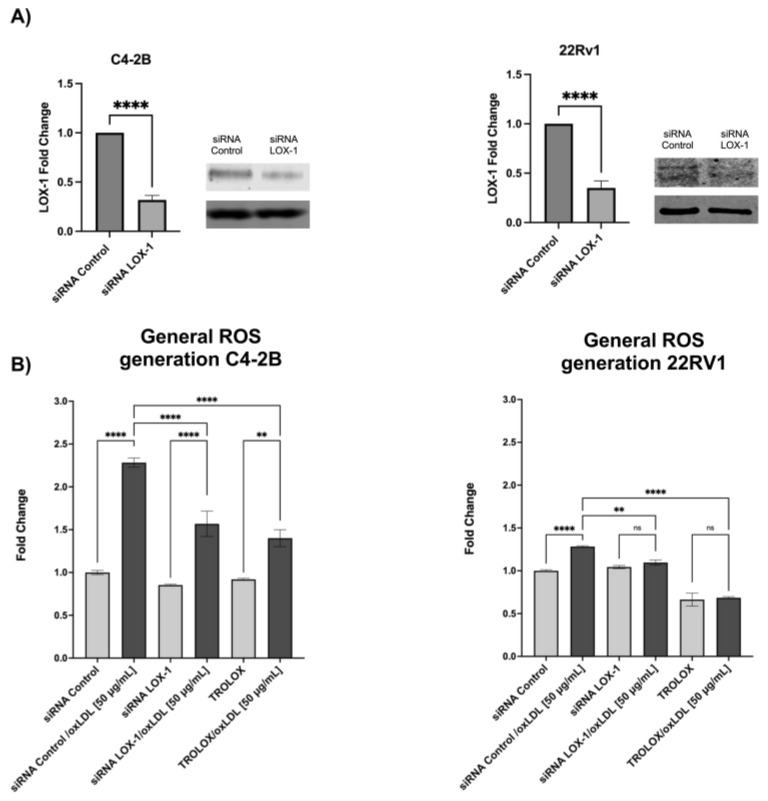
Figure 1
Figure 1
(A) Western blot of LOX-1 expression in CRPC cells, C4-2B and 22RV1 transfected with siRNA against LOX-1. To silence the LOX-1 RNA expression, C4-2B and 22RV1 prostate cancer cell lines were transfected with siRNA-LOX-1 or siRNA-control for 48 h, and the expression of LOX-1 was analyzed by Western blot. (B) OxLDL/LOX-1 induces ROS generation in castration-resistant prostate cancer cell models. C4-2B and 22Rv1 were transfected with a siRNA against LOX-1 or the control for 48 h or treated with 25 μM Trolox and then treated with 50 μg/mL oxLDL, and the ROS generation was analyzed 3 h post-treatment. The data represent the means ± S.D. of three independent experiments analyzed by one-way analysis of variance and Dunnett’s post-test or t-test for LOX-1 expression analysis (**** p ≤ 0.0001, ** p ≤ 0.01, ns: non-significant statistical difference).
Figure 2
Figure 2
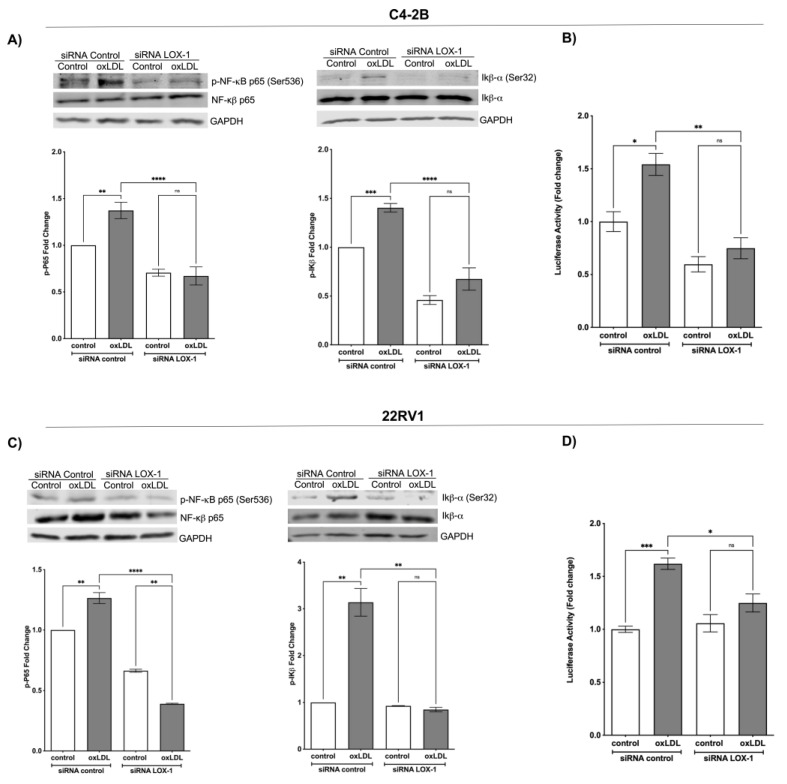
OxLDL/LOX-1 induces the activation of NF-κB in CRPC cell models. Western blot analysis of p-p65 and p-IκB-α in protein extracts of (A) C4-2B and (C) 22Rv1 cells transfected with siRNA against LOX-1 or control and treated with 50 μg/mL oxLDLs for 1 h. The NF-κB activity was analyzed using the reporter plasmid pHAGE NFKB-TA-LUC-UBC-dTomato-W in (B) C4-2B or (D) 22RV1 cells, co-transfected with siRNA control or siRNA LOX-1 and treated with 50 μg/mL oxLDLs for 24 h. The data represent the means ± S.D. of three independent experiments analyzed by one-way analysis of variance and Dunnett’s post-test (**** p ≤ 0.0001, *** p ≤ 0.001, ** p ≤ 0.01, * p ≤ 0.05, ns: non-significant statistical difference).
Figure 3
Figure 3
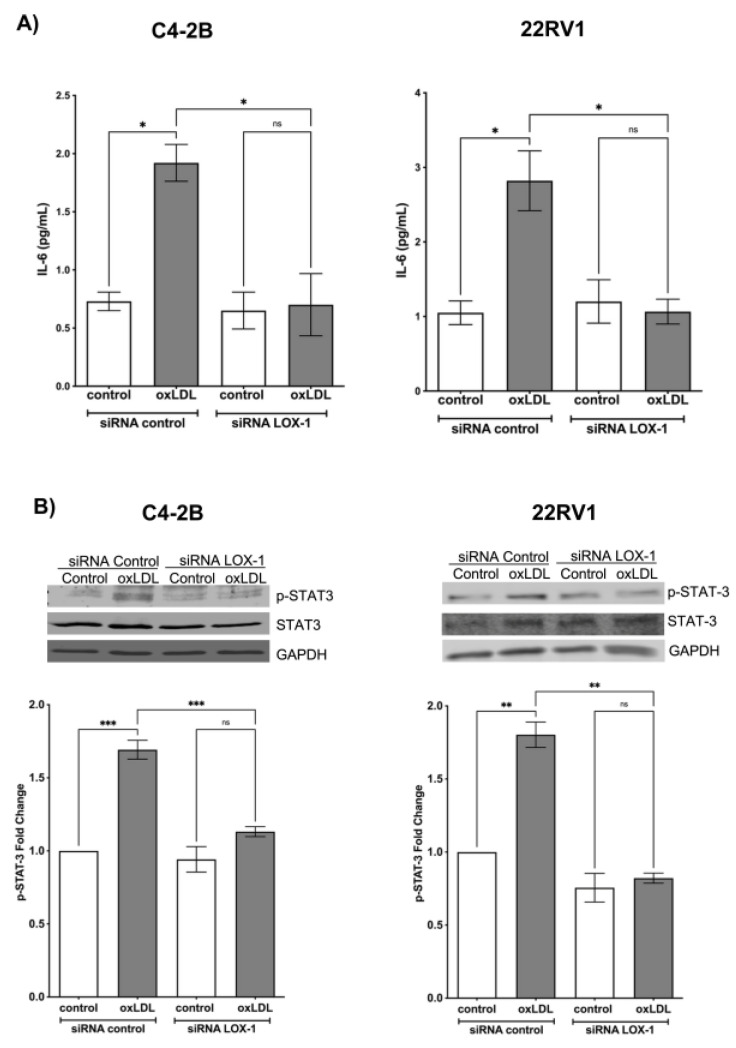
OxLDL/LOX-1 induces IL-6 secretion and STAT3 activation in CRPC cell models. (A) IL-6 ELISA assay from culture supernatants of C4-2B and 22Rv1 cells transfected with siRNA against LOX-1 or control and treated with 50 μg/mL oxLDLs for 24 h. (B) OxLDLs/LOX-1 induce the activation of STAT3 in CRPC cell models. Western blot analysis of p-STAT3 in protein extracts of C4-2B and 22Rv1 cells transfected with siRNA against LOX-1 or siRNA control treated with 50 μg/mL oxLDLs for 24 h. The data represent the means ± S.D. of three independent experiments analyzed by one-way analysis of variance and Dunnett’s post-test (*** p ≤ 0.001, ** p ≤ 0.01, * p ≤ 0.05, ns: non-significant statistical difference).
Figure 4
Figure 4
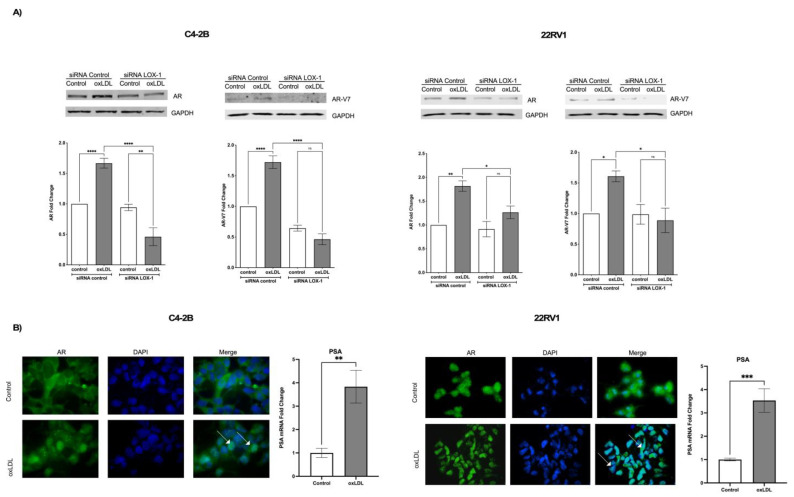
OxLDL/LOX-1 induces the expression of AR and AR-V7 on C4-2B and 22RV1 cells. (A) Western blot analysis of AR and AR-V7 in protein extracts of C4-2B and 22RV-1 cells transfected with siRNA against LOX-1 and treated with 50 μg/mL oxLDLs for 24 h. (B) OxLDL promotes AR nuclear translocation and PSA mRNA expression in C4-2B and 22RV1 cells. The white arrows indicate nuclear immunodetection of AR in oxLDL-treated C4-2B or 22RV1 cells. The data represent the means ± S.D. of three independent experiments analyzed by one-way analysis of variance and Dunnett’s post-test o t-test for PSA expression analysis (**** p ≤ 0.0001, *** p ≤ 0.001, ** p ≤ 0.01, * p ≤ 0.05, ns: non-significant statistical difference).
Figure 5
Figure 5
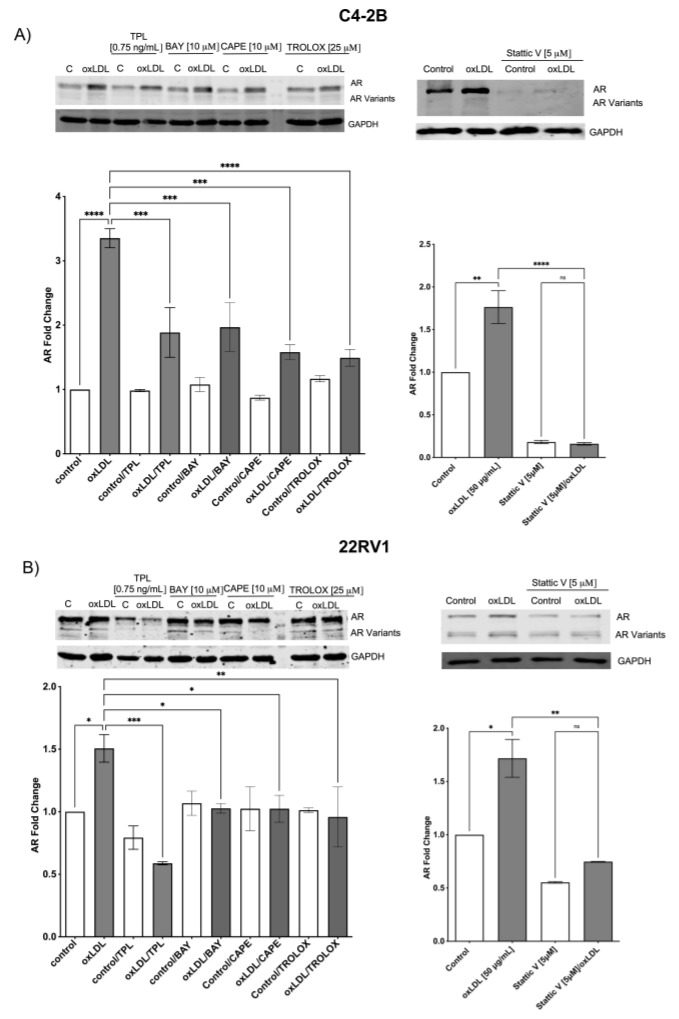
Inhibition of ROS generation, NF-κB, and STAT3 prevent oxLDL-induced AR expression. (A) C4-2B and (B) 22Rv1 cells were incubated with or without Trolox, triptolide (TLP), bay 11-7082 (BAY), caffeic acid phenethyl ester (CAPE), or Stattic (STAT3 inhibitor), then were treated with 50 μg/mL oxLDLs for 24 h and AR expression was evaluated by Western blot. The data represent the means ± S.D. of three independent experiments analyzed by one-way analysis of variance and Dunnett’s post-test (**** p ≤ 0.0001, *** p ≤ 0.001, ** p ≤ 0.01, * p ≤ 0.05, ns: non-significant statistical difference).
Figure 6
Figure 6
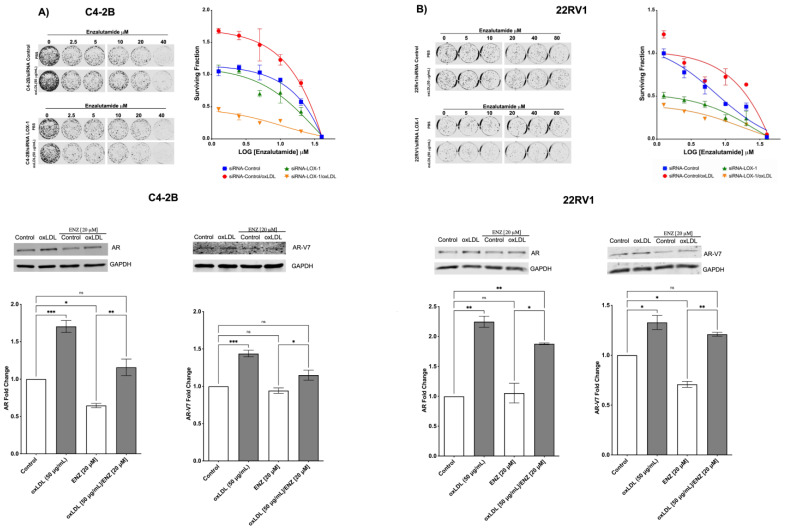
OxLDL/LOX-1 prevents the enzalutamide effects in CRPC cell lines. (A) clonogenic assay of C4-2B and 22Rv1 cells transfected with a siRNA against LOX-1 or siRNA control and co-treated with enzalutamide [0–40 μM] and oxLDL 50 μg/mL oxLDL. (B) oxLDL prevents the effects of enzalutamide on AR and AR-V7 expression in CRPC cell lines. Western blot analysis of AR and AR-V7 on C4-2B and 22Rv1 cells co-treated with enzalutamide [20 μM]/oxLDL [50 μg/mL]. The data represent the means ± S.D. of three independent experiments analyzed by one-way analysis of variance and Dunnett’s post-test. *** p ≤ 0.001, ** p ≤ 0.01, * p ≤ 0.05, ns: non-significant statistical difference).

References

    1. Hoover-Plow J., Huang M. Lipoprotein(a) metabolism: Potential sites for therapeutic targets. Metabolism. 2013;62:479–491. doi: 10.1016/j.metabol.2012.07.024. - DOI - PMC - PubMed
    1. Austin M.A., Hokanson J., Brunzell J.D. Characterization of low-density lipoprotein subclasses: Methodologic approaches and clinical relevance. Curr. Opin. Lipidol. 1994;5:395–403. doi: 10.1097/00041433-199412000-00002. - DOI - PubMed
    1. Elshourbagy N.A., Meyers H., Abdel-Meguid S. Cholesterol: The good; the bad, and the ugly—Therapeutic targets for the treatment of dyslipidemia. Med. Princ. Pract. 2014;23:99–111. doi: 10.1159/000356856. - DOI - PMC - PubMed
    1. Koba S., Dyslipidemia T.H., Rinsho N. Dyslipidemia and Atherosclerosis. Nihon Rinsho. 2011;69:138–143. - PubMed
    1. Linton M.R.F., Yancey P.G., Davies S.S., Jerome W.G., Linton E.F., Song W.L., Doran A.C., Vickers K.C. The Role of Lipids and Lipoproteins in Atherosclerosis. In: Feingold K.R., Anawalt B., Blackman M.R., editors. Endotext. Elsevier Health Sciences; South Dartmouth, MA, USA: 2000.

MeSH terms