Review
. 2023 Mar 9;24(6):5218.
doi: 10.3390/ijms24065218.

Biology and Regulation of Staphylococcal Biofilm

Affiliations
Review

Biology and Regulation of Staphylococcal Biofilm

Patrice François et al. Int J Mol Sci. .

Abstract

Despite continuing progress in medical and surgical procedures, staphylococci remain the major Gram-positive bacterial pathogens that cause a wide spectrum of diseases, especially in patients requiring the utilization of indwelling catheters and prosthetic devices implanted temporarily or for prolonged periods of time. Within the genus, if Staphylococcus aureus and S. epidermidis are prevalent species responsible for infections, several coagulase-negative species which are normal components of our microflora also constitute opportunistic pathogens that are able to infect patients. In such a clinical context, staphylococci producing biofilms show an increased resistance to antimicrobials and host immune defenses. Although the biochemical composition of the biofilm matrix has been extensively studied, the regulation of biofilm formation and the factors contributing to its stability and release are currently still being discovered. This review presents and discusses the composition and some regulation elements of biofilm development and describes its clinical importance. Finally, we summarize the numerous and various recent studies that address attempts to destroy an already-formed biofilm within the clinical context as a potential therapeutic strategy to avoid the removal of infected implant material, a critical event for patient convenience and health care costs.

Keywords: biofilm; foreign body; gene expression; metabolism; phenotype; regulation; resistance; staphylococci; tolerance.


Conflict of interest statement

The authors declare no conflict of interest.

Figures
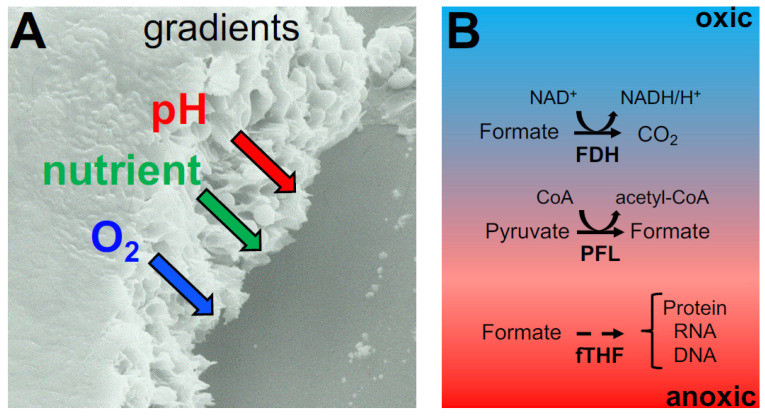
Figure 4
Figure 4
Biofilm matrix and metabolism. (A) Scanning electron microscopy (SEM), of S. epidermidis. The cells grown for 24 h on a cellulose acetate surface show closely packed bacterial cells embedded in a slimy matrix [125]. The cells are embedded in many layers in this biofilm. The bacterial cells multiply upwards from the adherent cells and are surrounded by a layer of mucus to create a multilayer coating (biofilm). The picture shows a cross-section of this biofilm. At the perfused surface, the pH is neutral and nutrients and oxygen are present. However, towards the layers below, the oxygen, nutrients, and pH decrease continuously, forming gradients. It can be assumed that the cells permanently adapt to the changed conditions and released metabolites. (B) Schematic representation of formate metabolism in S. aureus biofilms. In the anaerobic layers (red) of the mature biofilm, the PFL converts pyruvate to acetyl-CoA and formate. The latter can be used by strictly anaerobically grown cells for the synthesis of formyl-THF and therefore for the biosynthesis of proteins, DNA, and RNA. At the same time, formate accumulates and diffuses to microaerobic regions (light red). Here, it might be oxidized by the FDH under the production of NADH [127].
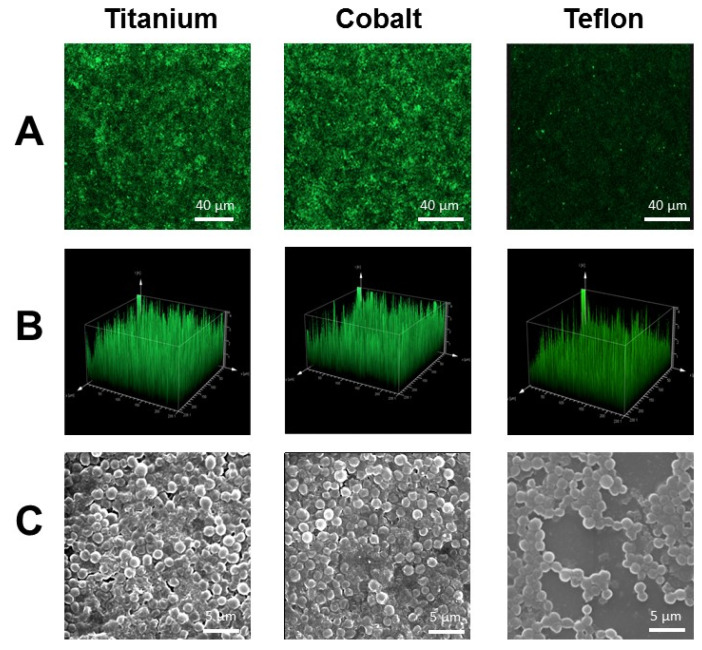
Figure 1
Figure 1
Biofilm formation of S. aureus (pCtuf-gfp) on glass slides coated with different biomaterials. (A) Confocal scanning laser micrographs of S. aureus (pCtuf-gfp) biofilm formation on glass slides coated with titanium, cobalt–chromium, and amorphous Teflon. (B) Three-dimensional view of the fluorescence emitted by S. aureus (pCtuf-gfp) in the biofilm. (C) Scanning electron micrographs (SEM) of the corresponding biofilms. S. aureus adheres very strongly to surfaces coated with titanium and cobalt–chromium, yielding thick biofilms, while adherence to Teflon was decreased and a less-dense biofilm was formed (modified according [21]).
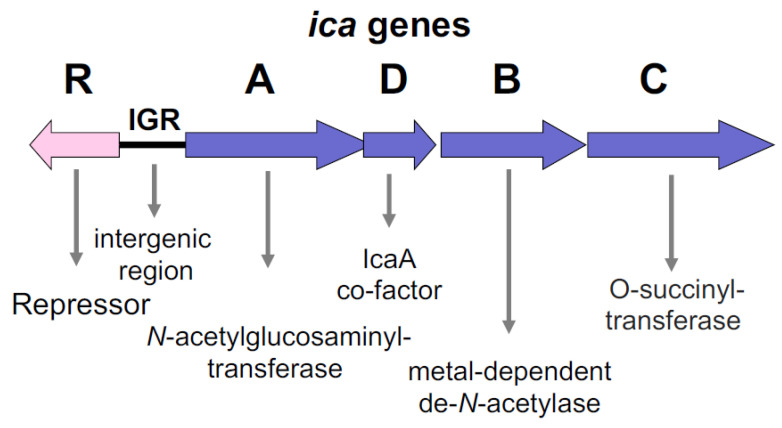
Figure 2
Figure 2
Organization and function of the ica gene cluster in staphylococci. The cluster is composed of the ica operon icaADBC and the repressor gene icaR, which is inversely oriented to icaA. The approximately 160–170 nt long intergenic region (IGR) carries the promoters for icaR and icaA and operator sites. The icaADBC operon encodes all enzymes necessary for PIA/dPNAG biosynthesis. IcaA is a cytoplasmic enzyme which has N-acetylglucosaminyltransferase activity using UDP-N-acetylglucosamine as a substrate; its activity is enhanced by IcaD, which acts as a co-enzyme. IcaB is a surface-attached poly-N-acetylglucosamine deacetylase responsible for deacetylation of approximately every fourth N-acetylglucosamine molecule; its activity is essential for biofilm function. IcaC is membrane-localized and demonstrates O-succinyltransferase activity in approximately 6% of the dPNAG, rendering PIA/dPNAG anionic. IcaC plays also a role in the elongation of oligo N-acetylglucosamines.
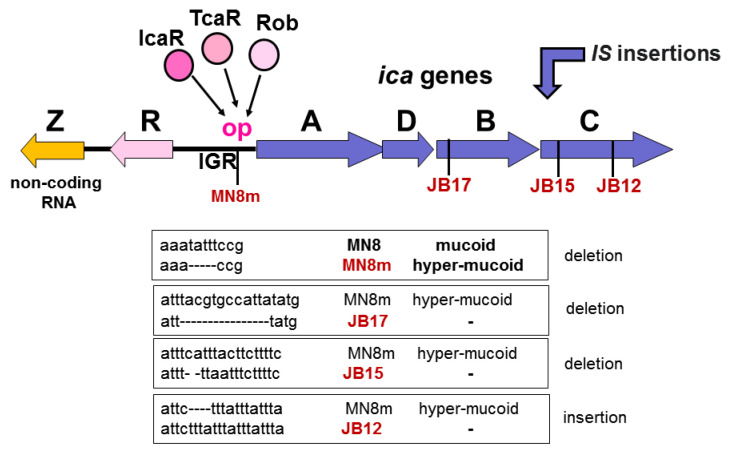
Figure 3
Figure 3
Phase variation of staphylococcal PIA/dPNAG expression. icaADBC expression is controlled at different levels. (1) Repressor binding: IcaR binds to the operator site (op) of the intergenic region (IGR) and thus prevents icaADBC transcription by blocking RNA polymerase binding. TcaR and Rob also appear to bind to IGR, but the exact binding needs to be verified. (2) Repetitive -TATT- motives cause deletions and insertions by slipped-strand mispairing during DNA replication. A 5 bp TATTT deletion in IGR affects binding of the repressor proteins (IcaR, TcaR, and Rob) causing overexpression of icaADBC. The same motive in icaB and icaC causes frameshift mutations by small deletions or insertions, leading to gene inactivation. (3) In S. epidermidis, there is downstream of the icaR gene, lacZ, that encodes a non-coding RNA which silences icaR expression, causing icaADBC activation. (4) Finally, insertion sequences (IS) can integrate in ica genes, causing inactivation of the corresponding gene.

References

    1. Costerton J.W., Lewandowski Z., DeBeer D., Caldwell D., Korber D., James G. Biofilms, the customized microniche. J. Bacteriol. 1994;176:2137–2142. doi: 10.1128/jb.176.8.2137-2142.1994. - DOI - PMC - PubMed
    1. Costerton J.W., Lewandowski Z., Caldwell D.E., Korber D.R., Lappin-Scott H.M. Microbial biofilms. Annu. Rev. Microbiol. 1995;49:711–745. doi: 10.1146/annurev.mi.49.100195.003431. - DOI - PubMed
    1. Costerton J.W., Stewart P.S., Greenberg E.P. Bacterial biofilms: A common cause of persistent infections. Science. 1999;284:1318–1322. doi: 10.1126/science.284.5418.1318. - DOI - PubMed
    1. Donlan R.M. Biofilm formation: A clinically relevant microbiological process. Clin. Infect. Dis. 2001;33:1387–1392. doi: 10.1086/322972. - DOI - PubMed
    1. Donlan R.M. Biofilms and device-associated infections. Emerg. Infect. Dis. 2001;7:277–281. doi: 10.3201/eid0702.010226. - DOI - PMC - PubMed

Substances

LinkOut - more resources