Review
. 2023 Mar 21;24(6):5926.
doi: 10.3390/ijms24065926.

Neuropharmacological Modulation of N-methyl-D-aspartate, Noradrenaline and Endocannabinoid Receptors in Fear Extinction Learning: Synaptic Transmission and Plasticity

Affiliations
Review

Neuropharmacological Modulation of N-methyl-D-aspartate, Noradrenaline and Endocannabinoid Receptors in Fear Extinction Learning: Synaptic Transmission and Plasticity

Simone Battaglia et al. Int J Mol Sci. .

Abstract

Learning to recognize and respond to potential threats is crucial for survival. Pavlovian threat conditioning represents a key paradigm for investigating the neurobiological mechanisms of fear learning. In this review, we address the role of specific neuropharmacological adjuvants that act on neurochemical synaptic transmission, as well as on brain plasticity processes implicated in fear memory. We focus on novel neuropharmacological manipulations targeting glutamatergic, noradrenergic, and endocannabinoid systems, and address how the modulation of these neurobiological systems affects fear extinction learning in humans. We show that the administration of N-methyl-D-aspartate (NMDA) agonists and modulation of the endocannabinoid system by fatty acid amide hydrolase (FAAH) inhibition can boost extinction learning through the stabilization and regulation of the receptor concentration. On the other hand, elevated noradrenaline levels dynamically modulate fear learning, hindering long-term extinction processes. These pharmacological interventions could provide novel targeted treatments and prevention strategies for fear-based and anxiety-related disorders.

Keywords: brain plasticity; enzyme fatty acid amide hydrolase (FAAH); fear extinction learning; fear learning; glutamatergic receptor N-methyl-D-aspartate (NMDA); neuropharmacology; noradrenaline (NA); synaptic receptors; threat learning.


Conflict of interest statement

The authors declare that the literature review research was conducted in the absence of any commercial or financial relationships that could be construed as a potential conflict of interest.

Figures
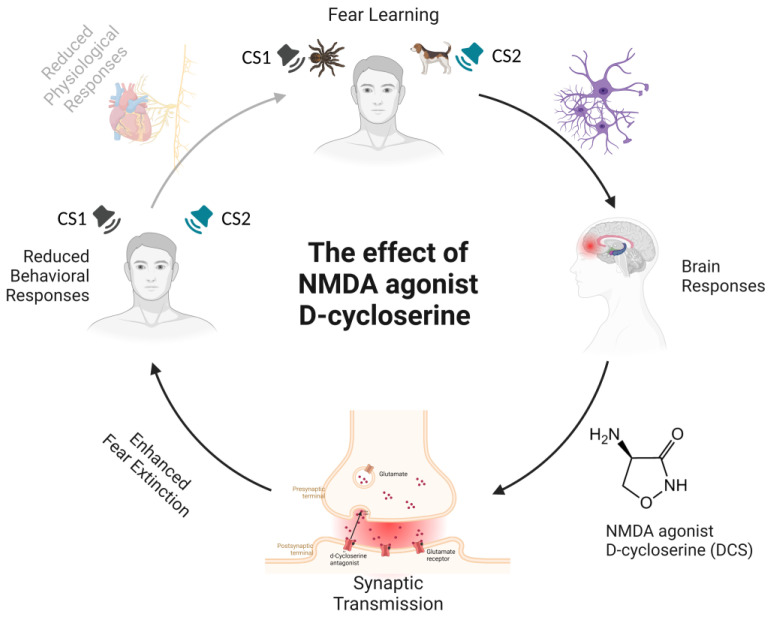
Figure 1
Figure 1
Schematic representation of the amelioration of N-methyl-D-aspartate (NMDA) receptor activity-related effects by the administration of agonist D-cycloserine (DCS) during fear extinction. During a fear-learning paradigm, a previously neutral stimulus (the conditioned stimulus) acquires emotional significance through pairing with an aversive stimulus. The aversive stimulus elicits a range of automatic, unconditioned fear responses, such as freezing and increased heart rate or blood pressure. After a few pairings, the presentation of the conditioned stimulus alone is capable of eliciting a conditioned fear response. The neural networks underlying fear learning mainly include the amygdala, prefrontal cortex, and hippocampus. Connections between these cortical and subcortical brain regions regulate the acquisition and extinction of fear. The activation of NMDA receptors—ionotropic channels that allow calcium ions into the cell—is necessary for long-term potentiation processes underlying fear learning. DCS, an NMDA partial antagonist, binds to one of the subunits of the NMDA receptor complex and changes its shape. The result is that glutamate opens up the channel and lets more calcium in, leading to boosted excitation by raising the glutamate levels in the interneurons. The specific effects of DCS in humans include enhanced fear extinction memory retention, expressed as attenuated conditioned responses during extinction recall on subjective (i.e., valence and arousal ratings) and physiological (SCR, BOLD response) levels. Notes. CS1 = Conditioned Stimulus 1; CS2 = Conditioned Stimulus 2; DCS = D-cycloserine; NMDA = N-methyl-D-aspartate.
Figure 2
Figure 2
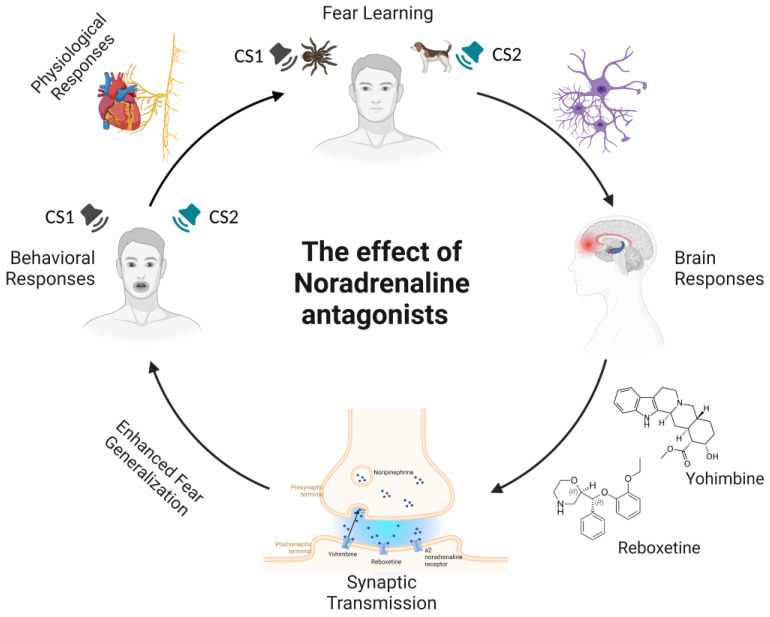
Schematic representation of noradrenergic modulation during fear learning by the administration of adrenergic antagonists. In fear-learning paradigms, following the pairing of a neutral stimulus with an innately aversive stimulus, conditioned fear responses develop after the presentation of the conditioned stimulus alone. Exposure to aversive events leads to the release of neurotransmitters, such as noradrenaline (NA). Specifically, NA is released from noradrenergic nerve terminals, where it diffuses across the synaptic cleft and activates adrenergic receptors to elicit a postsynaptic effect. Noradrenergic antagonists in presynaptic terminals act by decreasing the inhibitory influence of the α2-adrenoceptor on noradrenaline release. This causes the enhancement of fear memory and increased fear generalization, an active process that refers to an increased ability to discriminate between CS1 and CS2, leading to increased retrieval of fear memory and fear expression. Notes. CS1 = Conditioned stimulus 1; CS2 = Conditioned stimulus 2; NA = noradrenaline.
Figure 3
Figure 3
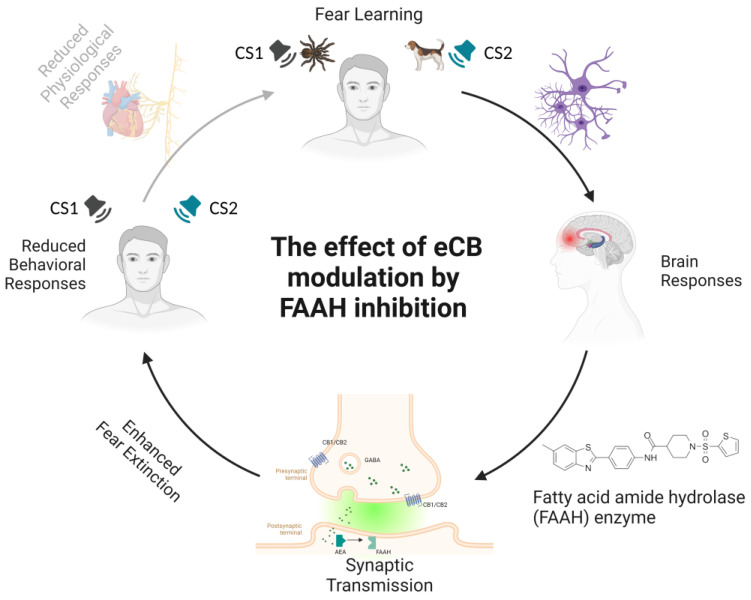
Schematic representation of the effects of anandamide (AEA) elevation on fear extinction learning. The acquisition of conditioned fear is achieved by presenting a stimulus paired with an aversive unconditioned event. As a result of this pairing, fear learning takes place, manifesting as the development of conditioned responses to the conditioned stimulus. The modulation of fear learning by the endocannabinoid (eCB) system occurs via cannabinoid receptor type 1 (CB1) signaling. The endocannabinoid transporter (ECT) mediates eCB synaptic re-uptake. The most important eCB, anandamide (AEA), acts as a low-efficacy agonist at CB1 receptors and is released after postsynaptic synthesis to retroactively bind to endocannabinoid receptors CB1 and CB2 at the presynaptic site. AEA is preferentially metabolized by fatty acid amide hydrolase (FAAH) into arachidonic acid and ethanolamine. Indeed, the inhibition of FAAH activity maintains AEA signaling during fear learning, favoring top-down cortical control of the amygdala and resulting in emotion regulation. Specific effects of the local inhibition of AEA in humans are reflected by an increased firing rate in prefrontal brain regions that facilitates prefrontal–amygdala connectivity through alterations in synaptic transmission. FAAH activity is expressed in enhanced fear extinction and selective attenuation of autonomic stress responses (i.e., reduced physiological and behavioral responses to fear stimuli). Notes. eCB = endocannabinoid system; FAAH = fatty acid amide hydrolase; CS1 = conditioned stimulus 1; CS2 = conditioned stimulus 2.

References

    1. Bouton M.E. Context and Behavioral Processes in Extinction. Learn. Mem. 2004;11:485–494. doi: 10.1101/lm.78804. - DOI - PubMed
    1. Bechara A., Damasio H., Damasio A.R., Lee G.P. Different Contributions of the Human Amygdala and Ventromedial Prefrontal Cortex to Decision-Making. J. Neurosci. 1999;19:5473–5481. doi: 10.1523/JNEUROSCI.19-13-05473.1999. - DOI - PMC - PubMed
    1. Lonsdorf T.B., Menz M.M., Andreatta M., Fullana M.A., Golkar A., Haaker J., Heitland I., Hermann A., Kuhn M., Kruse O., et al. Don’t Fear ‘Fear Conditioning’: Methodological Considerations for the Design and Analysis of Studies on Human Fear Acquisition, Extinction, and Return of Fear. Neurosci. Biobehav. Rev. 2017;77:247–285. doi: 10.1016/j.neubiorev.2017.02.026. - DOI - PubMed
    1. Maren S., Quirk G.J. Neuronal Signalling of Fear Memory. Nat. Rev. Neurosci. 2004;5:844–852. doi: 10.1038/nrn1535. - DOI - PubMed
    1. Quirk G.J., Mueller D. Neural Mechanisms of Extinction Learning and Retrieval. Neuropsychopharmacol. Off. Publ. Am. Coll. Neuropsychopharmacol. 2008;33:56–72. doi: 10.1038/sj.npp.1301555. - DOI - PMC - PubMed

LinkOut - more resources