


Low-Density sEMG-Based Pattern Recognition of Unrelated Movements Rejection for Wrist Joint Rehabilitation
- PMID: 36984962
- PMCID: PMC10056026
- DOI: 10.3390/mi14030555
Low-Density sEMG-Based Pattern Recognition of Unrelated Movements Rejection for Wrist Joint Rehabilitation
Abstract
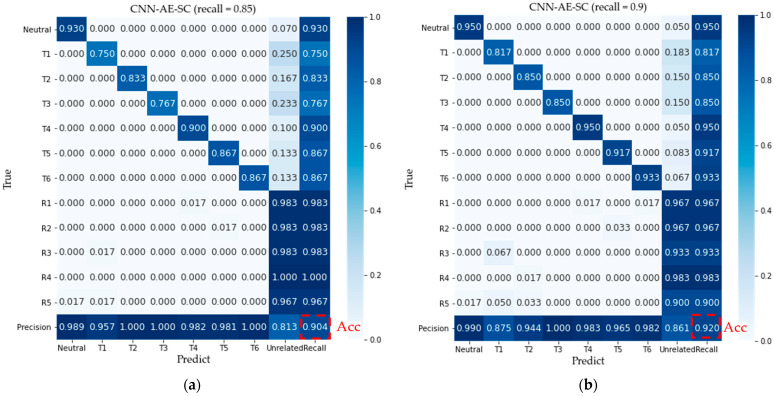
sEMG-based pattern recognition commonly assumes a limited number of target categories, and the classifiers often predict each target category depending on probability. In wrist rehabilitation training, the patients may make movements that do not belong to the target category unconsciously. However, most pattern recognition methods can only identify limited patterns and are prone to be disturbed by abnormal movement, especially for wrist joint movements. To address the above the problem, a sEMG-based rejection method for unrelated movements is proposed to identify wrist joint unrelated movements using center loss. In this paper, the sEMG signal collected by the Myo armband is used as the input of the sEMG control method. First, the sEMG signal is processed by sliding signal window and image coding. Then, the CNN with center loss and softmax loss is used to describe the spatial information from the sEMG image to extract discriminative features and target movement recognition. Finally, the deep spatial information is used to train the AE to reject unrelated movements based on the reconstruction loss. The results show that the proposed method can realize the target movements recognition and reject unrelated movements with an F-score of 93.4% and a rejection accuracy of 95% when the recall is 0.9, which reveals the effectiveness of the proposed method.
Keywords: autoencoder (AE); convolutional neural network (CNN); surface electromyography (sEMG); unrelated movements rejection; wrist joint rehabilitation training.
Conflict of interest statement
The authors declare no conflict of interest.
Figures




References
-
- Castiblanco J.C., Ortmann S., Mondragon I.F., Alvarado-Rojas C., Jöbges M., Colorado J.D. Myoelectric pattern recognition of hand motions for stroke rehabilitation. Biomed. Signal Process. Control. 2020;57:101737. doi: 10.1016/j.bspc.2019.101737. - DOI
-
- Yang Z., Guo S., Liu Y., Hirata H., Tamiya T. An intention-based online bilateral training system for upper limb motor rehabilitation. Microsyst. Technol. 2020;27:211–222. doi: 10.1007/s00542-020-04939-x. - DOI
-
- Gautam A., Panwar M., Biswas D., Acharyya A. MyoNet A Transfer-Learning-Based LRCN for Lower Limb Movement Recognition and Knee Joint Angle Prediction for Remote Monitoring of Rehabilitation Progress From sEMG. IEEE J. Transl. Eng. Health Med. 2020;8:1–10. doi: 10.1109/JTEHM.2020.2972523. - DOI - PMC - PubMed
LinkOut - more resources
Full Text Sources
