


Distribution and Prevalence of Anaplasmataceae, Rickettsiaceae and Coxiellaceae in African Ticks: A Systematic Review and Meta-Analysis
- PMID: 36985288
- PMCID: PMC10051480
- DOI: 10.3390/microorganisms11030714
Distribution and Prevalence of Anaplasmataceae, Rickettsiaceae and Coxiellaceae in African Ticks: A Systematic Review and Meta-Analysis
Abstract
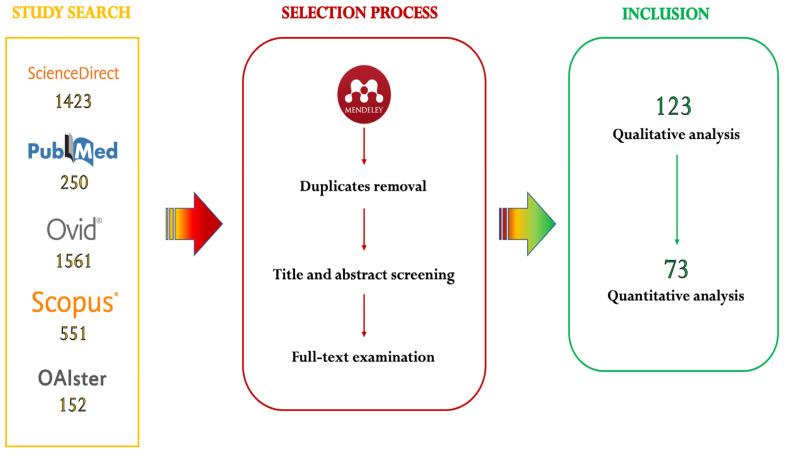
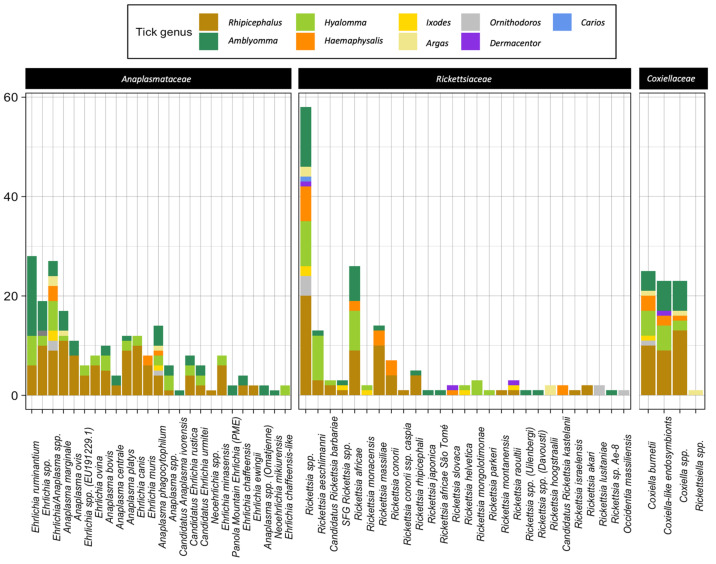
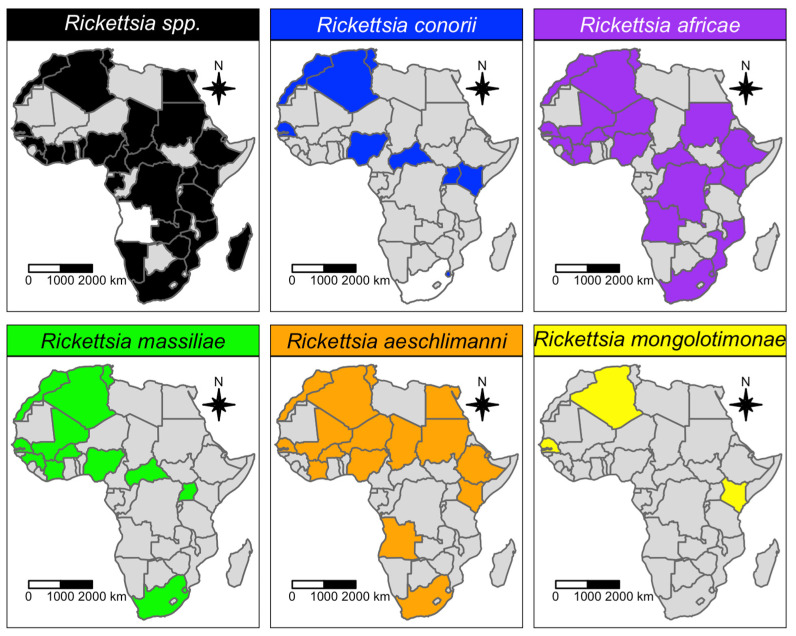
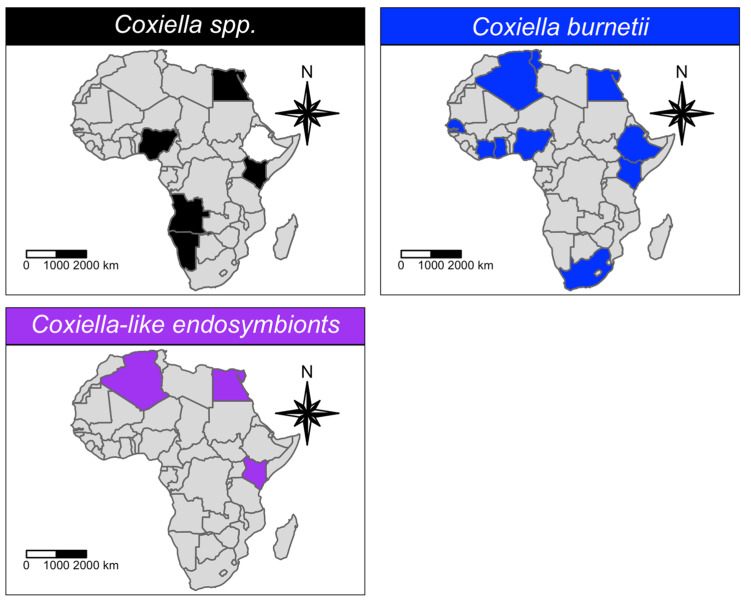
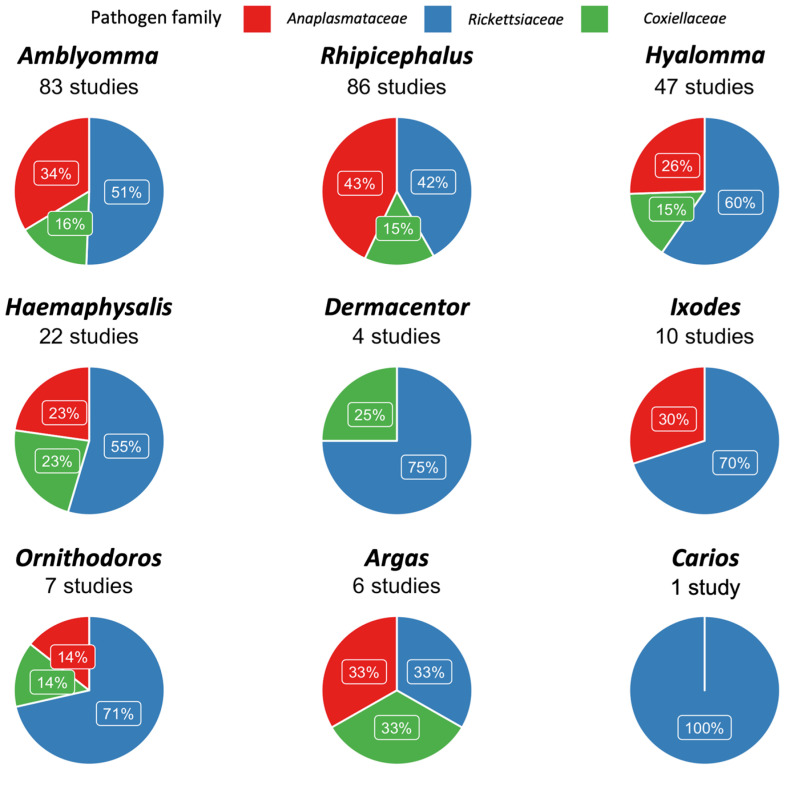
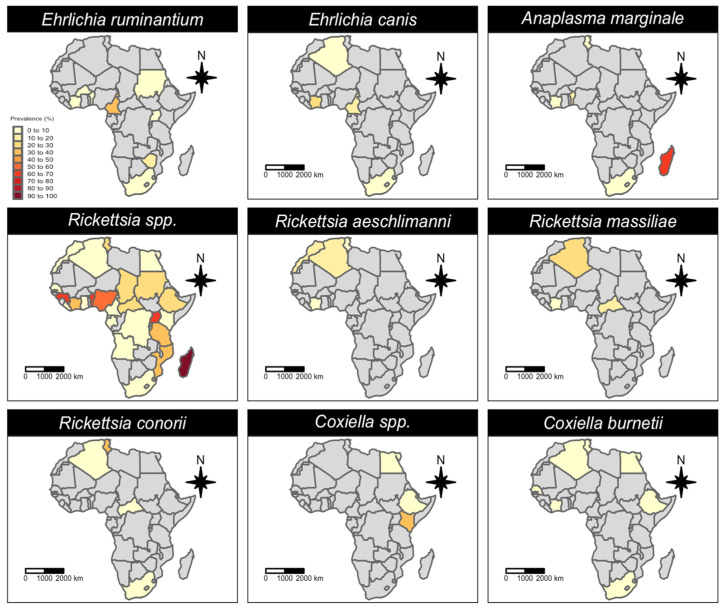
In Africa, ticks continue to be a major hindrance to the improvement of the livestock industry due to tick-borne pathogens that include Anaplasma, Ehrlichia, Rickettsia and Coxiella species. A systemic review and meta-analysis were conducted here and highlighted the distribution and prevalence of these tick-borne pathogens in African ticks. Relevant publications were searched in five electronic databases and selected using inclusion/exclusion criteria, resulting in 138 and 78 papers included in the qualitative and quantitative analysis, respectively. Most of the studies focused on Rickettsia africae (38 studies), followed by Ehrlichia ruminantium (27 studies), Coxiella burnetii (20 studies) and Anaplasma marginale (17 studies). A meta-analysis of proportions was performed using the random-effects model. The highest prevalence was obtained for Rickettsia spp. (18.39%; 95% CI: 14.23-22.85%), R. africae (13.47%; 95% CI: 2.76-28.69%), R. conorii (11.28%; 95% CI: 1.77-25.89%), A. marginale (12.75%; 95% CI: 4.06-24.35%), E. ruminantium (6.37%; 95% CI: 3.97-9.16%) and E. canis (4.3%; 95% CI: 0.04-12.66%). The prevalence of C. burnetii was low (0%; 95% CI: 0-0.25%), with higher prevalence for Coxiella spp. (27.02%; 95% CI: 10.83-46.03%) and Coxiella-like endosymbionts (70.47%; 95% CI: 27-99.82%). The effect of the tick genera, tick species, country and other variables were identified and highlighted the epidemiology of Rhipicephalus ticks in the heartwater; affinity of each Rickettsia species for different tick genera; dominant distribution of A. marginale, R. africae and Coxiella-like endosymbionts in ticks and a low distribution of C. burnetii in African hard ticks.
Keywords: Africa; Anaplasma; Coxiella; Ehrlichia; Rickettsia; tick-borne disease.
Conflict of interest statement
The authors declare no conflict of interest.
Figures

References
-
- Guglielmone A.A., Robbins R.G., Apanaskevich D.A., Petney T.N., Estrada-Peňa A., Horak I.G., Shao R., Barker S.C. The Argasidae, Ixodidae and Nuttalliellidae (Acari: Ixodida) of the world: A list of valid species names. Zootaxa. 2010;2528:1–28. doi: 10.11646/zootaxa.2528.1.1. - DOI
-
- Ackermann R., Gall C., Brayton K., Collins N., Van Wyk I., Wentzel J., Kolo A., Oosthuizen M.C. The bacterial microbiome of Rhipicephalus sanguineus ticks in the Mnisi community, South Africa; Proceedings of the 27th Conference of the World Association for the Advancement of Veterinary Parasitology (WAAVP2019); Madison, WI, USA. 7–11 July 2019.
Publication types
LinkOut - more resources
Full Text Sources
Miscellaneous
