Review
. 2023 Feb 26;12(3):379.
doi: 10.3390/pathogens12030379.

The Devastating Rice Blast Airborne Pathogen Magnaporthe oryzae-A Review on Genes Studied with Mutant Analysis

Affiliations
Review

The Devastating Rice Blast Airborne Pathogen Magnaporthe oryzae-A Review on Genes Studied with Mutant Analysis

Jinyi Tan et al. Pathogens. .

Abstract

Magnaporthe oryzae is one of the most devastating pathogenic fungi that affects a wide range of cereal plants, especially rice. Rice blast disease causes substantial economic losses around the globe. The M. oryzae genome was first sequenced at the beginning of this century and was recently updated with improved annotation and completeness. In this review, key molecular findings on the fungal development and pathogenicity mechanisms of M. oryzae are summarized, focusing on fully characterized genes based on mutant analysis. These include genes involved in the various biological processes of this pathogen, such as vegetative growth, conidia development, appressoria formation and penetration, and pathogenicity. In addition, our syntheses also highlight gaps in our current understanding of M. oryzae development and virulence. We hope this review will serve to improve a comprehensive understanding of M. oryzae and assist disease control strategy designs in the future.

Keywords: Magnaporthe oryzae; knockout; mutant analysis; plant fungal pathogen; rice blast.


Conflict of interest statement

The authors declare no conflict of interest.

Figures
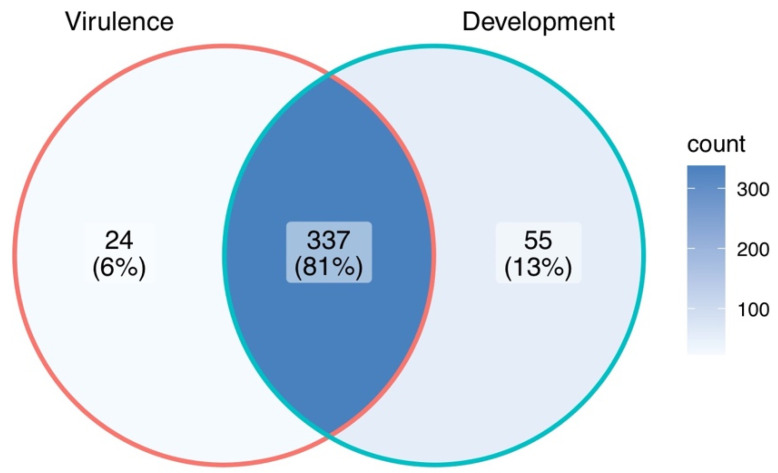
Figure 1
Figure 1
A Venn diagram summary of M. oryzae genes studied with mutant analysis (detailed in Supplementary Table S1).
Figure 2
Figure 2
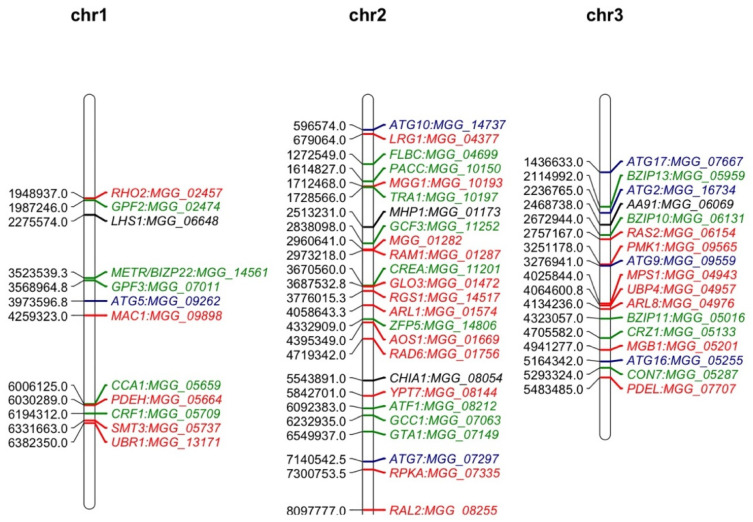
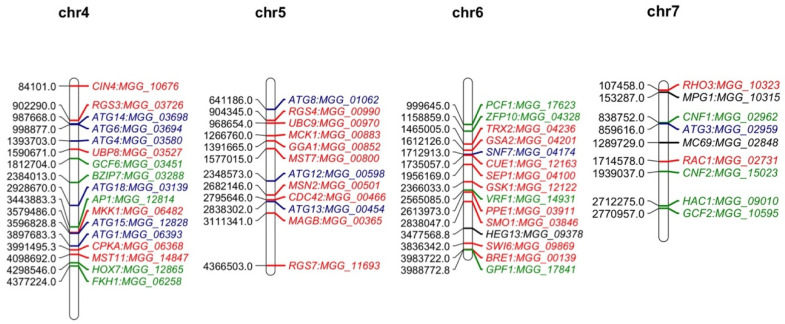
Map positions of important genes studied in the M. oryzae genome through mutant analysis. The numbers on the left of each chromosome represent the locations of these genes. Genes in this map contribute to both development and virulence of M. oryzae. Genes labeled in red are components in different important signaling pathways. Genes labeled in green are transcription factor-encoding genes. Genes labeled in blue are autophagy related while the ones in black are genes encoding effectors. The chromosomal map was drawn using ‘MapChart’ software using information from Supplementary Table S1.
Figure 2
Figure 2
Map positions of important genes studied in the M. oryzae genome through mutant analysis. The numbers on the left of each chromosome represent the locations of these genes. Genes in this map contribute to both development and virulence of M. oryzae. Genes labeled in red are components in different important signaling pathways. Genes labeled in green are transcription factor-encoding genes. Genes labeled in blue are autophagy related while the ones in black are genes encoding effectors. The chromosomal map was drawn using ‘MapChart’ software using information from Supplementary Table S1.
Figure 3
Figure 3
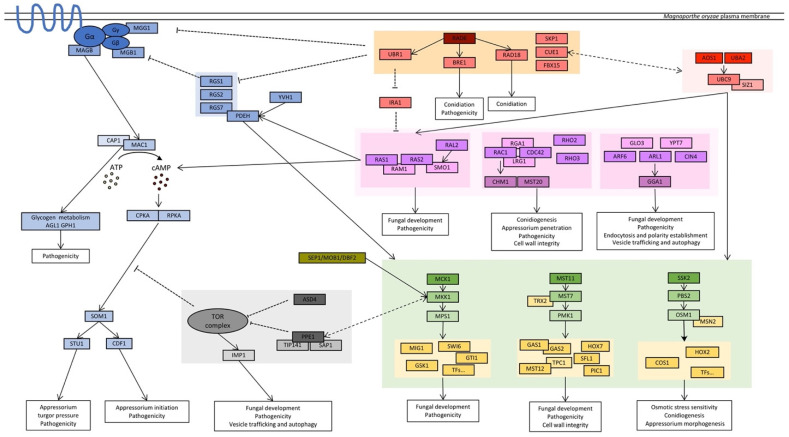
Important signaling pathways in M. oryzae that are discussed in this review. G proteins and cAMP/PKA signaling pathways are colored blue. MAPK cascades are colored green. Monomeric GTPase modules (Ras superfamily) are colored pink. Target of Rapamycin (TOR) signaling pathway is colored grey. Ubiquitination pathways are colored orange.

References

    1. Fairbrothers D.E. An annotated bibliography of the floristic publications of New Jersey from 1753–1961. Bull. Torrey Bot. Club. 1964;91:47–56. doi: 10.2307/2483614. - DOI
    1. Rossman A.Y., Howard R.J., Valent B. Pyricularia grisea, the Correct Name for the Rice Blast Disease Fungus. Mycologia. 1990;82:509–512. doi: 10.1080/00275514.1990.12025916. - DOI
    1. Couch B.C., Kohn L.M. A multilocus gene genealogy concordant with host preference indicates segregation of a new species, Magnaporthe oryzae, from M. grisea. Mycologia. 2002;94:683–693. doi: 10.1080/15572536.2003.11833196. - DOI - PubMed
    1. TeBeest D.O., Guerber C., Ditmore M. Rice Blast. [(accessed on 15 January 2023)]. Available online: https://www.apsnet.org/edcenter/disandpath/fungalasco/pdlessons/Pages/Ri....
    1. Meng Q., Gupta R., Min C.W., Kwon S.W., Wang Y., Je B.I., Kim Y.J., Jeon J.S., Agrawal G.K., Rakwal R., et al. Proteomics of Rice—Magnaporthe oryzae interaction: What have we learned so far? Front. Plant Sci. 2019;10:1383. doi: 10.3389/fpls.2019.01383. - DOI - PMC - PubMed