Review
. 2023 Mar 5;15(3):846.
doi: 10.3390/pharmaceutics15030846.

Lentiviral Vectors as a Vaccine Platform against Infectious Diseases

Affiliations
Review

Lentiviral Vectors as a Vaccine Platform against Infectious Diseases

Kirill Nemirov et al. Pharmaceutics. .

Abstract

Lentiviral vectors are among the most effective viral vectors for vaccination. In clear contrast to the reference adenoviral vectors, lentiviral vectors have a high potential for transducing dendritic cells in vivo. Within these cells, which are the most efficient at activating naive T cells, lentiviral vectors induce endogenous expression of transgenic antigens that directly access antigen presentation pathways without the need for external antigen capture or cross-presentation. Lentiviral vectors induce strong, robust, and long-lasting humoral, CD8+ T-cell immunity and effective protection against several infectious diseases. There is no pre-existing immunity to lentiviral vectors in the human population and the very low pro-inflammatory properties of these vectors pave the way for their use in mucosal vaccination. In this review, we have mainly summarized the immunological aspects of lentiviral vectors, their recent optimization to induce CD4+ T cells, and our recent data on lentiviral vector-based vaccination in preclinical models, including prophylaxis against flaviviruses, SARS-CoV-2, and Mycobacterium tuberculosis.

Keywords: T-cell vaccines; antigen presentation; inflammation; lentiviral vaccine vectors; major histocompatibility complex; pre-existing anti-vector immunity; tropism for dendritic cells.


Conflict of interest statement

P.C. is the founder and CSO of TheraVectys. LM is a consultant for TheraVectys. KN and FA are employees of TheraVectys. MB and YW declare no competing interest.

Figures
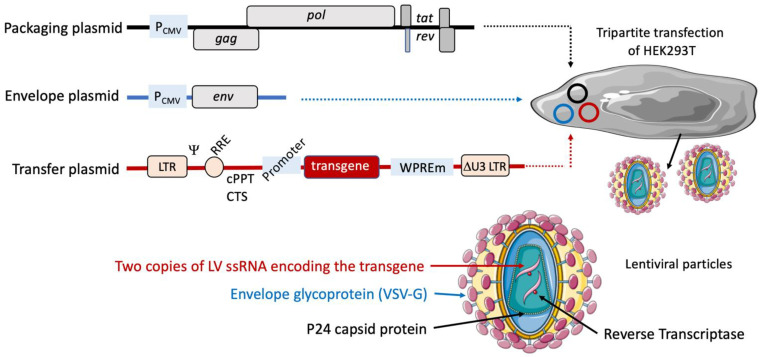
Figure 1
Figure 1
Lentiviral plasmids and the principle of production of lentiviral vectors. The genetic information necessary for the production of LVs is distributed over at least three distinct plasmids. The packaging plasmid contains gag, pol, tat, and rev genes. The envelope plasmid encodes VSV-G. These elements are under the transcriptional control of the cytomegalovirus promoter (PCMV). The transfer plasmid contains the Ψ packaging signal, RRE, and cPPT/CTS cis-acting elements upstream of the transgene of vaccinal interest under an internal promoter of choice. At its 3′ untranslated region, this plasmid also harbors the mutated WPRE sequence (WPREm), which enhances transgenic antigen expression. In the transfer plasmid, these genes are flanked by two LTRs. LV particles are generated by the tripartite transfection of the HEK293T cell line with the three plasmids. The LV particles are harvested in the culture supernatants at day 3 post-transfection.
Figure 2
Figure 2
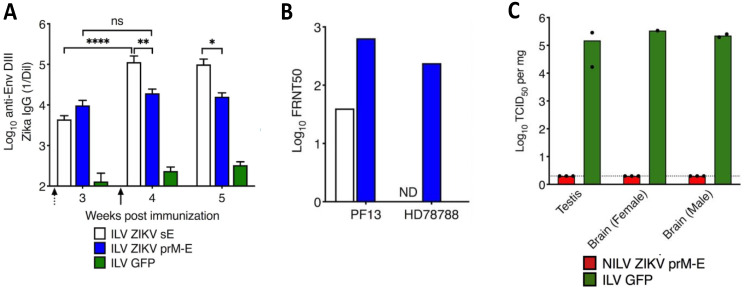
The humoral response induced by LV prM-E vaccine candidate fully protects from lethal ZIKV challenge. C57BL/6 mice were injected i.p. with integrative LV (ILV) ZIKV sE, LV ZIKV prM-E, or LV GFP, as a negative control. (A) IgG antibody titers specific to EDIII (a target of protective neutralizing mAbs against ZIKV) were determined by ELISA after priming (dotted arrow) and boosting (black arrow) with the respective LV vaccine candidates(ns = not significant, * p > 0.05, ** p > 0.01, **** p > 0.0001, Mann-Whitney test). (B) Serum neutralizing (Focus Reduction Neutralization Test with 50% neutralization cutoff, FRNT50) titers against PF13 and HD78788 ZIKV strains at 4 weeks postimmunization. (C) Female or male IFNα/βR°/° A129 mice were immunized with a single dose of non-integrative (NILV) ZIKV prM-E or ILV GFP. Immunized mice were challenged at 4 weeks post-immunization with ZIKV HD78788strain. Viral loads in testis and brain quantified 28 days post-challenge using a TCID50 (Median Tissue Culture Infectious Dose) assay. Each dot represents one mouse. Adapted from [93].
Figure 3
Figure 3
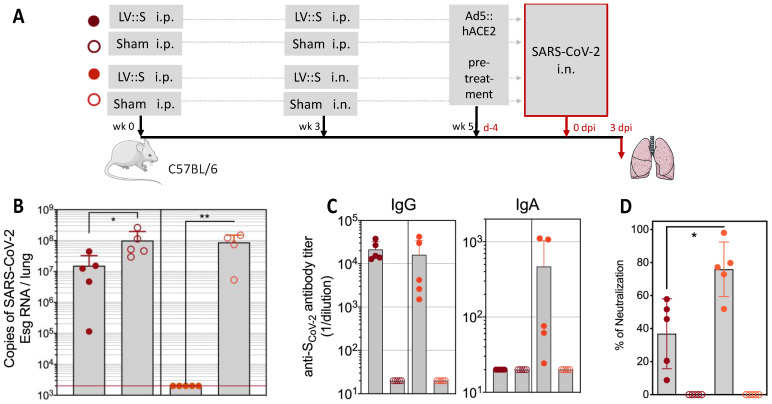
An intranasal boost with LV::S fully protects against SARS-CoV-2 replication. (A) Timeline of prime (i.p.) and boost (i.p. or i.n.) with LV::S in C57BL/6 mice, followed by pretreatment with an Ad5::hACE2 vector encoding the human ACE2 receptor four days before an i.n. challenge with SARS-CoV-2. The control LV vector encodes an irrelevant antigen (sham). (B) Pulmonary viral content determined at three days post infection (dpi) by qRT-PCR specific for a subgenomic RNA (Esg) expressed only by replicating SARS-CoV-2. The red line indicates the limit of detection. (C) Titers of IgG and IgA antibodies specific for SARS-CoV-2 spike antigen, determined by ELISA, in lung homogenates. (D) Anti-SARS-CoV-2 antibody neutralizing activity detected in lung homogenates using spike-bearing pseudoviral particles. Statistical significance of the differences was determined by the Mann-Whitney U test (* p < 0.02, ** p < 0.01). Adapted from [34] ).
Figure 4
Figure 4
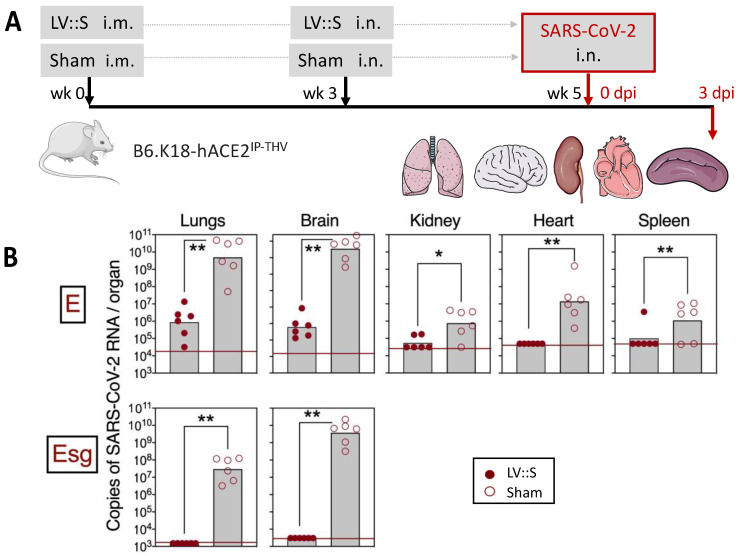
Vaccination with LV::S protects both the lungs and brain against SARS-CoV-2 infection in highly susceptible B6.K18-hACE2IP-THV transgenic mice. (A) Timeline of the prime (i.m.)-boost (i.n.) with LV::S and SARS-CoV-2 challenge in B6.K18-hACE2IP-THV transgenic mice. (B) Viral RNA content, determined in various organs at 3 dpi by a conventional E-specific or a sub-genomic Esg-specific qRT-PCR. Red lines indicate the detection limits (* p > 0.05, ** p > 0.01, Mann-Whitney test). Adapted from [33].
Figure 5
Figure 5
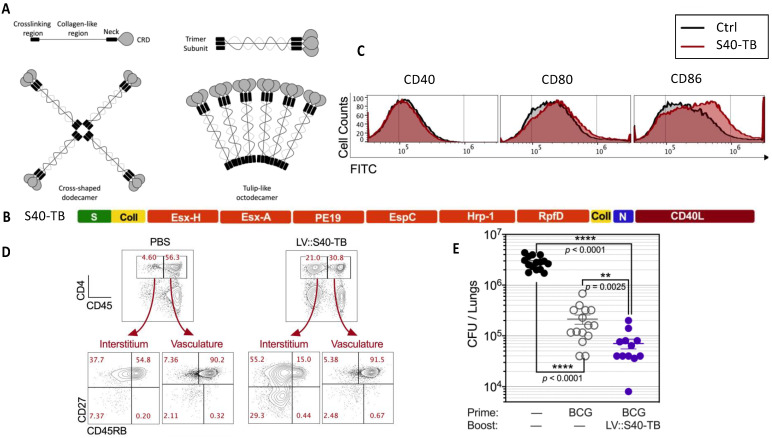
Collectin-based antigen carriers as encoded by LVs and their immunogenicity and protective potential against M. tuberculosis.(A) Structure of collectin monomers and polymers. CRD = carbohydrate-recognition domain. Self-assembled triple helixes can multimerize to form cross-shaped dodecamers or “tulip bouquet-like” octodecamers. Adapted from [119]. (B) Representation of the primary structure of the engineered surfactant D, harboring mycobacterial antigens and substituted within its CRD domain by the ectodomain of CD40L. S = crosslinking region, Coll = collagen-like region, N = neck region. (C) Phenotypic maturation of murine bone-marrow-derived DCs, untreated or incubated overnight with supernatants from HEK-293T cells transduced with a control LV or LV::S40-TB. Expression of co-stimulatory molecules on the surface of DCs, as assessed by cytometry. (D) Mucosal CD4+ T cells induced by i.n. immunization of mice with LV::S40-TB at 14 days post-immunization. Lung CD4+ T cells were distinguished by their location in the interstitium (CD45i.v) or vasculature (CD45i.v+) subsequent to i.v. injection of PE-anti-CD45 mAb, 3 min before sacrifice, which allowed determination of the CD27 vs. CD45RB profile of CD4+ T cells in the lung parenchyma and vasculature. (E) Evaluation of the booster effect of LV::S40-TB in the protection against M. tuberculosis. C57BL/6 mice were unvaccinated, vaccinated with BCG alone (s.c., week 0) or BCG-primed (s.c., week 0) and LV::S40-TB-boosted (s.c., week 5 and i.n., week 10) and challenged with the virulent M. tuberculosis H37Rv strain (i.n., week 12). Lung mycobacterial loads were determined in week 17. The significance of the differences was determined using the Mann-Whitney U test. Ns = not significant. Adapted from [8].

References

    1. Charneau P., Alizon M., Clavel F. A second origin of DNA plus-strand synthesis is required for optimal human immunodeficiency virus replication. J. Virol. 1992;66:2814–2820. doi: 10.1128/jvi.66.5.2814-2820.1992. - DOI - PMC - PubMed
    1. Charneau P., Mirambeau G., Roux P., Paulous S., Buc H., Clavel F. HIV-1 reverse transcription. A termination step at the center of the genome. J. Mol. Biol. 1994;241:651–662. doi: 10.1006/jmbi.1994.1542. - DOI - PubMed
    1. Dragic T., Charneau P., Clavel F., Alizon M. Complementation of murine cells for human immunodeficiency virus envelope/CD4-mediated fusion in human/murine heterokaryons. J. Virol. 1992;66:4794–4802. doi: 10.1128/jvi.66.8.4794-4802.1992. - DOI - PMC - PubMed
    1. Ku M.W., Charneau P., Majlessi L. Use of lentiviral vectors in vaccination. Expert Rev. Vaccines. 2021;20:1571–1586. doi: 10.1080/14760584.2021.1988854. - DOI - PubMed
    1. Liu L., Chavan R., Feinberg M.B. Dendritic cells are preferentially targeted among hematolymphocytes by Modified Vaccinia Virus Ankara and play a key role in the induction of virus-specific T cell responses in vivo. BMC Immunol. 2008;9:15. doi: 10.1186/1471-2172-9-15. - DOI - PMC - PubMed