


Relationship between Total Antioxidant Capacity, Cannabinoids and Terpenoids in Hops and Cannabis
- PMID: 36986914
- PMCID: PMC10056619
- DOI: 10.3390/plants12061225
Relationship between Total Antioxidant Capacity, Cannabinoids and Terpenoids in Hops and Cannabis
Abstract
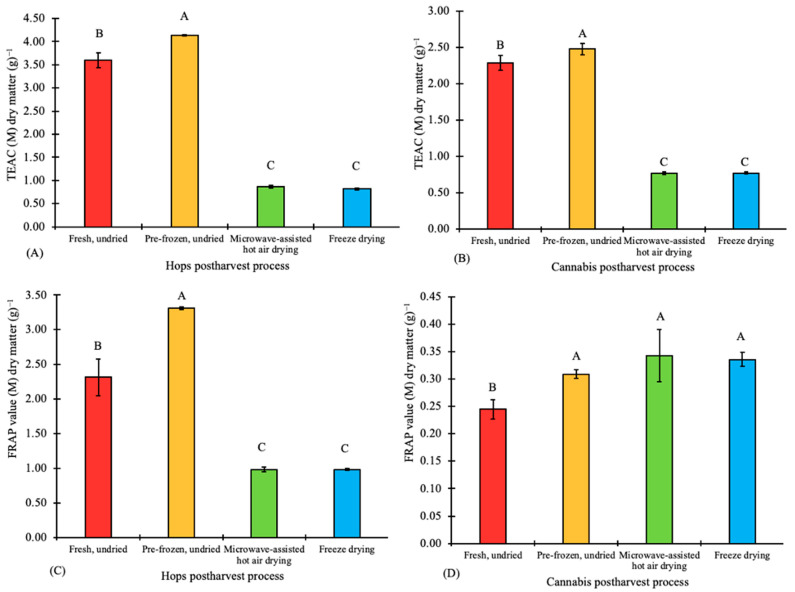
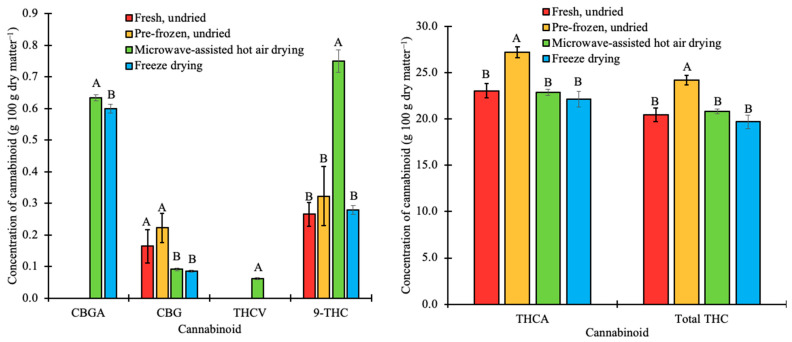
Efficient determination of antioxidant activity in medicinal plants may provide added value to extracts. The effects of postharvest pre-freezing and drying [microwave-assisted hot air (MAHD) and freeze drying] on hops and cannabis were evaluated to determine the relationship between antioxidant activity and secondary metabolites. The 2,2-diphenyl-1-picrylhydrazine (DPPH) reduction and ferric reducing ability of power (FRAP) assays were assessed for suitability in estimating the antioxidant activity of extracted hops and cannabis inflorescences and correlation with cannabinoid and terpene content. Antioxidant activity in extracts obtained from fresh, undried samples amounted to 3.6 Trolox equivalent antioxidant activity (TEAC) (M) dry matter-1 and 2.32 FRAP (M) dry matter-1 for hops, in addition to 2.29 TEAC (M) dry matter-1 and 0.25 FRAP (M) dry matter-1 for cannabis. Pre-freezing significantly increased antioxidant values by 13% (DPPH) and 29.9% (FRAP) for hops, and by 7.7% (DPPH) and 19.4% (FRAP) for cannabis. ANOVA analyses showed a significant (p < 0.05) increase in total THC (24.2) and THCA (27.2) concentrations (g 100 g dry matter-1) in pre-frozen, undried samples compared to fresh, undried samples. Freeze-drying and MAHD significantly (p < 0.05) reduced antioxidant activity in hops by 79% and 80.2% [DPPH], respectively and 70.1% and 70.4% [FRAP], respectively, when compared to antioxidant activity in extracts obtained from pre-frozen, undried hops. DPPH assay showed that both freeze-drying and MAHD significantly (p < 0.05) reduced the antioxidant activity of cannabis by 60.5% compared to the pre-frozen samples although, there was no significant (p < 0.05) reduction in the antioxidant activity using the FRAP method. Greater THC content was measured in MAHD-samples when compared to fresh, undried (64.7%) and pre-frozen, undried (57%), likely because of decarboxylation. Both drying systems showed a significant loss in total terpene concentration, yet freeze-drying has a higher metabolite retention compared to MAHD. These results may prove useful for future experiments investigating antioxidant activity and added value to cannabis and hops.
Keywords: Cannabis sativa; DPPH; FRAP; Humulus lupulus; antioxidants; drying.
Conflict of interest statement
The authors declare no conflict of interest.
Figures
References
-
- Ren M., Tang Z., Wu X., Spengler R., Jiang H., Yang Y., Boivin N. The origins of cannabis smoking: Chemical residue evidence from the first millennium BCE in the Pamirs. [(accessed on 22 December 2022)];Sci. Adv. 2019 5:eaaw1391. doi: 10.1126/sciadv.aaw1391. Available online: http://advances.sciencemag.org/content/5/6/eaaw1391. - DOI - PMC - PubMed
-
- Gabriel L.M., Méndez Rodríguez D., Hendrix S., Escalona Arranz J.C., Fung Boix Y., Pacheco A.O., García Díaz J., Morris-Quevedo H.J., Ferrer Dubois A., Aleman E.I. Antioxidants in plants: A valorization potential emphasizing the need for the conservation of plant biodiversity in Cuba. Antioxidants. 2020;9:48. doi: 10.3390/antiox9111048. - DOI - PMC - PubMed
Grants and funding
LinkOut - more resources
Full Text Sources
Miscellaneous
