. 2023 Mar 14;12(6):1310.
doi: 10.3390/plants12061310.

Identification and Characterization of Common Bean (Phaseolus vulgaris) Non-Nodulating Mutants Altered in Rhizobial Infection

Affiliations

Identification and Characterization of Common Bean (Phaseolus vulgaris) Non-Nodulating Mutants Altered in Rhizobial Infection

Rocío Reyero-Saavedra et al. Plants (Basel). .

Abstract

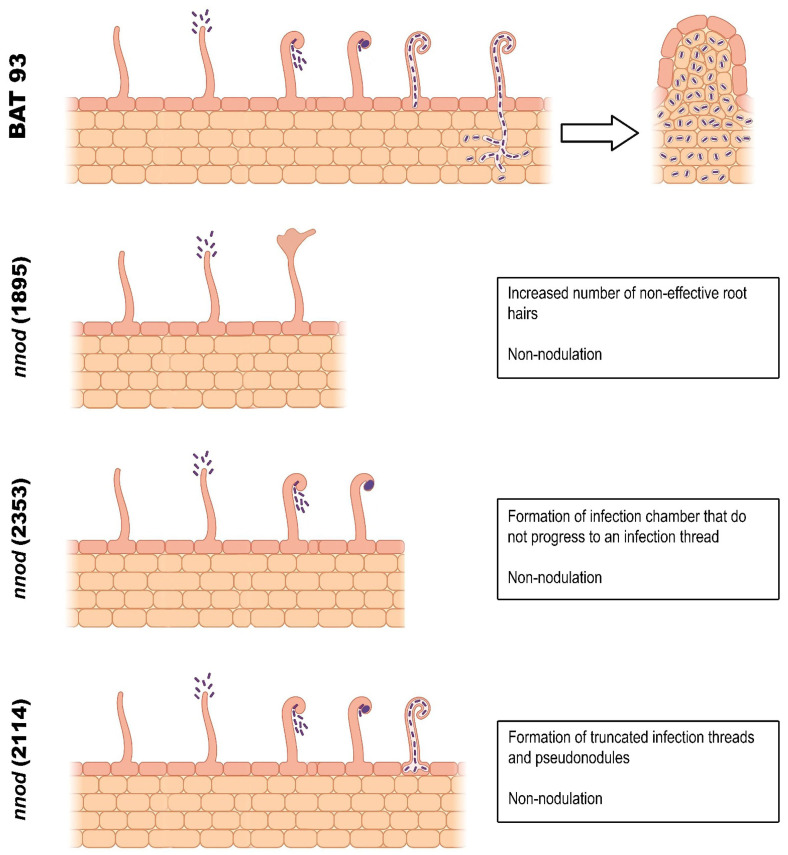
The symbiotic N2-fixation process in the legume-rhizobia interaction is relevant for sustainable agriculture. The characterization of symbiotic mutants, mainly in model legumes, has been instrumental for the discovery of symbiotic genes, but similar studies in crop legumes are scant. To isolate and characterize common bean (Phaseolus vulgaris) symbiotic mutants, an ethyl methanesulphonate-induced mutant population from the BAT 93 genotype was analyzed. Our initial screening of Rhizobium etli CE3-inoculated mutant plants revealed different alterations in nodulation. We proceeded with the characterization of three non-nodulating (nnod), apparently monogenic/recessive mutants: nnod(1895), nnod(2353) and nnod(2114). Their reduced growth in a symbiotic condition was restored when the nitrate was added. A similar nnod phenotype was observed upon inoculation with other efficient rhizobia species. A microscopic analysis revealed a different impairment for each mutant in an early symbiotic step. nnod(1895) formed decreased root hair curling but had increased non-effective root hair deformation and no rhizobia infection. nnod(2353) produced normal root hair curling and rhizobia entrapment to form infection chambers, but the development of the latter was blocked. nnod(2114) formed infection threads that did not elongate and thus did not reach the root cortex level; it occasionally formed non-infected pseudo-nodules. The current research is aimed at mapping the responsible mutated gene for a better understanding of SNF in this critical food crop.

Keywords: EMS; Phaseolus vulgaris; infection; nodulation; rhizobia; symbiosis.


Conflict of interest statement

The authors declare no conflict of interest.

Figures

Figure 1
Figure 1
Phenotype of the Phaseolus vulgaris non-nodulating mutants: nnod(1895), nnod(2353) and nnod(2114). (A) Representative plants of wild type (WT) BAT 93 (left) and each of the non-nodulating (nnod) mutants (right), after 25 days post-inoculation (dpi) with Rhizobium etli CE3. (B) Growth, calculated as fresh weight (g), of WT in comparison to nnod mutants, watered with N-free solution and inoculated with R. etli CE3 (left) or watered with full-nutrient solution (7 mM N-content, right). The data are presented as average from at least 5 individual plants with standard error (SE) as indicated by error bars. (*) significant difference in fresh weight between WT and each nnod mutant-inoculated root; (ns) no significant difference (p ≤ 0.05, Student’s t-test).
Figure 2
Figure 2
Nodulation and root growth of P. vulgaris BAT 93 and nnod mutants. (A) BAT 93 and nnod mutants after 25 dpi with R. etli CE3. White arrows point to the small-white pseudo-nodules formed in nnod(2114)-inoculated plants. Bar = 1 cm. (B) Length of the main root of WT and nnod mutant plants from at least 5 inoculated individuals per genotype. In box plots, horizontal box side represents the first and third quartile while the outside whiskers represents the minimum and maximal values. (*) significant difference of main root length between WT and each nnod mutant-inoculated root (p ≤ 0.0001, Student’s t-test).
Figure 3
Figure 3
Nodulation phenotype of WT and nnod mutants. Analyses were conducted at 25 dpi. (A) Quantification of nodules formed in WT or nnod mutants inoculated with R. etli CE3, Sinorhizobium fredii NGR234 or Rhizobium phaseoli CIAT652 strains. (B) Evaluation of the perimeter of nodules formed in WT and nnod(2114) plants inoculated with R. etli CE3 in each genotype. Nodule number and size data (A,B) were obtained from at least 10 individual plants. In box plots, horizontal box side represents the first and third quartile, while the outside whiskers represent the minimum and maximal values. (C,D) Colonization of R. etli CE3/pGUS in nodules of WT or nnod(2114), visualized after GUS staining. C. Bar = 1 mm. D. Bar = 100 μm. (*) significant difference (p ≤ 0.1, Student’s t-test).
Figure 4
Figure 4
Response to rhizobia infection of WT and nnod(1895) mutant inoculated with R. etli CE3/pGUS. (A) Rhizobia-induced, effective or non-effective, root hair deformations were quantified at 25 dpi. Two biological replicates per genotype were analyzed by counting the root hair deformation in 20 root segments (1 cm) from each inoculated root. In box plots, horizontal box side represents the first and third quartile, while the outside whiskers represent the minimum and maximal values. Different lower-case letter from each set of values (effective and non-effective root hair deformations) indicates significant difference according to one-way analysis of variance (ANOVA) (p ≤ 0.0001). Representative image of rhizobia-induced root hair deformations in WT-inoculated roots; insert shows root hair curling and hook-type effective root hair deformations (B) and in nnod(1895)-inoculated roots; insert shows aberrant spatula-like non-effective root hair deformations (C). Bar = 100 µm.
Figure 5
Figure 5
Infection phenotype of nnod(2353) mutant inoculated with R. etli CE3/pGUS: formation of infection chambers. Microscopic observations of the infection chamber, or microcolony, formed in curled root hair of inoculated nnod(2353) roots, visualized after GUS staining. (A,B) Bar = 100 μm. (C) Bar = 10 μm.
Figure 6
Figure 6
Infection phenotype of nnod(2114) mutant inoculated with R. etli CE3/pGUS: formation and development of infection threads (ITs). (A) Microscopic observations of the ITs formed in BAT 93 and in the nnod(2114) mutant, visualized after GUS staining. Arrows point to progression of an IT in the WT genotype (left) and abortion of IT development in the nnod(2114) mutant (right). (B) Quantification of ITs in 5 root segments (1 cm) of WT and nnod(2114)-inoculated roots. In box plots, horizontal boxes represent the first and third quartiles, while the outside whiskers represent the minimum and maximal values. (*) Significant difference of IT number between WT and nnod(2114)-inoculated roots (p ≤ 0.1, Student’s t-test).
Figure 7
Figure 7
Summary of the defective phenotype of P. vulgaris non-nodulating mutants: nnod(1985), nnod(2353) and nnod(2114), impaired in a different step of the rhizobia infection process. This figure was created with Biorender.com.

References

    1. Doyle J.J., Luckow M.A. The Rest of the Iceberg. Legume Diversity and Evolution in a Phylogenetic Context. Plant Physiol. 2003;131:900–910. doi: 10.1104/pp.102.018150. - DOI - PMC - PubMed
    1. Oldroyd G.E.D. Speak, Friend, and Enter: Signalling Systems That Promote Beneficial Symbiotic Associations in Plants. Nat. Rev. Microbiol. 2013;11:252–263. doi: 10.1038/nrmicro2990. - DOI - PubMed
    1. Venkateshwaran M., Volkening J.D., Sussman M.R., Ané J.-M. Symbiosis and the Social Network of Higher Plants. Curr. Opin. Plant Biol. 2013;16:118–127. doi: 10.1016/j.pbi.2012.11.007. - DOI - PubMed
    1. Broughton W.J., Hernández G., Blair M., Beebe S., Gepts P., Vanderleyden J. Beans (Phaseolus Spp.)–Model Food Legumes. Plant Soil. 2003;252:55–128. doi: 10.1023/A:1024146710611. - DOI
    1. Ferguson B.J., Indrasumunar A., Hayashi S., Lin M.-H., Lin Y.-H., Reid D.E., Gresshoff P.M. Molecular Analysis of Legume Nodule Development and Autoregulation. J. Integr. Plant. Biol. 2010;52:61–76. doi: 10.1111/j.1744-7909.2010.00899.x. - DOI - PubMed

LinkOut - more resources