


Accelerating action to reduce anemia: Review of causes and risk factors and related data needs
- PMID: 36987993
- PMCID: PMC10918744
- DOI: 10.1111/nyas.14985
Accelerating action to reduce anemia: Review of causes and risk factors and related data needs
Abstract
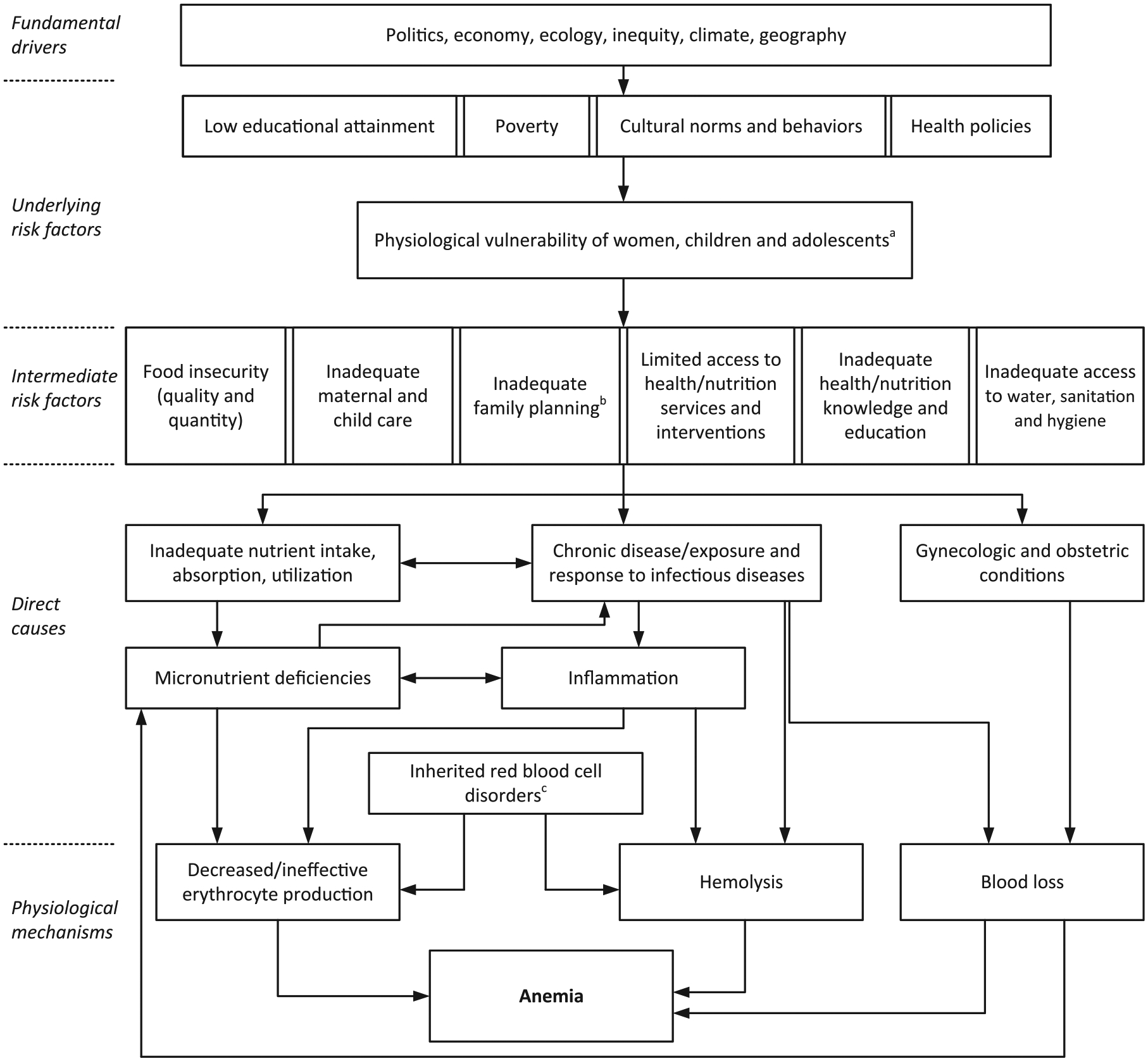
Anemia is a major public health concern. Young children, menstruating adolescent girls and women, and pregnant women are among the most vulnerable. Anemia is the consequence of a wide range of causes, including biological, socioeconomic, and ecological risk factors. Primary causes include: iron deficiency; inherited red blood cell disorders; infections, such as soil-transmitted helminthiasis, schistosomiasis, and malaria; gynecological and obstetric conditions; and other chronic diseases that lead to blood loss, decreased erythropoiesis, or destruction of erythrocytes. The most vulnerable population groups in low- and middle-income countries are often at the greatest risk to suffer from several of these causes simultaneously as low socioeconomic status is linked with an increased risk of anemia through multiple pathways. Targeted and effective action is needed to prevent anemia. Understanding the causes and risk factors of anemia for different population subgroups within a country guides the design and implementation of effective strategies to prevent and treat anemia. A coordinated approach across various expert groups and programs could make the best use of existing data or could help to determine when newer and more relevant data may need to be collected, especially in countries with a high anemia burden and limited information on the etiology of anemia.
Keywords: anemia; anemia of inflammation; iron deficiency anemia; non-nutritional anemia; nutritional anemia.
© 2023 The Authors. Annals of the New York Academy of Sciences published by Wiley Periodicals LLC on behalf of New York Academy of Sciences.
Conflict of interest statement
COMPETING INTERESTS
The spouse of S.Y.H. serves as a consultant to the Micronutrient Forum and to the Bill & Melinda Gates Foundation. All other authors have no competing interests to declare.
Figures

References
-
- World Health Organization. (2011). Hemoglobin concentrations for the diagnosis of anemia and assessment of severity. Geneva: World Health Organization.
-
- Haas JD, & Brownlie T (2001). Iron deficiency and reduced work capacity: A critical review of the research to determine a causal relationship. Journal of Nutrition, 131, S676–S690. discussion 688S-690S. - PubMed
-
- Jung J, Rahman MM, Rahman MS, Swe KT, Islam MR, Rahman MO, & Akter S (2019). Effects of hemoglobin levels during pregnancy on adverse maternal and infant outcomes: A systematic review and meta-analysis. Annals of the New York Academy of Sciences, 1450, 69–82. - PubMed
-
- Larson LM, Kubes JN, Ramírez-Luzuriaga MJ, Khishen S, Shankar AH, & Prado EL (2019). Effects of increased hemoglobin on child growth, development, and disease: A systematic review and meta-analysis. Annals of the New York Academy of Sciences, 1450, 83–104. - PubMed
Publication types
MeSH terms
Grants and funding
LinkOut - more resources
Full Text Sources
Medical
