


Magnetic resonance brain volumetry biomarkers of CLN2 Batten disease identified with miniswine model
- PMID: 36991106
- PMCID: PMC10060411
- DOI: 10.1038/s41598-023-32071-z
Magnetic resonance brain volumetry biomarkers of CLN2 Batten disease identified with miniswine model
Abstract
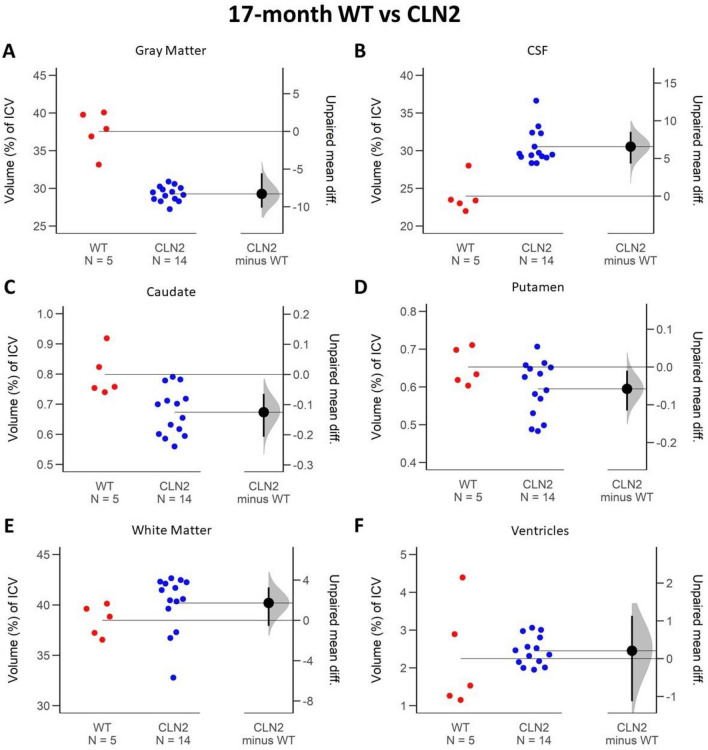
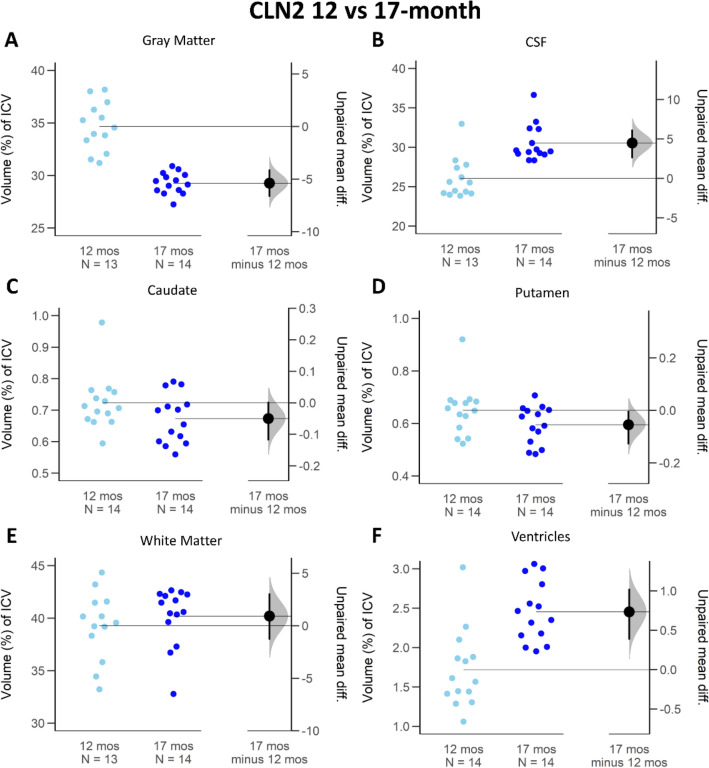
Late-infantile neuronal ceroid lipofuscinosis type 2 (CLN2) disease (Batten disease) is a rare pediatric disease, with symptom development leading to clinical diagnosis. Early diagnosis and effective tracking of disease progression are required for treatment. We hypothesize that brain volumetry is valuable in identifying CLN2 disease at an early stage and tracking disease progression in a genetically modified miniswine model. CLN2R208X/R208X miniswine and wild type controls were evaluated at 12- and 17-months of age, correlating to early and late stages of disease progression. Magnetic resonance imaging (MRI) T1- and T2-weighted data were acquired. Total intercranial, gray matter, cerebrospinal fluid, white matter, caudate, putamen, and ventricle volumes were calculated and expressed as proportions of the intracranial volume. The brain regions were compared between timepoints and cohorts using Gardner-Altman plots, mean differences, and confidence intervals. At an early stage of disease, the total intracranial volume (- 9.06 cm3), gray matter (- 4.37% 95 CI - 7.41; - 1.83), caudate (- 0.16%, 95 CI - 0.24; - 0.08) and putamen (- 0.11% 95 CI - 0.23; - 0.02) were all notably smaller in CLN2R208X/R208X miniswines versus WT, while cerebrospinal fluid was larger (+ 3.42%, 95 CI 2.54; 6.18). As the disease progressed to a later stage, the difference between the gray matter (- 8.27%, 95 CI - 10.1; - 5.56) and cerebrospinal fluid (+ 6.88%, 95 CI 4.31; 8.51) continued to become more pronounced, while others remained stable. MRI brain volumetry in this miniswine model of CLN2 disease is sensitive to early disease detection and longitudinal change monitoring, providing a valuable tool for pre-clinical treatment development and evaluation.
© 2023. The Author(s).
Conflict of interest statement
C.S.R. is an employee of Precigen Exemplar, a company commercializing the CLN2 porcine model. J.M.W. has equity in Amicus Therapeutics, a biotechnology company focused on developing medicines for people with rare metabolic diseases. All other authors have no competing interests.
Figures




References
-
- Mole S, Williams R, Goebel H. The Neuronal Ceroid Lipofuscinoses (Batten Disease) Oxford University Press; 2012.
-
- Nickel M, Simonati A, Jacoby D, Lezius S, Kilian D, Van de Graaf B, Pagovich OE, Kosofsky B, Yohay K, Downs M, et al. Disease characteristics and progression in patients with late-infantile neuronal ceroid lipofuscinosis type 2 (CLN2) disease: An observational cohort study. Lancet Child Adolesc. Health. 2018;2(8):582–590. doi: 10.1016/S2352-4642(18)30179-2. - DOI - PMC - PubMed
-
- Kovacs KD, Patel S, Orlin A, Kim K, Van Everen S, Conner T, Sondhi D, Kaminsky SM, D'Amico DJ, Crystal RG, et al. Symmetric age association of retinal degeneration in patients with CLN2-associated batten disease. Ophthalmol. Retina. 2020;4(7):728–736. doi: 10.1016/j.oret.2020.01.011. - DOI - PMC - PubMed
Publication types
MeSH terms
Substances
Grants and funding
LinkOut - more resources
Full Text Sources
Research Materials
