


An integrative review of adult patient-reported reasons for non-urgent use of the emergency department
- PMID: 36991388
- PMCID: PMC10061911
- DOI: 10.1186/s12912-023-01251-7
An integrative review of adult patient-reported reasons for non-urgent use of the emergency department
Abstract
Objective: To conduct an integrative review of the scientific literature to explore adult patient-reported reasons for using the emergency department (ED) non-urgently.
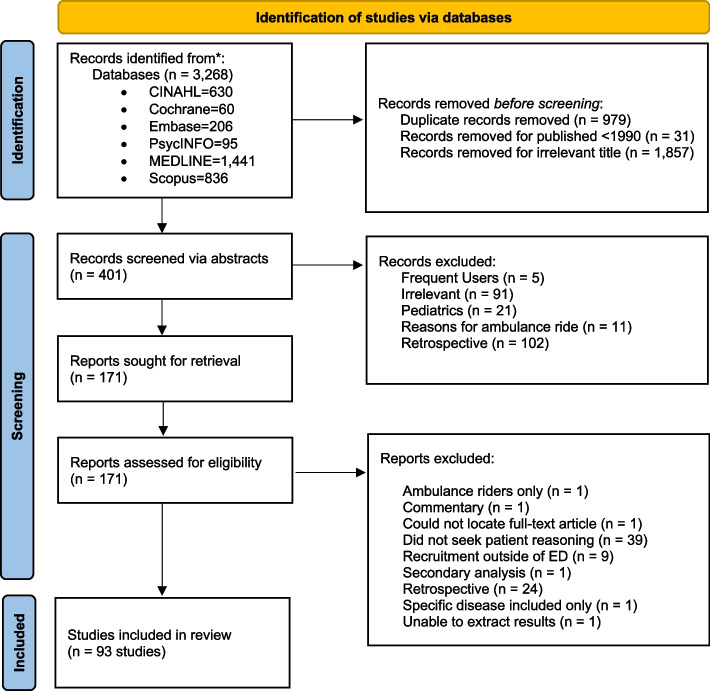
Method: A literature search of CINAHL, Cochrane, Embase, PsycINFO, and MEDLINE was conducted with filters for humans, published January 1, 1990-September 1, 2021, and English language. Methodological quality was assessed using Critical Appraisal Skills Programme Qualitative Checklist for qualitative and National Institutes Health (NIH) Quality Assessment Tool for Observational Cohort and Cross-Sectional Studies for quantitative studies. Data was abstracted on study and sample characteristics, and themes/reasons for ED use. Cited reasons were coded using thematic analysis.
Results: Ninety-three studies met inclusion criteria. Seven themes were found: need to be risk averse with respect to the health issue; knowledge and awareness of alternative sources of care; dissatisfaction with primary care provider; satisfaction with ED; ED accessibility and convenience resulting in low access burden; referred to the ED by others; and relationships between patients and health care providers.
Discussion: This integrative review examined patient-reported reasons for attending the ED on a non-urgent basis. The results suggest that ED patients are heterogenous and many factors influence their decision-making. Considering the complexity with which patients live, treating them as a single entity may be problematic. Limiting excessive non-urgent visits likely requires a multi-pronged approach.
Conclusion: For many ED patients, they have a very clear problem which needed to be addressed. Future studies should explore psychosocial factors driving decision-making (e.g., health literacy, health-related personal beliefs, stress and coping ability).
Keywords: Decision-making; Emergency department; Emergency medicine; Emergency nursing; Emergency room; Non-urgent use; Nurses; Nursing; Patient; Perception.
© 2023. The Author(s).
Conflict of interest statement
The authors declare no competing interests.
Figures
References
LinkOut - more resources
Full Text Sources
Miscellaneous
