


The Role of Viral Infections in the Onset of Autoimmune Diseases
- PMID: 36992490
- PMCID: PMC10051805
- DOI: 10.3390/v15030782
The Role of Viral Infections in the Onset of Autoimmune Diseases
Abstract
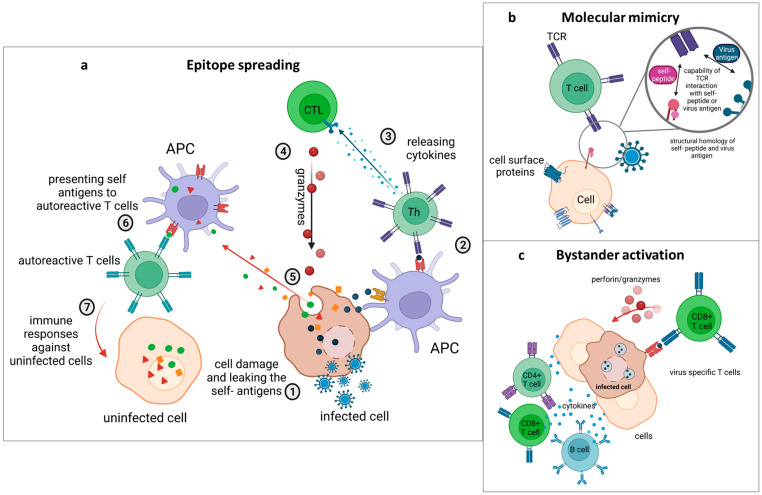
Autoimmune diseases (AIDs) are the consequence of a breach in immune tolerance, leading to the inability to sufficiently differentiate between self and non-self. Immune reactions that are targeted towards self-antigens can ultimately lead to the destruction of the host's cells and the development of autoimmune diseases. Although autoimmune disorders are comparatively rare, the worldwide incidence and prevalence is increasing, and they have major adverse implications for mortality and morbidity. Genetic and environmental factors are thought to be the major factors contributing to the development of autoimmunity. Viral infections are one of the environmental triggers that can lead to autoimmunity. Current research suggests that several mechanisms, such as molecular mimicry, epitope spreading, and bystander activation, can cause viral-induced autoimmunity. Here we describe the latest insights into the pathomechanisms of viral-induced autoimmune diseases and discuss recent findings on COVID-19 infections and the development of AIDs.
Keywords: COVID-19; autoimmunity; bystander activation; central tolerance; epitope spreading; molecular mimicry; multiple sclerosis; peripheral tolerance; rheumatoid arthritis; systemic lupus erythematosus; type 1 diabetes.
Conflict of interest statement
The authors declare no conflict of interest.
Figures
References
-
- Aaltonen J., Björses P., Perheentupa J., Horelli–Kuitunen N., Palotie A., Peltonen L., Lee Y.S., Francis F., Henning S., Thiel C., et al. An autoimmune disease, APECED, caused by mutations in a novel gene featuring two PHD-type zinc-finger domains. Nat. Genet. 1997;17:399–403. doi: 10.1038/ng1297-399. - DOI - PubMed
Publication types
MeSH terms
Substances
LinkOut - more resources
Full Text Sources
Medical
