


Competitive interactions in two different plant species: Do grassland mycorrhizal communities and nitrogen addition play the same game?
- PMID: 36993846
- PMCID: PMC10040756
- DOI: 10.3389/fpls.2023.1084218
Competitive interactions in two different plant species: Do grassland mycorrhizal communities and nitrogen addition play the same game?
Abstract
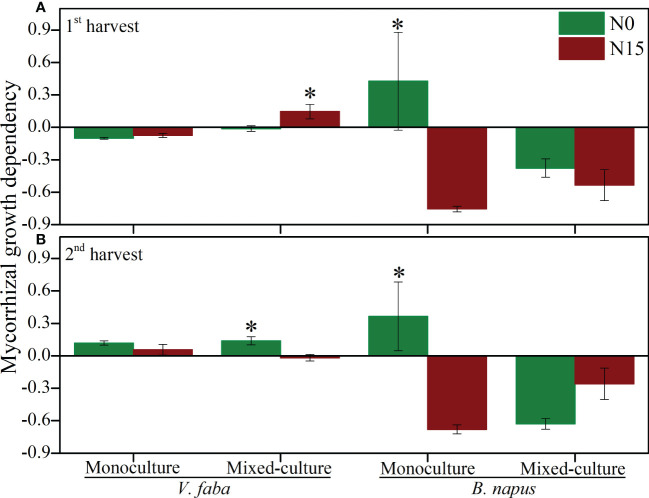
In the Tibetan Plateau grassland ecosystems, nitrogen (N) availability is rising dramatically; however, the influence of higher N on the arbuscular mycorrhizal fungi (AMF) might impact on plant competitive interactions. Therefore, understanding the part played by AMF in the competition between Vicia faba and Brassica napus and its dependence on the N-addition status is necessary. To address this, a glasshouse experiment was conducted to examine whether the grassland AMF community's inocula (AMF and NAMF) and N-addition levels (N-0 and N-15) alter plant competition between V. faba and B. napus. Two harvests took day 45 (1st harvest) and day 90 (2nd harvest), respectively. The findings showed that compared to B. napus, AMF inoculation significantly improved the competitive potential of the V. faba. In the occurrence of AMF, V. faba was the strongest competitor being facilitated by B. napus in both harvests. While under N-15, AMF significantly enhanced tissue N:P ratio in B. napus mixed-culture at 1st harvest, the opposite trend was observed in 2nd harvest. The mycorrhizal growth dependency slightly negatively affected mixed-culture compared to monoculture under both N-addition treatments. The aggressivity index of AMF plants was higher than NAMF plants with both N-addition and harvests. Our observation highlights that mycorrhizal associations might facilitate host plant species in mixed-culture with non-host plant species. Additionally, interacting with N-addition, AMF could impact the competitive ability of the host plant not only directly but also indirectly, thereby changing the growth and nutrient uptake of competing plant species.
Keywords: grassland AMF inoculum; host plant; nitrogen deposition; non-host plant; plant competition.
Copyright © 2023 Bahadur, Jiang, Zhang, Sajjad, Usman, Nasir, Amir Zia, Zhang, Pan, Liu, Chen and Feng.
Conflict of interest statement
The authors declare that the research was conducted in the absence of any commercial or financial relationships that could be construed as a potential conflict of interest. The RE-GF declared a shared affiliation with the author FN to the handling editor at the time of review. RE’s department is “Institute of Geographic Sciences and Natural Resources Research”, AUT’s department is “Northeast Institute of Geography and Agroecology” Chinese Academy of Sciences CAS, Beijing, Chinas
Figures



References
-
- Allen M. F., Allen E. B., Friese C. F. (1989). Responses of the non-mycotrophic plant salsola kali to invasion by vesicular–arbuscular mycorrhizal fungi. New Phytol. 111, 45–49. doi: 10.1111/j.1469-8137.1989.tb04216.x - DOI
-
- Armada E., López-Castillo O., Roldán A., Azcón R. (2016). Potential of mycorrhizal inocula to improve growth, nutrition and enzymatic activities in retama sphaerocarpa compared with chemical fertilization under drought conditions. J. Soil Sci. Plant Nutr. 16, 380–399. doi: 10.4067/S0718-95162016005000035 - DOI
-
- Armas C., Ordiales R., Pugnaire F. I. (2004). Measuring plant interactions: A new comparative index. Ecology 85, 2682–2686. doi: 10.1890/03-0650 - DOI
-
- Ayres R. L., Gange A. C., Aplin D. M. (2006). Interactions between arbuscular mycorrhizal fungi and intraspecific competition affect size, and size inequality, of plantago lanceolata l. J. Ecol. 94, 285–294. doi: 10.1111/j.1365-2745.2006.01103.x - DOI
LinkOut - more resources
Full Text Sources
