


Minimally Invasive Versus Open Liver Resections for Hepatocellular Carcinoma in Patients With Metabolic Syndrome
- PMID: 36994755
- PMCID: PMC11218006
- DOI: 10.1097/SLA.0000000000005861
Minimally Invasive Versus Open Liver Resections for Hepatocellular Carcinoma in Patients With Metabolic Syndrome
Abstract
Objective: To compare minimally invasive (MILR) and open liver resections (OLRs) for hepatocellular carcinoma (HCC) in patients with metabolic syndrome (MS).
Background: Liver resections for HCC on MS are associated with high perioperative morbidity and mortality. No data on the minimally invasive approach in this setting exist.
Material and methods: A multicenter study involving 24 institutions was conducted. Propensity scores were calculated, and inverse probability weighting was used to weight comparisons. Short-term and long-term outcomes were investigated.
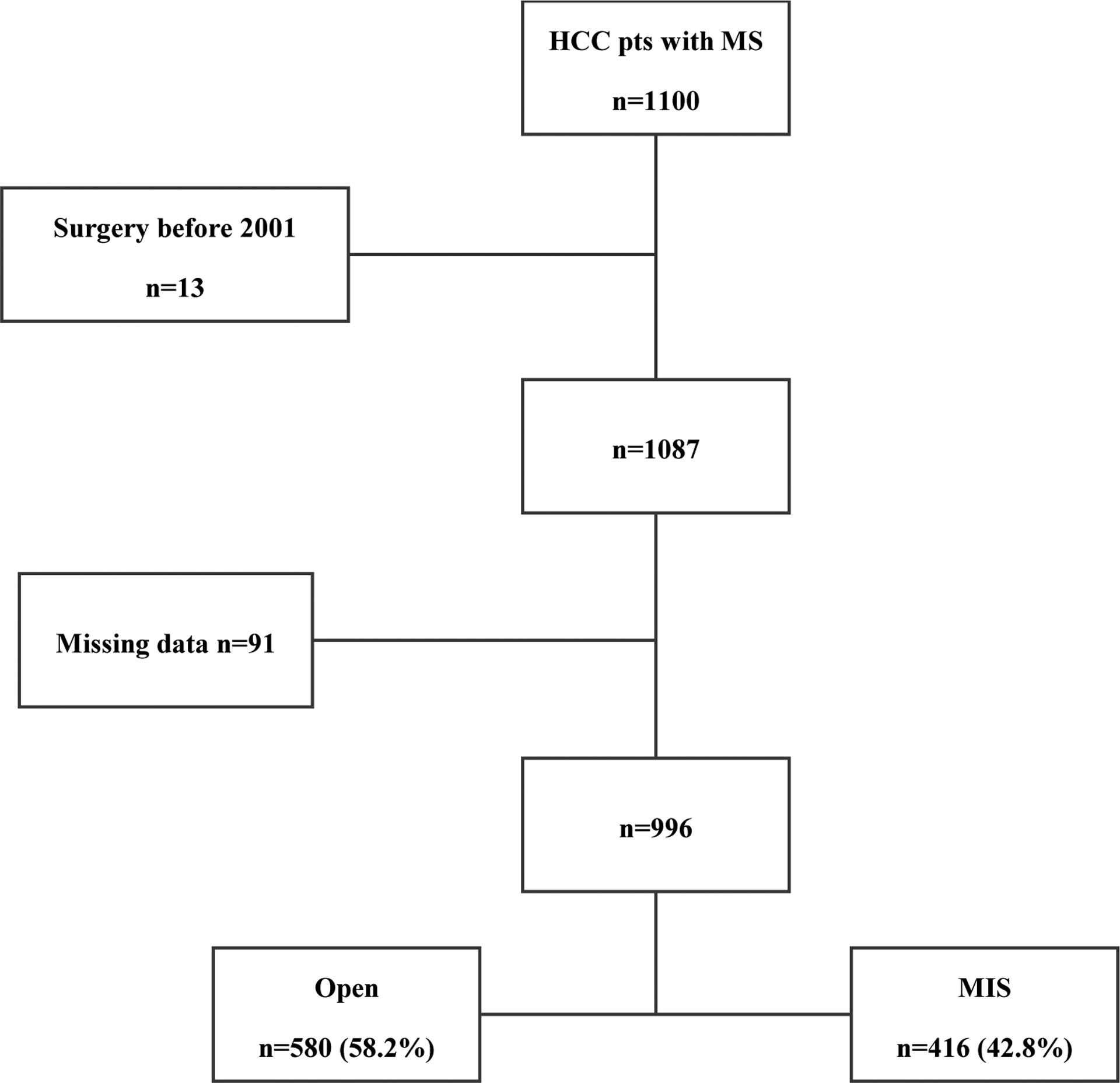
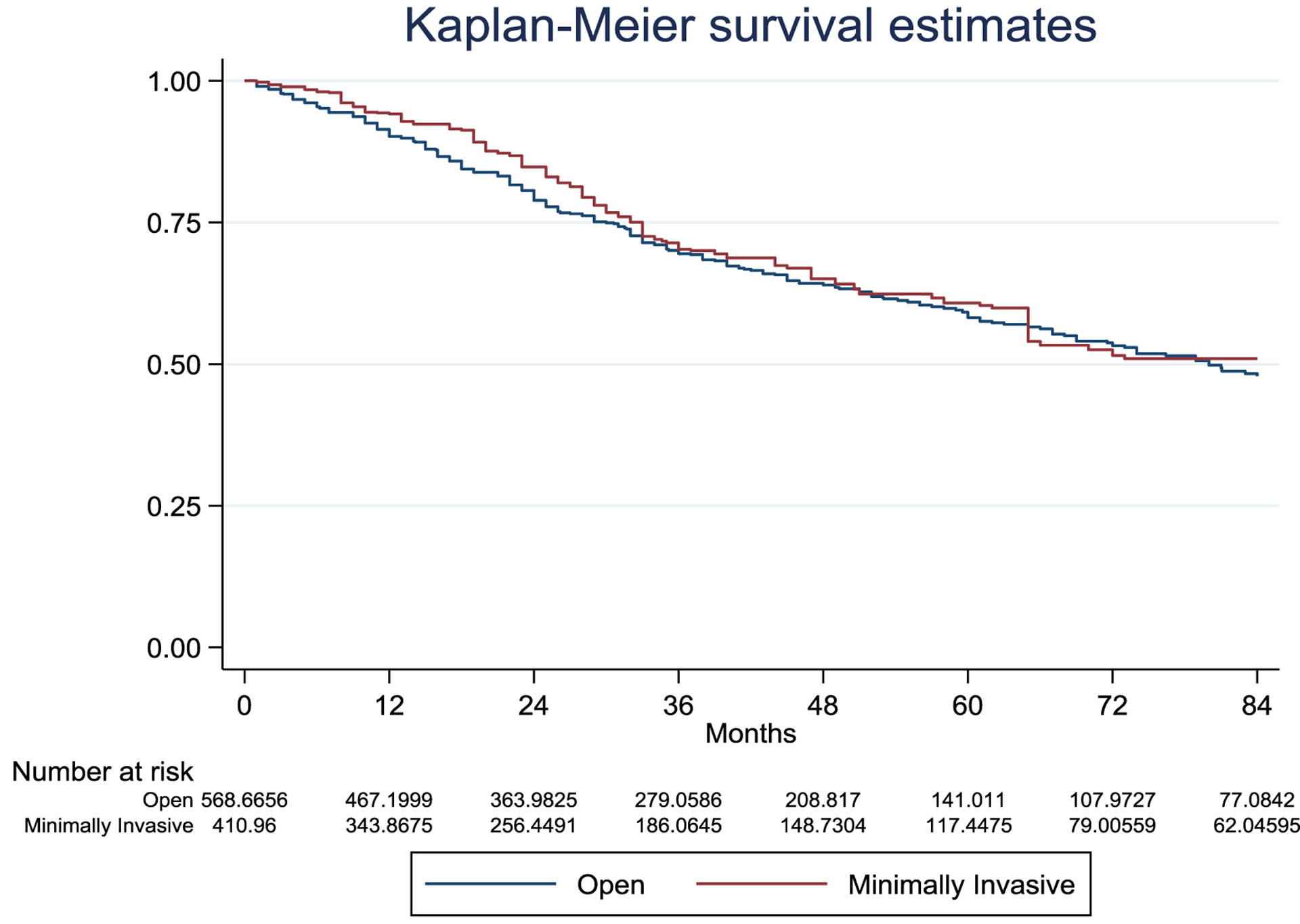
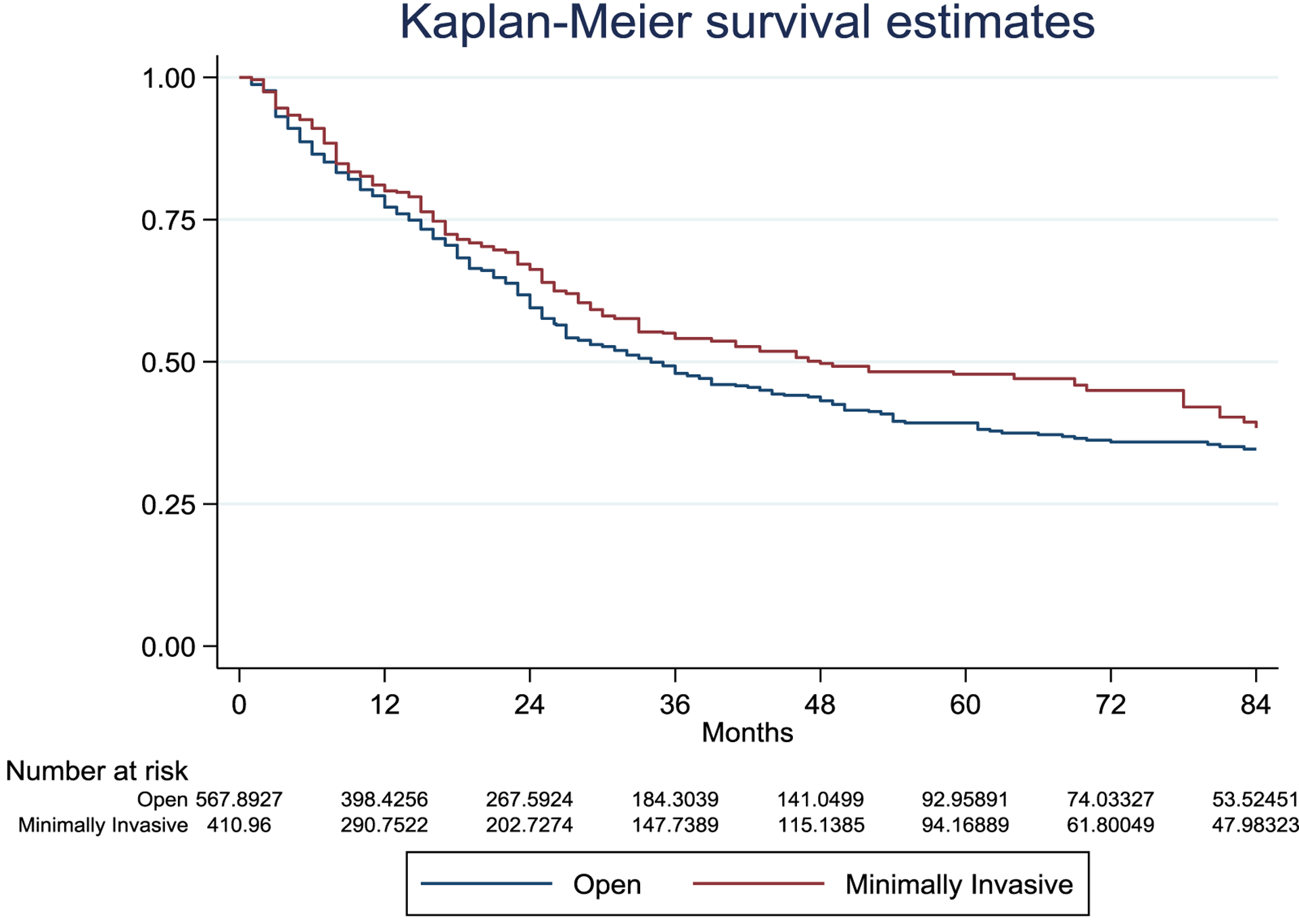
Results: A total of 996 patients were included: 580 in OLR and 416 in MILR. After weighing, groups were well matched. Blood loss was similar between groups (OLR 275.9±3.1 vs MILR 226±4.0, P =0.146). There were no significant differences in 90-day morbidity (38.9% vs 31.9% OLRs and MILRs, P =0.08) and mortality (2.4% vs 2.2% OLRs and MILRs, P =0.84). MILRs were associated with lower rates of major complications (9.3% vs 15.3%, P =0.015), posthepatectomy liver failure (0.6% vs 4.3%, P =0.008), and bile leaks (2.2% vs 6.4%, P =0.003); ascites was significantly lower at postoperative day 1 (2.7% vs 8.1%, P =0.002) and day 3 (3.1% vs 11.4%, P <0.001); hospital stay was significantly shorter (5.8±1.9 vs 7.5±1.7, P <0.001). There was no significant difference in overall survival and disease-free survival.
Conclusions: MILR for HCC on MS is associated with equivalent perioperative and oncological outcomes to OLRs. Fewer major complications, posthepatectomy liver failures, ascites, and bile leaks can be obtained, with a shorter hospital stay. The combination of lower short-term severe morbidity and equivalent oncologic outcomes favor MILR for MS when feasible.
Copyright © 2023 Wolters Kluwer Health, Inc. All rights reserved.
Conflict of interest statement
The authors report no conflicts of interest.
Figures
Comment in
-
Minimally invasive liver resection in metabolic syndrome: insights and future directions.Hepatobiliary Surg Nutr. 2024 Aug 1;13(4):703-705. doi: 10.21037/hbsn-24-294. Epub 2024 Jul 18. Hepatobiliary Surg Nutr. 2024. PMID: 39175735 Free PMC article. No abstract available.
References
-
- Sung H, Ferlay J, Siegel RL, et al. Global Cancer Statistics 2020: GLOBOCAN Estimates of Incidence and Mortality Worldwide for 36 Cancers in 185 Countries. CA Cancer J Clin 2021; 71(3):209–249. - PubMed
