. 2023 Mar 31;379(6639):1336-1341.
doi: 10.1126/science.abn1366. Epub 2023 Mar 30.

Cytosolic antibody receptor TRIM21 is required for effective tau immunotherapy in mouse models

Affiliations

Cytosolic antibody receptor TRIM21 is required for effective tau immunotherapy in mouse models

Aamir S Mukadam et al. Science. .

Abstract

Aggregates of the protein tau are proposed to drive pathogenesis in neurodegenerative diseases. Tau can be targeted by using passively transferred antibodies (Abs), but the mechanisms of Ab protection are incompletely understood. In this work, we used a variety of cell and animal model systems and showed that the cytosolic Ab receptor and E3 ligase TRIM21 (T21) could play a role in Ab protection against tau pathology. Tau-Ab complexes were internalized to the cytosol of neurons, which enabled T21 engagement and protection against seeded aggregation. Ab-mediated protection against tau pathology was lost in mice that lacked T21. Thus, the cytosolic compartment provides a site of immunotherapeutic protection, which may help in the design of Ab-based therapies in neurodegenerative disease.


Conflict of interest statement

Competing interests

WAM, LCJ, ASM, LVCM, SK, AES, and BJT are listed as inventors on a patent related to this study. WAM has acted as consultant to Ahren Innovation Capital.

Figures

Figure 1
Figure 1. Mechanisms of Ab protection in neuronal cultures.
A) Confocal immunofluorescence microscope images of mouse primary neurons expressing mCherry-T21 treated with tau assemblies in complex with tau C-terminus specific rabbit polyclonal Ab, BR134. Arrows indicate intracellular Ab:tau assembly complexes, the majority of which were found to colocalise with T21. Scale bar 25 μm, inset scale bar 10 μm. B) Number of tau assemblies detectable within neurons 8 h after their addition in the presence or absence of BR134. C) Number of intracellular tau puncta that colocalise with T21 in the presence or absence of BR134. D) Fluorescence anisotropy of Alexa488-labelled mouse T21 PRYSPRY domain in the presence of indicated concentration of BR134. E) Diagram of organotypic hippocampal slice culture (OHSC) model of seeded tau aggregation. Tau assemblies are pre-treated with Abs and provided to hippocampal slices prepared from P301S Tau-Tg animals on day in vitro (DIV) 7. OHSCs are fixed for immunofluorescence analysis of tau pathology (AT8) on DIV28 or lysed and examined for levels of tau seeding in HEK293 P301S tau-venus reporter cells. F) Representative immunofluorescence images for AT8-reactive tau structures in OHSCs from P301S Tau-Tg T21+/+ and T21-/- backgrounds challenged with tau assemblies that were untreated or incubated with control Ab 9C12 or BR134. Map2 staining reveals neuronal architecture. Scale bar 50 μm. G) Levels of AT8 reactivity in OHSCs following treatment with tau assemblies in the absence of Abs, or after pre-incubation with the indicated Ab. H) Levels of tau seeds present within OHSCs 3 weeks following treatment with indicated tau and Ab complexes. Levels were determined by applying OHSC homogenates to HEK293 cells expressing P301S tau-venus. I) Levels of AT8-reactive tau structures in primary neurons derived from P301S Tau-Tg mice challenged with tau assemblies that were untreated or incubated with the indicated Ab in the presence of DMSO or E1 inhibitor TAK-243. Data normalised to control antibody. Median and interquartile range indicated. B-C) Mean +/- sd from N=6 randomly selected fields of view; D) Mean +/- sd from N=2 repeats. G) Points represent 100x100 μm sections from images of OHSCs prepared from N=6 mice with median +/- interquartile range. H) Each point represents seeding from pooled OHSC homogenates derived from N=3 mice with median +/- interquartile range. I) Points represent values from individual fields of view from N=3 independent repeats with mean +/- sd. B, C) Mann-Whitney test; G, I) Kruskal-Wallis test with Dunn’s correction for multiple comparisons; H) one-way ANOVA with Tukey’s correction for multiple comparisons; **, P<0.01; ****, P<0.0001.
Figure 2
Figure 2. FcγR contributions in OHSCs and T21 in human iPSC-derived neurons.
A) Levels of AT8 staining in P301S Tau-Tg T21+/+ and T21-/- OHSCs treated with phospho-tau assemblies in the presence of AP422, a mouse IgG1 which binds to tau phosphorylated at S422, or isotype matched anti-adenovirus control, 9C12. B) Levels of seeding observed in extracts prepared from OHSCs treated with the indicated tau assemblies and Abs. C) Levels of seeded aggregation in HEK293 cells treated with 1 nM phospho-tau assemblies in the presence of indicated Abs. D) Levels of AT8 staining in OHSCs treated with phospho-tau assemblies that were incubated with the indicated recombinant Abs. Ragweed, anti-ragweed pollen control; AP422WT, mouse IgG2a; AP422PGLALA, mouse IgG2a with the PGLALA mutations that prevent FcγR interaction. E) Immunoblots for T21, synaptic marker PSD-95, IFN-stimulated gene STAT-1 and loading control CypB in human iPSC derived neurons in the presence and absence of IFNα. F) Levels of adenovirus type 5 infection in human iPSC derived neurons in the absence of Ab or in the presence of recombinant anti-AdV 9C12 expressed with human IgG1 Fc. Wildtype Fc or Fc bearing H433A which prevents interaction with TRIM21 was used. A-D) Median and interquartile range shown. A,D) Points represent 100x100 μm sections from images of OHSCs prepared from N=6 mice. B) Each point represents seeding from pooled OHSC homogenates derived from N=3 mice. C) N=3 biological replicates, points represent technical replicates. A, D) Kruskal-Wallis test with Dunn’s correction for multiple comparisons. B,C) One-way ANOVA with Tukey’s correction for multiple comparisons. F) Mean and standard deviation; N=3 independent replicates; unpaired t-test. **, P<0.01; ***, P<0.001; ****, P<0.0001.
Figure 3
Figure 3. T21 is required for immunotherapeutic protection against incipient tau pathology.
A) Immunoblot analysis of total homogenate and sarkosyl insoluble fractions prepared from the lumbar spinal column of P301S Tau-Tg mice at postnatal day 20, 50 and 80. Lanes represent individual animals. B) Quantification of tau in sarkosyl insoluble fractions using Abs AT8 and HT7, normalised to GAPDH. C) Levels of seeding in HEK293 P301S tau-venus cells treated with the same sarkosyl insoluble fractions, or with insoluble fractions from wildtype mice. D) Timeline of antibody treatment with mock (PBS), anti-adenovirus 9C12 (Con) or anti-pS422 tau (AP422) by weekly i.p. injection between ages 20-80 days. E) Immunoblot analysis of total and sarkosyl insoluble fractions of spines from treated mice. Each lane represents an individual mouse. F) Quantification of AT100 levels normalised to GAPDH from E). G) Levels of seed competent tau present in spine sarkosyl insoluble fraction derived from mice treated with the indicated Ab, points represent average seeding in multiple wells from N=4 mice. F) Mean +/- sd and one-way ANOVA with Dunnett’s multiple comparison test. G) Mean +/- sd and nested one-way ANOVA; **, P<0.01; ***, P<0.001.
Figure 4
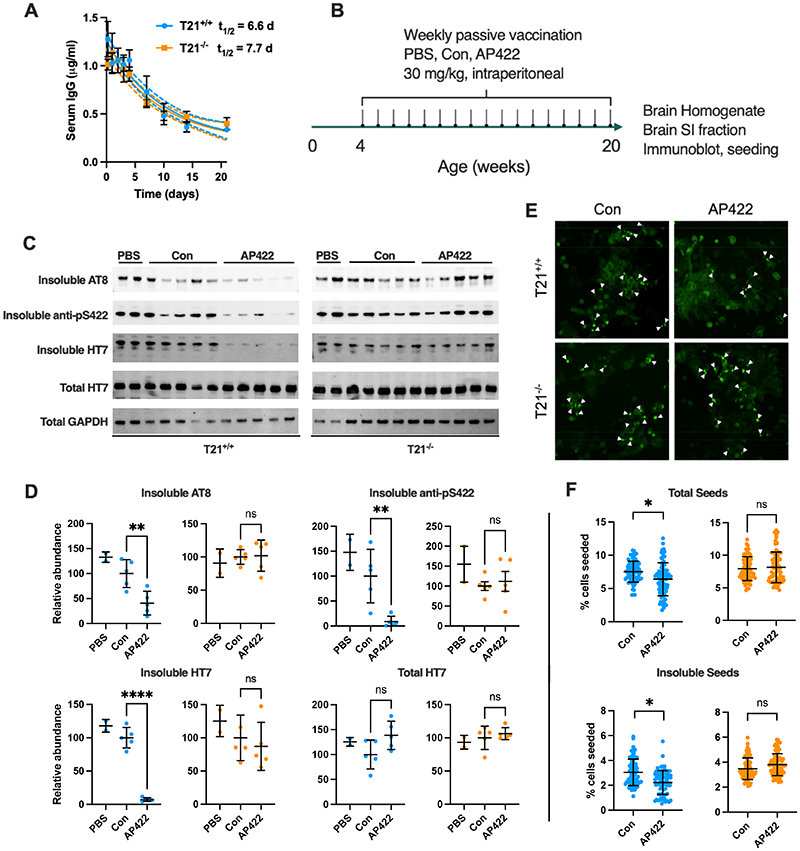
Figure 4. Long-term immunotherapy potentiates T21-dependent protection against tau pathology.
A) Serum concentration of biotinylated Abs at indicated time following injection of 30 mg/kg to N=3 P301S-Tg mice that were either T21+/+ or T21-/-. B) Cartoon depicting timeline of antibody treatment. Mice were treated with mock i.p. injection (PBS), control Ab 9C12 (Con) or anti-tau (AP422) for 17 weeks. Total homogenate and sarkosyl insoluble fractions were prepared for immunoblot and quantification of seed-competent species. C) Immunoblot of total and sarkosyl insoluble fractions from brain hemispheres from P301S-Tg mice that were either T21+/+ or T21-/-. Samples were probed with either pan-tau monoclonal antibody HT7, or phospho-specific tau Abs AT8 and anti-pS422. Each lane represents a single mouse. D) Quantification of HT7, AT8, and pS422 levels normalised to GAPDH using the same samples as C). E) Images of HEK293 cells expressing P301S tau-venus treated with diluted sarkosyl insoluble fractions from brains treated with the indicated Ab or PBS. F) Quantification of seed competent tau present in brain homogenates and sarkosyl insoluble fractions derived from mice treated with the indicated Ab. Points represent seeding in individual images from N=5 mice. A) Mean +/- sd; one-phase decay curves compared using extra sum-of-squares F-test, not significant. D-F) Mean +/- sd. D) one-way ANOVA with Dunnett’s test for multiple comparisons; F) nested t-test for individual mice; *, P<0.05; **, P<0.01; ****, P<0.0001.

References

    1. Goedert M. Tau filaments in neurodegenerative diseases. FEBS Lett. 2018;592:2383–239. - PubMed
    1. Rauch JN, Chen JJ, Sorum AW, Miller GM, Sharf T, See SK, Hsieh-Wilson LC, Kampmann M, Kosik KS. Tau Internalization is Regulated by 6-O Sulfation on Heparan Sulfate Proteoglycans (HSPGs) Sci Rep. 2018;8:6382. - PMC - PubMed
    1. Rauch JN, Luna G, Guzman E, Audouard M, Challis C, Sibih YE, Leshuk C, Hernandez I, Wegmann S, Hyman BT, Gradinaru V, et al. LRP1 is a master regulator of tau uptake and spread. Nature. 2020;580:381–385. - PMC - PubMed
    1. Cooper JM, Lathuiliere A, Migliorini M, Arai AL, Wani MM, Dujardin S, Muratoglu SC, Hyman BT, Strickland DK. Regulation of tau internalization, degradation, and seeding by LRP1 reveals multiple pathways for tau catabolism. Journal of Biological Chemistry. 2021;296:100715. - PMC - PubMed
    1. Holmes BB, DeVos SL, Kfoury N, Li M, Jacks R, Yanamandra K, Ouidja MO, Brodsky FM, Marasa J, Bagchi DP, Kotzbauer PT, et al. Heparan sulfate proteoglycans mediate internalization and propagation of specific proteopathic seeds. Proc Natl Acad Sci U S A. 2013;110:E3138–3147. - PMC - PubMed

MeSH terms