Review
. 2023 Mar 30;22(1):65.
doi: 10.1186/s12943-023-01765-3.

HOTAIR: a potential metastatic, drug-resistant and prognostic regulator of breast cancer

Affiliations
Review

HOTAIR: a potential metastatic, drug-resistant and prognostic regulator of breast cancer

Ganji Seeta Rama Raju et al. Mol Cancer. .

Abstract

HOX transcript antisense intergenic RNA (HOTAIR) is an oncogenic non-coding RNA whose expression is strongly correlated with the tumor grade and prognosis of a variety of carcinomas including breast cancer (BC). HOTAIR regulates various target genes via sponging and epigenetic mechanisms and controls various oncogenic cellular and signaling mechanisms including metastasis and drug resistance. In BC cells, HOTAIR expression is regulated by a variety of transcriptional and epigenetic mechanisms. In this review, we describe the regulatory mechanisms that govern HOTAIR expression during cancer development and explore how HOTAIR drives BC development, metastasis, and drug resistance. In the final section of this review, we focus on the role of HOTAIR in BC management, therapeutic treatment, and prognosis, highlighting its potential therapeutic applications.

Keywords: Breast cancer; Drug resistance; HOTAIR; Metastasis; Prognosis.


Conflict of interest statement

The authors declare that they have no competing interests.

Figures
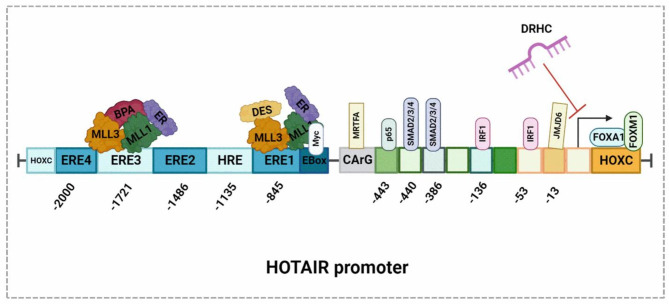
Fig. 1
Fig. 1
BisPhenol A, diethylstilbesterol, and IRF1 promote the overexpression of HOTAIR by binding to the corresponding gene promoter elements. Bisphenol A and diethylstilbesterol independently interact with estrogen receptors in the cytoplasm, translocate into the nucleus, associate with the methyl transferases MLL1 and MLL3, bind to the estrogen receptor elements ERE1 and ERE3, and then activate the overexpression of HOTAIR. IRF1 binds to the downstream sequence in between 53–64 and 136–148 within the promoter region and activates the overexpression of HOTAIR. P65, which is an important component of the NF-kB signaling pathway, directly binds to the sequence between − 443 and − 475 within the promoter element and regulates the expression of HOTAIR. Myocardin Related Transcription Factor(MRTF-A) binds to the CArG box located in the HOTAIR promoter and facilitates the association between SRF1 and RNA POL II, which is involved in the expression of HOTAIR. Transcription factor c-Myc binds specifically to the E-box sequence within the HOTAIR promoter region and increases its expression. FOXA1 and FOXM1 interact with the HOXC locus positioned adjacent to the HOTAIR gene promoter and regulates its expression LncRNA DRHC suppresses HOTAIR expression and inhibits the proliferation of triple negative BC cells. SMAD2/3/4 interacts with the promoter region of HOTAIR between − 386 and − 398 and between − 440 and − 452 to facilitate the transcription of HOTAIR, while MJD6 induces the expression of HOTAIR by directly binding to its promoter in the − 13 to −103 region
Fig. 2
Fig. 2
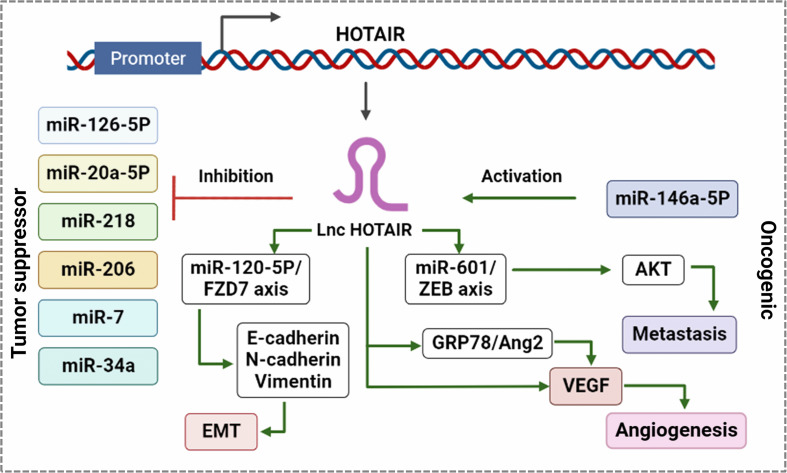
HOTAIR inhibits tumor suppressor miRNAs and activates pro-oncogenic miRNAs in BC. Activation of oncogenic miRNAs enhances the expression of EMT-specific proteins involved in metastasis by activating HOTAIR expression. HOTAIR regulates the miR-129-5p/FZD7 axis, which promotes EMT via the regulation of E-cadherin and N-cadherin vimentin. HOTAIR also activates the miR601/ZEB1 axis, which promotes metastasis by activating AKT. HOTAIR promotes angiogenesis by inducing the transcription of VEGF via direct interaction at the promoter or the activation of the GRP78/Ang2 axis
Fig. 3
Fig. 3
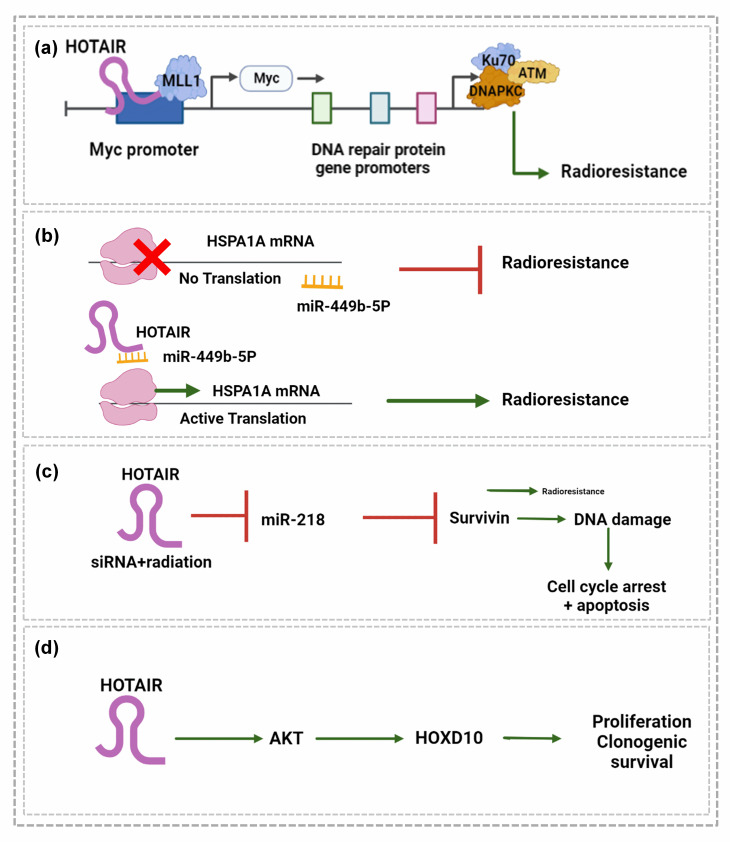
HOTAIR recruits EZH2 to the Myc promoter and facilitates the expression of Myc transcription factors. Myc binds to the gene promoter elements of DNA repair proteins Ku70/Ku80, DNA PKC, and ATM and promotes their expression to withstand the DNA damage caused by radiation in BC. b) miR 449b-5P suppresses radioresistance in BC by inhibiting the translation of HSPA1A. HOTAIR activates the translation and expression of HSPA1A by sponging miR-449b-5P. c) HOTAIR gene silencing and radiation therapy suppress miR-218, which in turn inhibits survivin, leading to DNA-damage dependent cell cycle arrest and apoptosis. d) HOTAIR activates AKP, which promotes proliferation and clonogenic survival via the activation of HOXD10
Fig. 4
Fig. 4
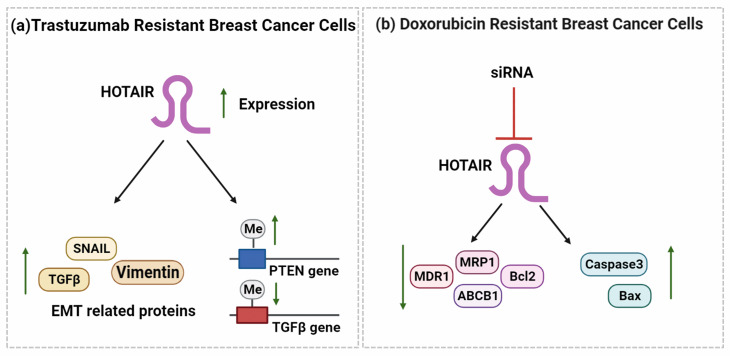
HOTAIR is overexpressed in trastuzumab-resistant BC cells and upregulates the expression of EMT-related proteins SNAIL, TGFß, and vimentin. At the same time, it also upregulates PTEN gene promoter methylation and downregulates TGFß gene promoter methylation. The siRNA-mediated silencing of HOTAIR in DOX-resistant BC cells downregulates the expression of oncogenic and anti-apoptotic proteins MDR1, MRP1, ABCB1, and Bcl2 and upregulates the pro-apoptotic proteins caspase 3 and Bax

References

    1. Cai B, Song XQ, Cai JP, Zhang S. HOTAIR: a cancer-related long non-coding RNA. Neoplasma. 2014;61(4):379–91. doi: 10.4149/neo_2014_075. - DOI - PubMed
    1. Liu XH, Sun M, Nie FQ, Ge YB, Zhang EB, Yin DD, Kong R, Xia R, Lu KH, Li JH, et al. Lnc RNA HOTAIR functions as a competing endogenous RNA to regulate HER2 expression by sponging mir-331-3p in gastric cancer. Mol Cancer. 2014;13:92. doi: 10.1186/1476-4598-13-92. - DOI - PMC - PubMed
    1. Biswas S, Feng B, Chen S, Liu J, Aref-Eshghi E, Gonder J, Ngo V, Sadikovic B, Chakrabarti S. The long non-coding RNA HOTAIR is a critical epigenetic mediator of angiogenesis in diabetic retinopathy. Invest Ophthalmol Vis Sci. 2021;62(3):20. doi: 10.1167/iovs.62.3.20. - DOI - PMC - PubMed
    1. Botti G, Collina F, Scognamiglio G, Aquino G, Cerrone M, Liguori G, Gigantino V, Malzone MG, Cantile M. LncRNA HOTAIR polymorphisms association with cancer susceptibility in different tumor types. Curr Drug Targets. 2018;19(10):1220–6. doi: 10.2174/1389450118666170622091940. - DOI - PubMed
    1. Miao Z, Ding J, Chen B, Yang Y, Chen Y. HOTAIR overexpression correlated with worse survival in patients with solid tumors. Minerva Med. 2016;107(6):392–400. - PubMed

Publication types

Substances