Review
. 2023 Mar 14:14:1154211.
doi: 10.3389/fimmu.2023.1154211. eCollection 2023.

Breast milk microRNAs: Potential players in oral tolerance development

Affiliations
Review

Breast milk microRNAs: Potential players in oral tolerance development

Emelie Ahlberg et al. Front Immunol. .

Abstract

Breast milk is an essential source of nutrition and hydration for the infant. In addition, this highly complex biological fluid contains numerous immunologically active factors such as microorganisms, immunoglobulins, cytokines and microRNAs (miRNAs). Here, we set out to predict the function of the top 10 expressed miRNAs in human breast milk, focusing on their relevance in oral tolerance development and allergy prevention in the infant. The top expressed miRNAs in human breast milk were identified on basis of previous peer-reviewed studies gathered from a recent systematic review and an updated literature search. The miRNAs with the highest expression levels in each study were used to identify the 10 most common miRNAs or miRNA families across studies and these were selected for subsequent target prediction. The predictions were performed using TargetScan in combination with the Database for Annotation, Visualization and Integrated Discovery. The ten top expressed miRNAs were: let-7-5p family, miR-148a-3p, miR-30-5p family, miR-200a-3p + miR-141-3p, miR-22-3p, miR-181-5p family, miR-146b-5p, miR-378a-3p, miR-29-3p family, miR-200b/c-3p and miR-429-3p. The target prediction identified 3,588 potential target genes and 127 Kyoto Encyclopedia of Genes and Genomes pathways; several connected to the immune system, including TGF-b and T cell receptor signaling and T-helper cell differentiation. This review highlights the role of breast milk miRNAs and their potential contribution to infant immune maturation. Indeed, breast milk miRNAs seem to be involved in several pathways that influence oral tolerance development.

Keywords: allergy; breast milk; dendritic cells; infant - age; micro-RNA; non-coding RNA; oral tolerance; regulatory T cell.


Conflict of interest statement

The authors declare that the research was conducted in the absence of any commercial or financial relationships that could be construed as a potential conflict of interest.

Figures
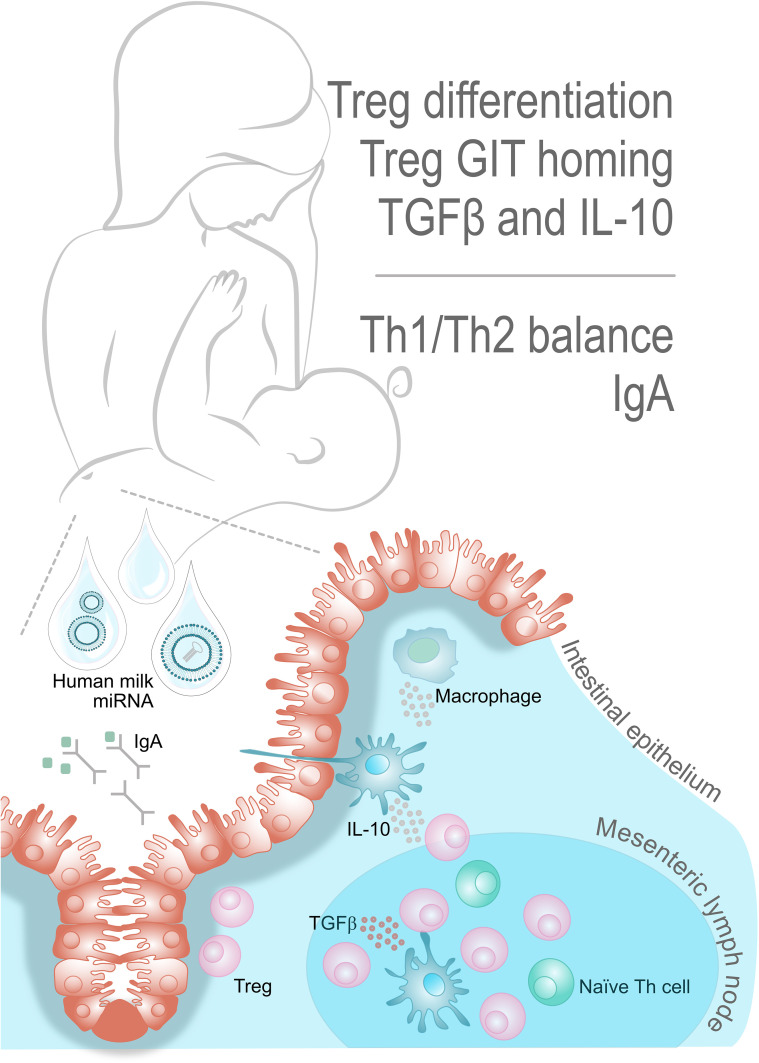
Figure 1
Figure 1
Key players in oral tolerance. Oral tolerance is an active suppression of cellular and humoral responses to antigens. The mesenteric lymph node is the major site for Treg cell differentiation, as mediated by CD103+ DCs. Production of the anti-inflammatory cytokines IL-10 and TGF-β supports the positive feedback loop of stimulating CD103+ DCs, Tregs and tolerogenic macrophages. The TGF-β also promotes B cell antibody class switching towards IgA, thus facilitating antigen exclusion in the intestinal lumen. Interestingly, there seems to exist several breastmilk miRNAs with potential involvement in these interactions.
Figure 2
Figure 2
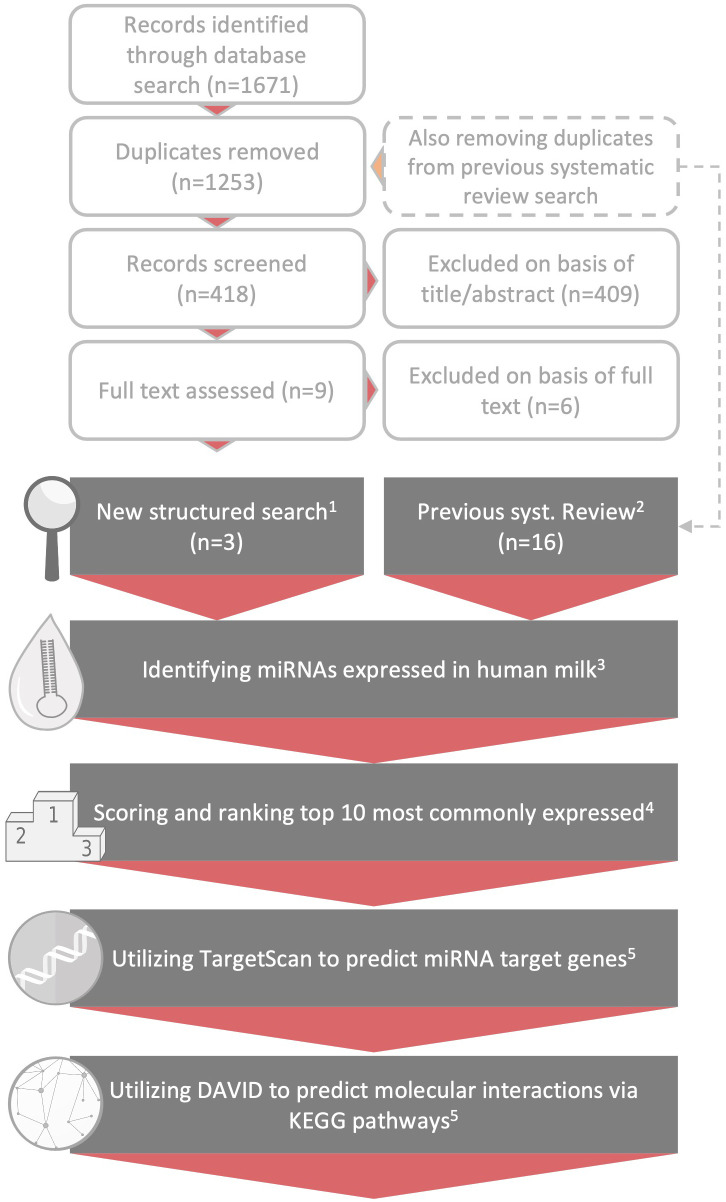
Methodological overview. Overview of the methodological process. The topmost light grey, unfilled text boxes depict the paper selection following the updated literature search. Below, depicted by the grey text boxes, follows the steps taken for the result generation: 1) and 2) illustrates how the three papers included after the new search was combined with the 16 papers analyzing miRNA in breast milk from our previous ncRNA review (14), 3) on basis of these 19 papers we identified the highest expressed breast milk miRNAs in each study (Supplementary B, Table S1 ), 4) thereafter the miRNAs were scored according to paragraph 2.2 (also refer to Supplementary B, Tables S2-S5 ) and for the last two steps denoted 5) please refer to method paragraph 2.2 and Supplementary B, Tables S6-S8 .
Figure 3
Figure 3
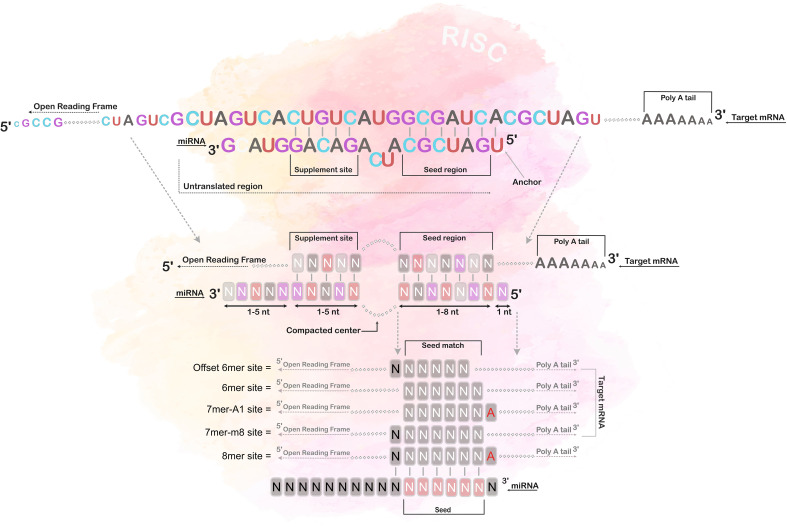
Seed region matching. The figure illustrates the different types of canonical site paring between the miRNA and its mRNA target, i.e. 8mer, 7mer-1A, 7mer-m8 and 6mer paring. The 8mer paring has a complete matched seed region of 7 bases, including an additional match at the 8th position, and an adenine opposite of the first position; the 7mer-1A has a match between position 2-7 and an adenine opposite of the first position; the 7mer-m8 has a match between position 2-8, and the 6mer has a match only in position 2-7. Notably, most miRNAs also have additional pairing beyond the seed region, called 3’-supplementary site.

References

    1. Le Doare K, Holder B, Bassett A, Pannaraj PS. Mother's milk: A purposeful contribution to the development of the infant microbiota and immunity. Front Immunol (2018) 9:361. doi: 10.3389/fimmu.2018.00361 - DOI - PMC - PubMed
    1. Chutipongtanate S, Morrow AL, Newburg DS. Human milk extracellular vesicles: A biological system with clinical implications. Cells (2022) 11(15). doi: 10.3390/cells11152345 - DOI - PMC - PubMed
    1. Newburg DS, Walker WA. Protection of the neonate by the innate immune system of developing gut and of human milk. Pediatr Res (2007) 61(1):2–8. doi: 10.1203/01.pdr.0000250274.68571.18 - DOI - PubMed
    1. Moossavi S, Miliku K, Sepehri S, Khafipour E, Azad MB. The prebiotic and probiotic properties of human milk: Implications for infant immune development and pediatric asthma. Front Pediatr (2018) 6:197. doi: 10.3389/fped.2018.00197 - DOI - PMC - PubMed
    1. Akhter H, Aziz F, Ullah FR, Ahsan M, Islam SN. Immunoglobulins content in colostrum, transitional and mature milk of Bangladeshi mothers: Influence of parity and sociodemographic characteristics. J Mother Child (2020) 24(3):8–15. doi: 10.34763/jmotherandchild.20202403.2032.d-20-00001 - DOI - PMC - PubMed