. 2023 Mar 1;4(2):e220102.
doi: 10.1530/RAF-22-0102. Online ahead of print.

The ovaries of transgender men indicate effects of high dose testosterone on the primordial and early growing follicle pool

Affiliations

The ovaries of transgender men indicate effects of high dose testosterone on the primordial and early growing follicle pool

Emily Bailie et al. Reprod Fertil. .

Abstract

Androgens are essential in normal ovarian function and follicle health but hyperandrogenism, as seen in polycystic ovary syndrome, is associated with disordered follicle development. There are few data on the effect of long-term exposure to high levels of testosterone as found in transgender men receiving gender-affirming endocrine therapy. In this study, we investigate the effect of testosterone on the development, morphological health and DNA damage and repair capacity of human ovarian follicles in vivo and their survival in vitro. Whole ovaries were obtained from transgender men (mean age: 27.6 ± 1.7 years; range 20-34 years, n = 8) at oophorectomy taking pre-operative testosterone therapy. This was compared to cortical biopsies from age-matched healthy women obtained at caesarean section (mean age: 31.8±1.5 years; range= 25-35 years, n=8). Cortical tissues were dissected into fragments and either immediately fixed for histological analysis or cultured for 6 days and subsequently fixed. Follicle classification and morphological health were evaluated from histological sections stained with H&E and expression of γH2AX as a marker of DNA damage by IHC. In uncultured tissue, testosterone exposure was associated with reduced follicle growth activation, poor follicle health and increased DNA damage. After 6 days of culture, there was enhanced follicle activation compared to control with further deterioration in morphological health and increased DNA damage. These data indicate that high circulating concentrations of testosterone have effects on the primordial and small-growing follicles of the ovary. These results may have implications for transgender men receiving gender-affirming therapy prior to considering pregnancy or fertility preservation measures.


Conflict of interest statement

The authors declare that there is no conflict of interest that could be perceived as prejudicing the impartiality of the research reported.

Figures

Figure 1
Figure 1
(A) Photomicrographs of non-growing and growing follicles from both groups. (A1) primordial follicle from control tissue, (A2) transitory follicles from control tissue, (A3–4) primordial follicles from transgender tissue, (A5) primary follicles from control tissue, (A6) secondary follicle from control tissue, (A7) primary follicles from transgender tissue and (A8) secondary follicle from transgender tissue. (B) Follicle classification: proportion of follicles in each classification stage in transgender and control tissue at D0 and D6 (n = 8 patients per group). In the analysis using Kruskal–Wallis test with post hoc Dunn test, results were analysed per patient and expressed as mean± s.e.m., P-value < 0.05 was considered significant, ***P ≤ 0.001, **P ≤ 0.01, *P < 0.05. Black bars control D0, pink bars control D6, green bars transgender D0 and purple bars transgender D6. (C) Morphological health: proportion of morphologically healthy follicles at each follicle stage in control and transgender tissue D0 and D6 (n = 8 patients per group). In the analysis performed using Kruskal–Wallis test with post-hoc Dunn test, results were analysed per patient and expressed as mean ± s.e.m., P-value < 0.05 was considered significant, ***P ≤ 0.001, **P ≤ 0.01, *P < 0.05. Black bars control D0, pink bars control D6, green bars transgender D0 and purple bars transgender D6.
Figure 2
Figure 2
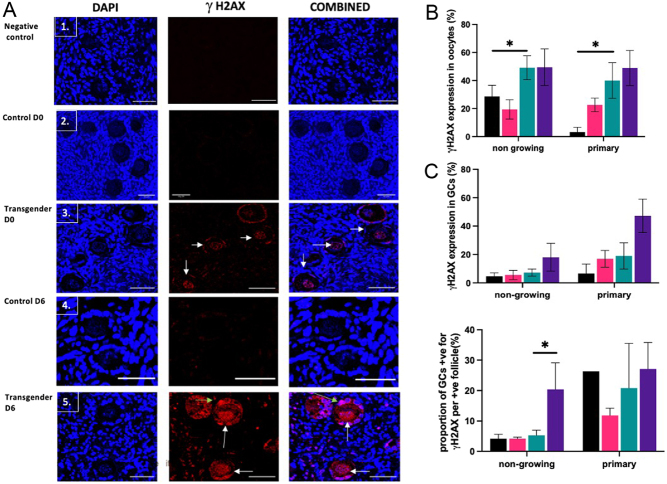
(A) Localisation of γH2AX by immunofluorescence in human ovarian tissue. γH2AX (red) and DAPI (blue) staining in oocyte and granulosa cells. γH2AX staining is identified as red foci within nuclei (white arrows) in oocytes and granulosa cells (green arrows). (1) negative control, (2) control D0 – non-growing follicles, oocytes and granulosa cells negative for γH2AX, (3) transgender D0 – foci of γH2AX identified within the oocytes and granulosa cells of non-growing follicles, (4) control D6 – growing follicles negative staining for γH2AX, (5) transgender D6 – growing follicles positive foci identified within oocytes and granulosa cells. Scale bar = 40 μm. (B–C) Positive expression of γH2AX in oocytes (B) and granulosa cells (C) (total number of follicles n = 840, control D0 n = 122, transgender D0 n = 384, control day 6 n = 145, transgender day 6 n = 189). Expression of γH2AX in oocytes and granulosa cells was analysed per patient (n = 8 patients per group) and results are expressed as the mean ± s.e.m. Expression in oocytes was analysed using the Kruskal–Wallis test with the post hoc Dunn test. Expression of γH2AX in granulosa cells and proportion of granulosa cells in affected follicles were analysed using the Kruskal–Wallis test followed by the post hoc Dunn test. Statistical significance assigned P < 0.05. *P < 0.05. Black bars control D0, pink bars control D6, green bars transgender D0 and purple bars transgender D6.
Figure 3
Figure 3
Immunohistochemical detection of RAD51, ATM and MRE11. Photomicrographs of ovarian follicles for RAD51 (A1–3), ATM (B1–3) and MRE11 (C1–3). Negative control (1), control follicles A2/B2/C2, transgender follicles A3/B3/C3. Positive staining (brown) in oocytes in A2–3, B2–3 and C2–3. Positive staining in granulosa cells in B3 and C2–3. Scale bar = 40 µm. Graphs showing positive expression in oocytes (A4, B4, C4) and granulosa cells (A5, B5, C5) (total number of follicles, RAD51 n = 834, ATM n = 800, MRE11 n = 550, n = 8 patients per group). Results were analysed per patient and expressed as the mean ± s.e.m. Expression in oocytes was analysed using Kruskal–Wallis test with the post hoc Dunn test. Expression in granulosa cells was analysed using Kruskal–Wallis test with the post hoc Dunn test. Statistical significance assigned P < 0.05. Black bars control D0, pink bars control D6, green bars transgender D0 and purple bars transgender D6.

References

    1. Abbott DH Tarantal AF & Dumesic DA. 2009Fetal, infant, adolescent and adult phenotypes of polycystic ovary syndrome in prenatally androgenized female rhesus monkeys. American Journal of Primatology 71776–784. ( 10.1002/ajp.20679) - DOI - PMC - PubMed
    1. Adeleye AJ Cedars MI Smith J & Mok-Lin E. 2019Ovarian stimulation for fertility preservation or family building in a cohort of transgender men. Journal of Assisted Reproduction and Genetics 362155–2161. ( 10.1007/s10815-019-01558-y) - DOI - PMC - PubMed
    1. Amirikia H Savoy-Moore RT Sundareson AS & Moghissi KS. 1986The effects of long-term androgen treatment on the ovary. Fertility and Sterility 45202–208. ( 10.1016/s0015-0282(1649155-7) - DOI - PubMed
    1. Baba T Endo T Honnma H Kitajima Y Hayashi T Ikeda H Masumori N Kamiya H Moriwaka O & Saito T. 2007Association between polycystic ovary syndrome and female-to-male transsexuality. Human Reproduction 221011–1016. ( 10.1093/humrep/del474) - DOI - PubMed
    1. Bertoldo MJ Walters KA Ledger WL Gilchrist RB Mermillod P & Locatelli Y. 2018In-vitro regulation of primordial follicle activation: challenges for fertility preservation strategies. Reproductive Biomedicine Online 36491–499. ( 10.1016/j.rbmo.2018.01.014) - DOI - PubMed

LinkOut - more resources