Review
. 2023 Jun:69:330-341.
doi: 10.1016/j.breast.2023.03.014. Epub 2023 Mar 27.

Tissue- and liquid biopsy-based biomarkers for immunotherapy in breast cancer

Affiliations
Review

Tissue- and liquid biopsy-based biomarkers for immunotherapy in breast cancer

Luca Licata et al. Breast. 2023 Jun.

Abstract

Immune checkpoint inhibitors (ICIs) have revolutionized cancer therapy and now represent the mainstay of treatment for many tumor types, including triple-negative breast cancer and two agnostic registrations. However, despite impressive durable responses suggestive of an even curative potential in some cases, most patients receiving ICIs do not derive a substantial benefit, highlighting the need for more precise patient selection and stratification. The identification of predictive biomarkers of response to ICIs may play a pivotal role in optimizing the therapeutic use of such compounds. In this Review, we describe the current landscape of tissue and blood biomarkers that could serve as predictive factors for ICI treatment in breast cancer. The integration of these biomarkers in a "holistic" perspective aimed at developing comprehensive panels of multiple predictive factors will be a major step forward towards precision immune-oncology.

Keywords: Breast cancer; Immune checkpoint inhibitors; Predictive biomarkers.


Figures

Fig. 1
Fig. 1
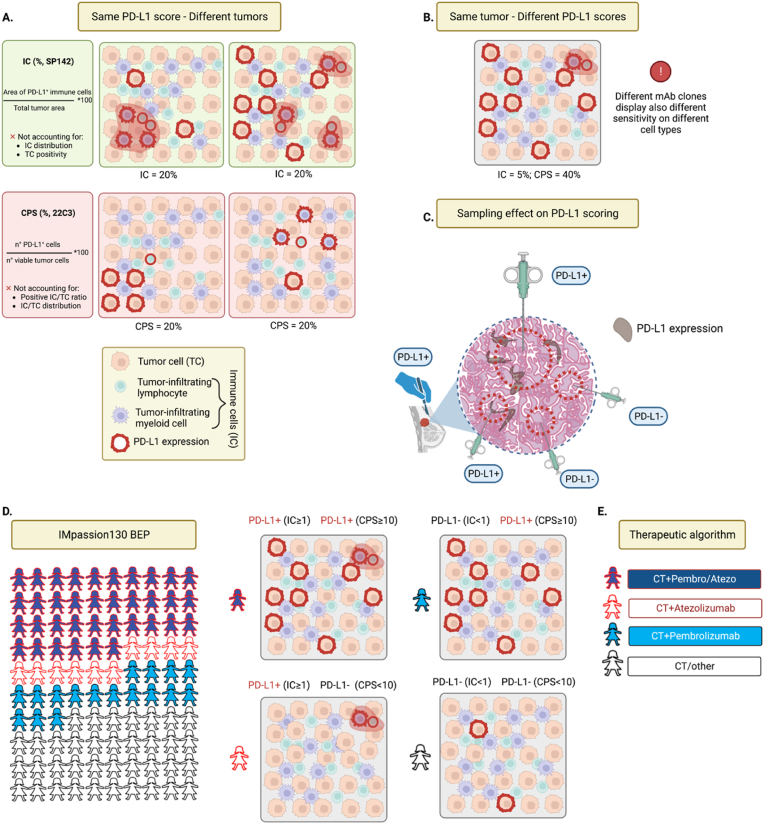
Controversies of PD-L1 assessment. A) Graphical representation of different companion diagnostic PD-L1 scores for immune checkpoint treatment of advanced TNBC. The immune cell score (IC, Ventana platform, SP142 anti-PD-L1 clone), accounts for the percent total tumor area occupied by PD-L1 expressing immune cells. The combined positive score (CPS, Dako platform, 22C3 anti-PD-L1 clone), represents the percent ratio of PD-L1 expressing cells (both tumor and immune) on total viable tumor cells. IC does not account for immune cell distribution and PD-L1 expression on tumor cells. CPS lacks information regarding the cell types expressing PD-L1 and their spatial distribution. Both scores may return similar values despite significant biological differences in analyzed samples, as depicted. Graphical legend at the bottom; PD-L1 expression is represented as either red cell membrane or red shadows when considering cell numbers or tumor areas, respectively. B) Conceptual representation of intratumoural poor concordance of different PD-L1 scores. IC and CPS can provide different readouts on the same tumor sample, possibly affecting therapeutic decisions. C) Type, size, and number of tumor tissue sampling can impact PD-L1 detection. The wider the area and the higher the number of samplings, the greater the chances of PD-L1 positivity. Legend: surgical resection, surgeon hand and scalpel; Fine needle agobiopsy, small syringe; Core biopsy, big syringe; sampled areas, red-dotted area, IHC expression of PD-L1, brown areas. D) Comparison between PD-L1 assessment by SP142 (IC ≥ 1%) and 22C3 (CPS≥10) in biomarker-evaluable population of IMpassion130. Overall percentage agreement is 73% (36% both positive; 37% both negative), while 27% of patients display opposite results with the two scores, highlighting the lack of interchangeability. Representative samples of each score combinations are shown on the right. E) Suggested therapeutic algorithm following the considerations from D. (For interpretation of the references to colour in this figure legend, the reader is referred to the Web version of this article.)
Fig. 2
Fig. 2
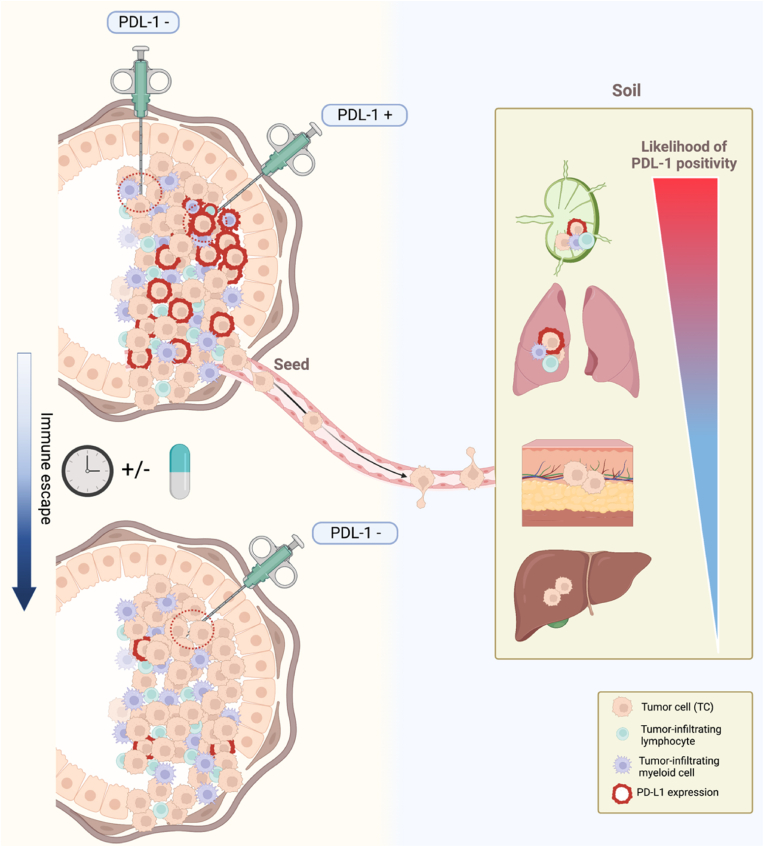
Temporal and spatial heterogeneity of PD-L1 expression. Sources of PD-L1 assay variability through tissue biopsy encompass site of tissue sampling and dynamic changes in PD-L1 expression across the disease course. When clinically relevant, the concept of PD-L1 as a dynamic biomarker should be taken into account. Furthermore, for accurate PD-L1 detection in metastatic settings, it is crucial to consider the impact of the “soil” microenvironment in light of the tissue-specific likelihood of PD-L1 positivity.
Fig. 3
Fig. 3
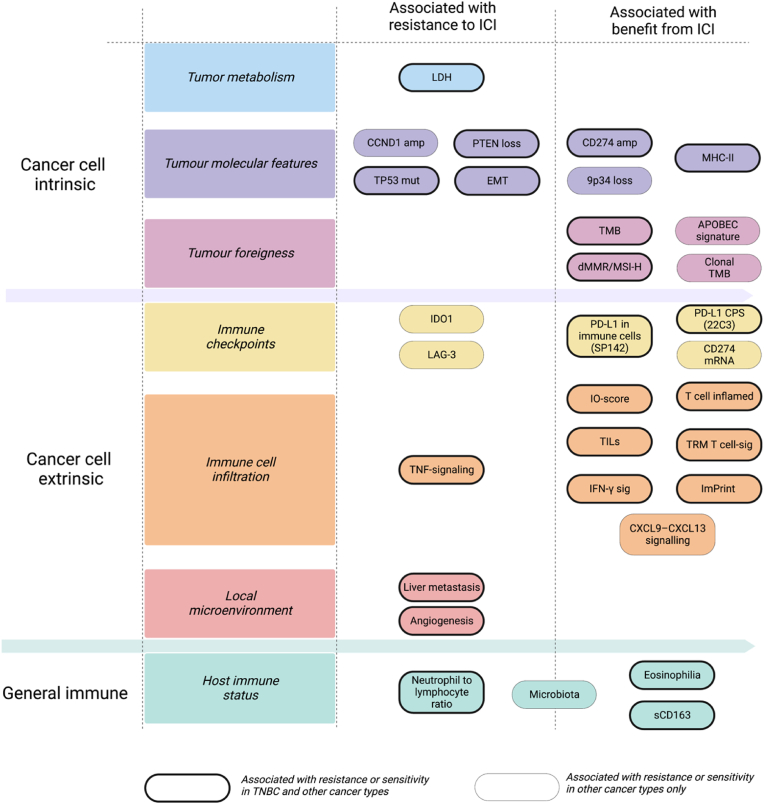
Landscape of biological features associated with immunotherapy response. Cancer cell intrinsic and extrinsic features, including host immunity, impact the effectiveness of immune checkpoint inhibitors targeting the PD-1/PD-L1 axis. The features reported are associated to resistance or sensitivity in either TNBC and other cancer types (bold contoured boxes) or exclusively in other cancer types (thin contoured boxes). Comprehensive assessment of such factors may be pivotal to select patients that are more likely to respond to ICI. (Adapted and updated from Bianchini et al. Nat Rev Clin Oncol 2022).

References

    1. Sharma P., Allison J.P. The future of immune checkpoint therapy. Science. 2015;348:56–61. - PubMed
    1. Pusztai L., Karn T., Safonov A., et al. New strategies in breast cancer: immunotherapy. Clin Cancer Res. 2016;22:2105–2110. - PMC - PubMed
    1. Bianchini G., De Angelis C., Licata L., et al. Treatment landscape of triple-negative breast cancer - expanded options, evolving needs. Nat Rev Clin Oncol. 2022;19:91–113. - PubMed
    1. Jacob SL, Huppert LA, Rugo HS. Role of immunotherapy in breast cancer. JCO Oncology Practice. 2023;0 OP.22.00483. - PubMed
    1. Schmid P, Adams S, Rugo HS, Schneeweiss A, Barrios CH, Iwata H, Diéras V, Hegg R, Im SA, Shaw Wright G, Henschel V, Molinero L, Chui SY, Funke R, Husain A, Winer EP, Loi S, Emens LA; IMpassion130 Trial Investigators. Atezolizumab and Nab-Paclitaxel in Advanced Triple-Negative Breast Cancer. N Engl J Med. 2018 Nov 29;379(22):2108-2121. doi: 10.1056/NEJMoa1809615. Epub 2018 Oct 20. PMID: 30345906. - PubMed