


Clinical Correlates of Sports Betting: A Systematic Review
- PMID: 37004597
- PMCID: PMC10066997
- DOI: 10.1007/s10899-023-10196-0
Clinical Correlates of Sports Betting: A Systematic Review
Abstract
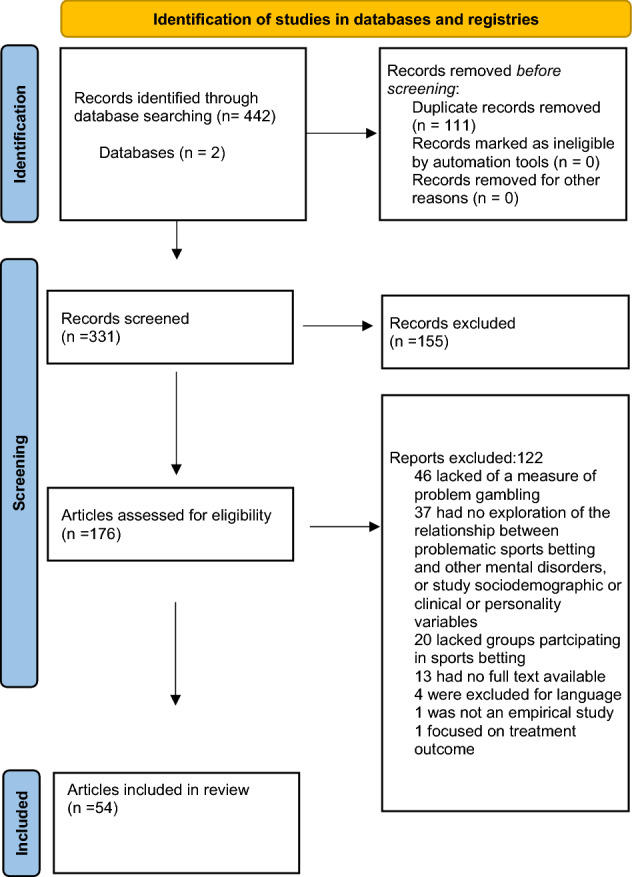
Sports betting is becoming increasingly widespread, and a growing number of individuals, both adolescents and adults, participate in this type of gambling. The main aim of this systematic review was to assess correlates of sports betting (sociodemographic features, gambling-related variables, co-occurring psychopathologies, and personality tendencies) through a systematic review conducted following the PRISMA guidelines. Relevant studies were identified via searches of NCBI/PubMed and APA PsycInfo databases. Individuals from the general population and/or with a clinical diagnosis of gambling disorder (GD) were included, irrespective of gender and age. In addition, the studies needed to have administered at least one clinical interview/psychometric instrument to assess the presence of problematic gambling/GD, contain at least one group of participants with sports betting, and directly analyze the association between sports betting and any of the following features: sociodemographics, gambling-related variables, co-occurring psychopathologies, and/or personality tendencies. Fifty-four articles were included. Multiple sociodemographic variables have been studied in relation to sports betting. In general, males with high impulsivity have greater tendencies for sports betting. The co-occurrence of certain pathologies, especially substance use or other addictive disorders, was also suggested. Most studies were cross-sectional, assessed participants using self-administered instruments, recruited samples using non-probability online panels, included small samples, had unbalanced samples, and included samples from only one country. Impulsive males may be particularly prone to sports gambling and related problems. Future research should examine prevention strategies that may help prevent the development of sport-betting-related GD and other addictive behaviors in vulnerable individuals.
Keywords: Addictive behaviors; Compulsive behaviors; Gambling; Impulsive behaviors; Personality; Psychopathology; Sports betting.
© 2023. The Author(s).
Conflict of interest statement
Dr. Potenza discloses that he has consulted for and advised Game DayData, Addiction Policy Forum, Baria-Tek, AXA, Idorsia, and Opiant Therapeutics; been involved in a patent application with Yale University and Novartis; received research support from the Mohegan Sun Casino and the Connecticut Council on Problem Gambling; consulted for or advised legal and gambling entities on issues related to impulse control and addictive behaviors; provided clinical care related to impulse-control and addictive behaviors; performed grant reviews; edited journals/journal sections; given academic lectures in grand rounds, CME events, and other clinical/scientific venues; and generated books or chapters for publishers of mental health texts. Dr. Derevensky has had a number of consultancy engagements from gambling operators and has provided webinars internationally on gambling and gaming disorders. He has also been the recipient of multiple government research grants. He has also worked as the Director of Research for the Florida Council on Compulsive Gambling and has provided expert testimony to government regulators internationally. Dr. Jimenez-Murcia received consultancy honoraria from Novo Nordisk. The rest of the authors declare no conflict of interest with the content of this manuscript. The funders had no role in the design of the study; in the collection, analyses, or interpretation of data; in the writing of the manuscript, or in the decision to publish the results.
Figures
References
-
- American Psychiatric Association. (2010). Diagnostic and statistical manual of mental disorders (4th Rev). American Psychiatric Association.
-
- American Psychiatric Association. (2013). Diagnostic and statistical manual of mental disorders (5 ed.) American Psychiatric Association.
-
- Armijo-Olivo S, Stiles CR, Hagen NA, Biondo PD, Cummings GG. Assessment of study quality for systematic reviews: a comparison of the cochrane collaboration risk of bias tool and the effective public health practice project quality assessment tool: methodological research. Journal of Evaluation in Clinical Practice. 2012;18:12–18. doi: 10.1111/j.1365-2753.2010.01516.x. - DOI - PubMed
-
- Baggio S, Gainsbury SM, Starcevic V, Richard J-B, Beck F, Billieux J. Gender differences in gambling preferences and problem gambling: A network-level analysis. International Gambling Studies. 2018;18(3):512–525. doi: 10.1080/14459795.2018.1495750. - DOI
