Review
. 2023 Jun;42(2):507-541.
doi: 10.1007/s10555-023-10100-7. Epub 2023 Apr 1.

Considerations for modelling diffuse high-grade gliomas and developing clinically relevant therapies

Affiliations
Review

Considerations for modelling diffuse high-grade gliomas and developing clinically relevant therapies

Sarah L Higginbottom et al. Cancer Metastasis Rev. 2023 Jun.

Abstract

Diffuse high-grade gliomas contain some of the most dangerous human cancers that lack curative treatment options. The recent molecular stratification of gliomas by the World Health Organisation in 2021 is expected to improve outcomes for patients in neuro-oncology through the development of treatments targeted to specific tumour types. Despite this promise, research is hindered by the lack of preclinical modelling platforms capable of recapitulating the heterogeneity and cellular phenotypes of tumours residing in their native human brain microenvironment. The microenvironment provides cues to subsets of glioma cells that influence proliferation, survival, and gene expression, thus altering susceptibility to therapeutic intervention. As such, conventional in vitro cellular models poorly reflect the varied responses to chemotherapy and radiotherapy seen in these diverse cellular states that differ in transcriptional profile and differentiation status. In an effort to improve the relevance of traditional modelling platforms, recent attention has focused on human pluripotent stem cell-based and tissue engineering techniques, such as three-dimensional (3D) bioprinting and microfluidic devices. The proper application of these exciting new technologies with consideration of tumour heterogeneity and microenvironmental interactions holds potential to develop more applicable models and clinically relevant therapies. In doing so, we will have a better chance of translating preclinical research findings to patient populations, thereby addressing the current derisory oncology clinical trial success rate.

Keywords: 3D printing; Clinically relevant; Glioma stem cells; High-grade glioma; Microfluidics; Organoids; Preclinical models; Tissue engineering; Tumour microenvironment.


Conflict of interest statement

The authors declare no competing interests.

Figures
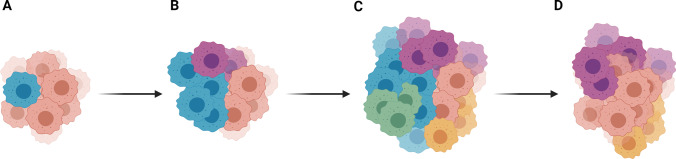
Fig. 1
Fig. 1
Intratumoural heterogeneity may arise by clonal evolution. A) A clonal population of neoplastic cells may acquire an additional mutation. B, C) Subsequent mutations may be acquired by these populations to generate progeny of increasing heterogeneity and abnormality. These populations may differentially expand. D) Resultant subpopulations may respond differently to selective pressures, such as therapeutic intervention, to alter subclone composition
Fig. 2
Fig. 2
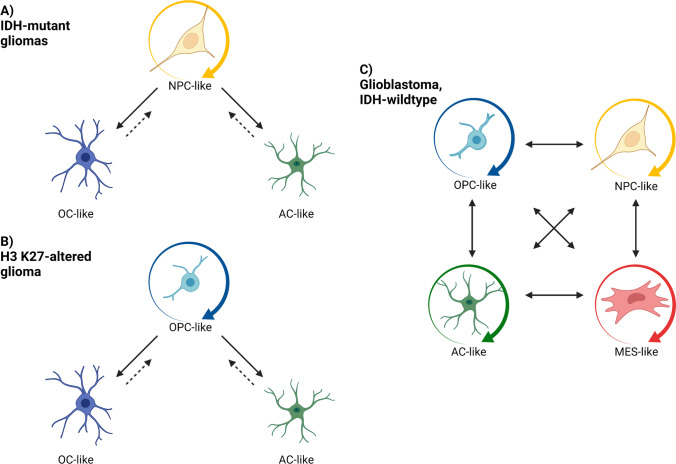
Cell states in high-grade gliomas are plastic. A) IDH-mutant astrocytomas and oligodendrogliomas contain a proliferative neural precursor cell (NPC)-like population capable of self-renewal and differentiating to give oligodendrocyte (OC)- and astrocyte (AC)-like progeny. Although less frequent, OC- and AC-like cells can dedifferentiate to regenerate NPC populations. B) Paediatric-type diffuse midline glioma, H3 K27-altered tumours contain an oligodendrocyte precursor cell (OPC)-like population with stemness features capable of generating differentiated OC- and AC-like progeny. It is expected that OC- and AC-like cells are capable of dedifferentiation to regenerate OPC-like populations. C) Glioblastoma, IDH-wildtype tumours contain OPC-, NPC-, AC- and mesenchymal (MES)-like compartments, each with stem-like and differentiated populations. Cells may move between cellular states through processes of differentiation and dedifferentiation
Fig. 3
Fig. 3
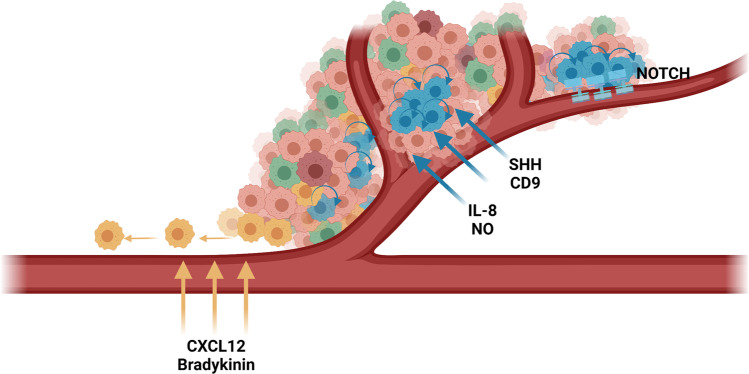
The perivascular niche promotes glioma cell migration and supports the therapy resistant glioma stem cell (GSC) phenotype. Endothelial cells in the perivascular niche release chemoattractants C-X-C motif chemokine ligand 12 (CXCL12) and bradykinin to increase the migration and invasive ability of glioma cell subpopulations expressing C-X-C motif chemokine receptor 4 (CXCR4) and bradykinin 2 receptor (B2R), respectively. These invasive populations migrate along pre-existing vasculature to invade healthy brain tissue. Endothelial cells also release sonic hedgehog (SHH), tetraspanin CD9 (CD9), interlukin-8 (IL-8) and nitric oxide (NO), promoting the stemness, self-renewal and survival of glioma stem cell (GSC) subpopulations. NOTCH receptors expressed on GSC surfaces bind NOTCH ligands, including delta-like 4 (DLL4), expressed on endothelial cells to facilitate the maintenance of the GSC state
Fig. 4
Fig. 4
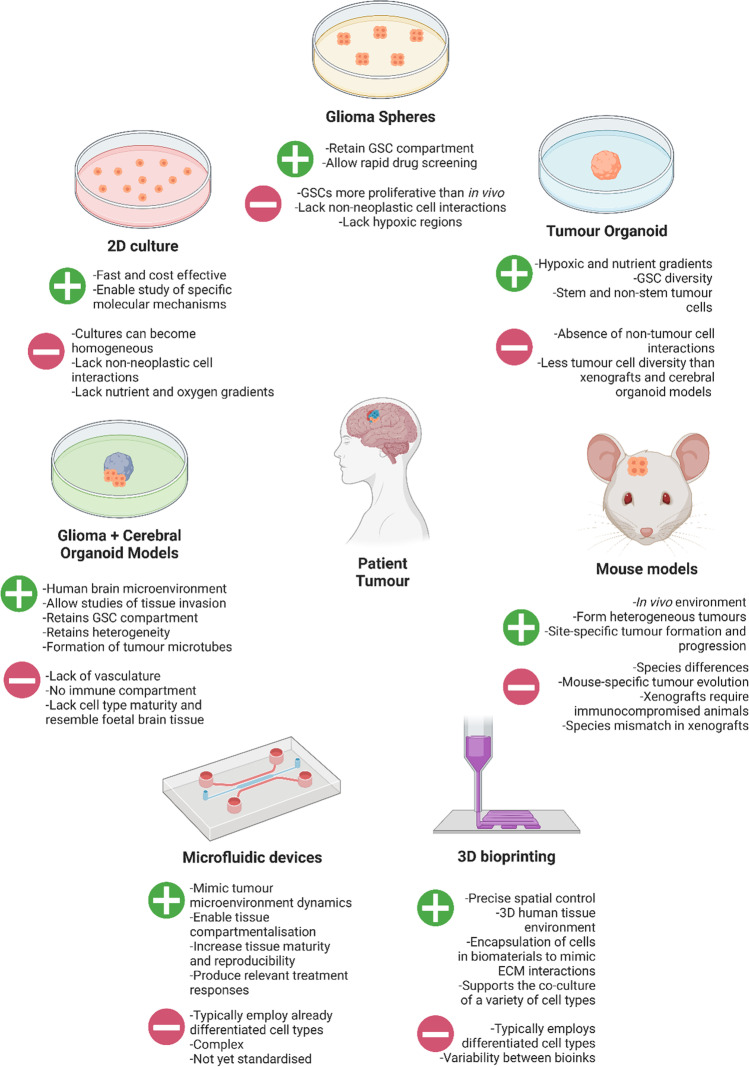
Advantages and disadvantages of modelling platforms. Diffuse high-grade gliomas have been modelled through two-dimensional (2D) cell culture, culture as glioma spheres under stem-promoting conditions, three-dimensional (3D) organoid culture of glioma cells, the generation of mouse models, by the co-culture of glioma cells and cerebral organoids, by microfluidic devices and by 3D bioprinting. Each have inherent advantages and limitations that require consideration in research and development. GSC, glioma stem cell. ECM, extracellular matrix

References

    1. Ostrom QT, Cioffi G, Gittleman H, Patil N, Waite K, Kruchko C, et al. CBTRUS Statistical Report: Primary Brain and Other Central Nervous System Tumors Diagnosed in the United States in 2012–2016. Neuro-Oncology. 2019;21(Suppl 5):v1–v100. doi: 10.1093/neuonc/noz150. - DOI - PMC - PubMed
    1. Louis DN, Perry A, Wesseling P, Brat DJ, Cree IA, Figarella-Branger D, et al. The 2021 WHO Classification of Tumors of the Central Nervous System: A summary. Neuro-Oncology. 2021 doi: 10.1093/neuonc/noab106. - DOI - PMC - PubMed
    1. Stupp R, Taillibert S, Kanner A, Read W, Steinberg D, Lhermitte B, et al. Effect of Tumor-Treating Fields Plus Maintenance Temozolomide vs Maintenance Temozolomide Alone on Survival in Patients With Glioblastoma: A Randomized Clinical Trial. JAMA. 2017;318(23):2306–2316. doi: 10.1001/jama.2017.18718. - DOI - PMC - PubMed
    1. Stupp R, Mason WP, van den Bent MJ, Weller M, Fisher B, Taphoorn MJ, et al. Radiotherapy plus concomitant and adjuvant temozolomide for glioblastoma. New England Journal of Medicine. 2005;352(10):987–996. doi: 10.1056/NEJMoa043330. - DOI - PubMed
    1. Weller M, Cloughesy T, Perry JR, Wick W. Standards of care for treatment of recurrent glioblastoma–are we there yet? Neuro-Oncology. 2013;15(1):4–27. doi: 10.1093/neuonc/nos273. - DOI - PMC - PubMed

Publication types