


Responsiveness and construct validity of EPIC-26, AQoL-6D and SF-6D following treatment in prostate cancer
- PMID: 37005587
- PMCID: PMC10067207
- DOI: 10.1186/s12885-023-10732-6
Responsiveness and construct validity of EPIC-26, AQoL-6D and SF-6D following treatment in prostate cancer
Abstract
Purpose: To assess construct validity and responsiveness of the Expanded Prostate Cancer Index Composite Instrument (EPIC-26) relative to the Short-Form Six-Dimension (SF-6D) and Assessment of Quality of Life 6-Dimension (AQoL-6D) in patients following treatment for prostate cancer.
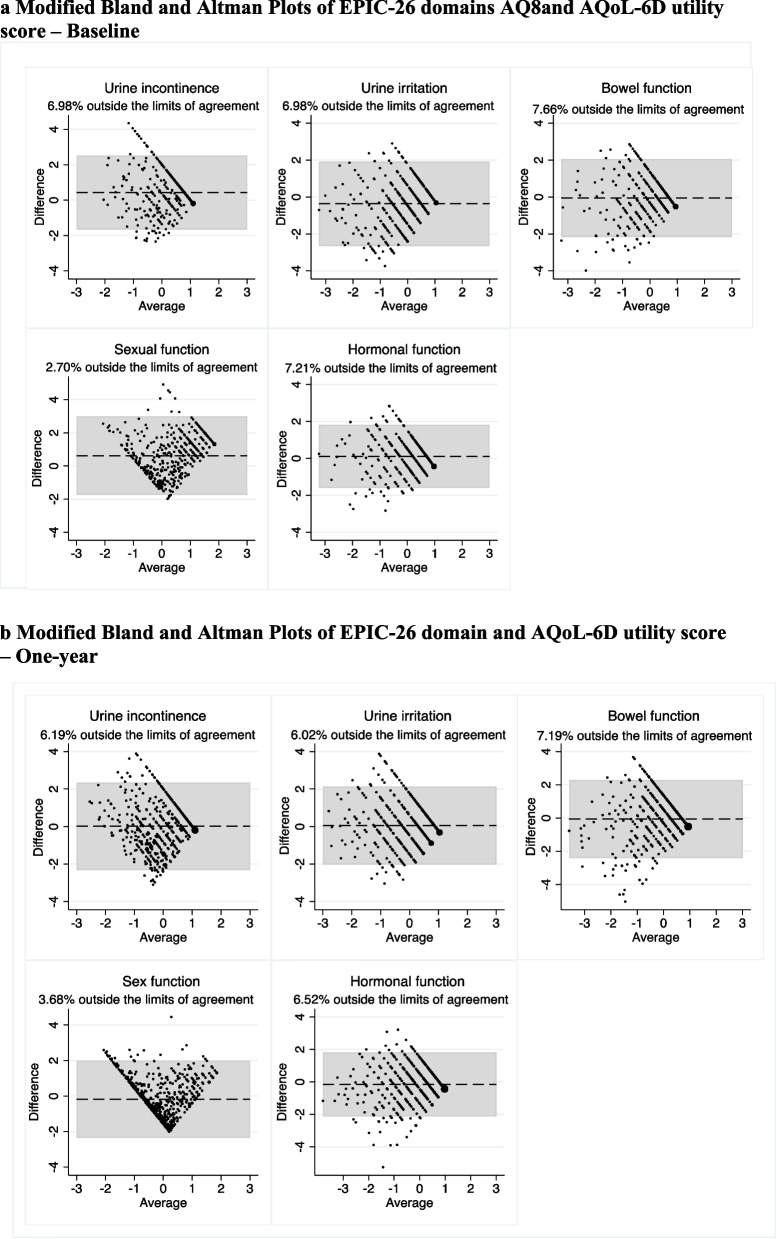
Methods: Retrospective prostate cancer registry data were used. The SF-6D, AQoL-6D, and EPIC-26 were collected at baseline and one year post treatment. Analyses were based on Spearman's correlation coefficient, Bland-Altman plots and intra-class correlation coefficient, Kruskal Wallis, and Effect Size and the Standardised Response Mean for responsiveness.
Results: The study sample was comprised of 1915 patients. Complete case analysis of 3,697 observations showed moderate evidence of convergent validity between EPIC-26 vitality/hormonal domain and AQoL-6D (r = 0.45 and 0.54) and SF-6D (r = 0.52 and 0.56) at both timepoints. Vitality/hormonal domain also showed moderate convergent validity with coping domain of AQoL-6D (r = 0.45 and 0.54) and with role (r = 0.41 and 0.49) and social function (r = 0.47 and 0.50) domains of SF-6D at both timepoints, and with independent living (r = 0.40) and mental health (r = 0.43) of AQoL-6D at one year. EPIC-26 sexual domain had moderate convergent validity with relationship domain (r = 0.42 and 0.41) of AQoL-6D at both timepoints. Both AQoL-6D and SF-6D did not discriminate between age groups and tumour stage at both timepoints but AQoL-6D discriminated between outcomes for different treatments at one year. All EPIC-26 domains discriminated between age groups and treatment at both timepoints. The EPIC-26 was more responsive than AQoL-6D and SF-6D between baseline and one year following treatment.
Conclusions: AQoL-6D can be used in combination with EPIC-26 in place of SF-12. Although EPIC-26 is not utility based, its popularity amongst clinicians and ability to discriminate between disease-specific characteristics and post-treatment outcomes in clinical trials makes it a candidate for use within cost-effectiveness analyses. The generic measure provides a holistic assessment of quality of life and is suitable for generating quality adjusted life years (QALYs).
Keywords: AQoL-6D; Construct validity; Convergent validity; Discriminant validity; EPIC-26; Prostate cancer; Responsiveness; SF-6D.
© 2023. The Author(s).
Conflict of interest statement
No conflict of interest to declare.
Figures

References
-
- Cancer Australia . Prostate cancer in Australia: Australian Government. 2019.
-
- Harris A, Bulfone L. Getting value for money: The Australian experience. In: Jost TS, editor. Health Care Coverage Determinations: An International Comparative Study. Maidenhead: Open University Press, McGraw-Hill International; 2004.
MeSH terms
LinkOut - more resources
Full Text Sources
Medical
