


SARS-CoV-2 in Nursing Homes: Analysis of Routine Surveillance Data in Four European Countries
- PMID: 37008047
- PMCID: PMC10017157
- DOI: 10.14336/AD.2022.0820
SARS-CoV-2 in Nursing Homes: Analysis of Routine Surveillance Data in Four European Countries
Abstract
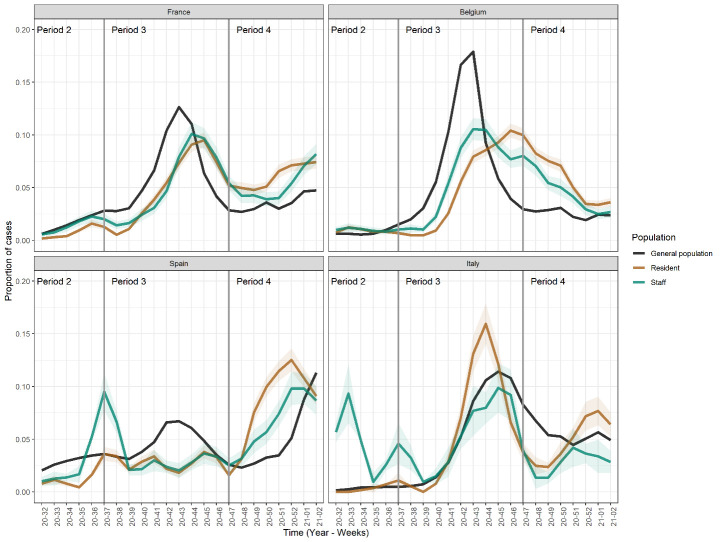
Transmission of SARS-CoV-2 in nursing homes is poorly documented. Using surveillance data of 228 European private nursing homes, we estimated weekly SARS-CoV-2 incidences among 21,467 residents and 14,371 staff members, compared to that in the general population, between August 3, 2020, and February 20, 2021. We studied the outcomes of "episodes of introduction" where one case was first detected and computed attack rates, reproduction ratio (R), and dispersion parameter (k). Out of 502 episodes of SARS-CoV-2 introduction, 77.1% (95%CI, 73.2%-80.6%) led to additional cases. Attack rates were highly variable, ranging from 0.4% to 86.5%. The R was 1.16 (95%CI, 1.11-1.22) with k at 2.5 (95%CI, 0.5-4.5). The timing of viral circulation in nursing homes did not mirror that in the general population (p-values<0.001). We estimated the impact of vaccination in preventing SARS-CoV-2 transmission. Before vaccination's roll-out, a cumulated 5,579 SARS-CoV-2 infections were documented among residents and 2,321 among staff. Higher staffing ratio and previous natural immunization reduced the probability of an outbreak following introduction. Despite strong preventive measures, transmission likely occurred, regardless of building characteristics. Vaccination started on January 15, 2021, and coverage reached 65.0% among residents, and 42.0% among staff by February 20, 2021. Vaccination yielded a 92% reduction (95%CI, 71%-98%) of outbreak probability, and lowered R to 0.87 (95%CI, 0.69-1.10). In the post-pandemic era, much attention will have to be paid to multi-lateral collaboration, policy making, and prevention plans.
Keywords: Europe; SARS-CoV-2; cohort; nursing homes; vaccination.
copyright: © 2022 Delory et al.
Conflict of interest statement
Conflict of interests The data provider (Colisee group) had no role in the study design, data analysis or data interpretation. PE-H and VK are employed by the Colisee group. The views expressed in this publication are those of the authors and not necessarily those of the Colisee group.
Figures
References
-
- Sablerolles RSG, Lafeber M, van Kempen JAL, van de Loo BPA, Boersma E, Rietdijk WJR, et al. (2021). Association between Clinical Frailty Scale score and hospital mortality in adult patients with COVID-19 (COMET): an international, multicentre, retrospective, observational cohort study. Lancet Healthy Longev, 2:e163-e170. - PMC - PubMed
-
- Canouï-Poitrine F, Rachas A, Thomas M, Carcaillon-Bentata L, Fontaine R, Gavazzi G, et al. (2021). Magnitude, change over time, demographic characteristics and geographic distribution of excess deaths among nursing home residents during the first wave of COVID-19 in France: a nationwide cohort study. Age Ageing, 50:1473-1481. - PMC - PubMed
LinkOut - more resources
Full Text Sources
Miscellaneous