


Face-to-face with scorching wildfire: potential toxicant exposure and the health risks of smoke for wildland firefighters at the wildland-urban interface
- PMID: 37008196
- PMCID: PMC10060103
- DOI: 10.1016/j.lana.2023.100482
Face-to-face with scorching wildfire: potential toxicant exposure and the health risks of smoke for wildland firefighters at the wildland-urban interface
Abstract
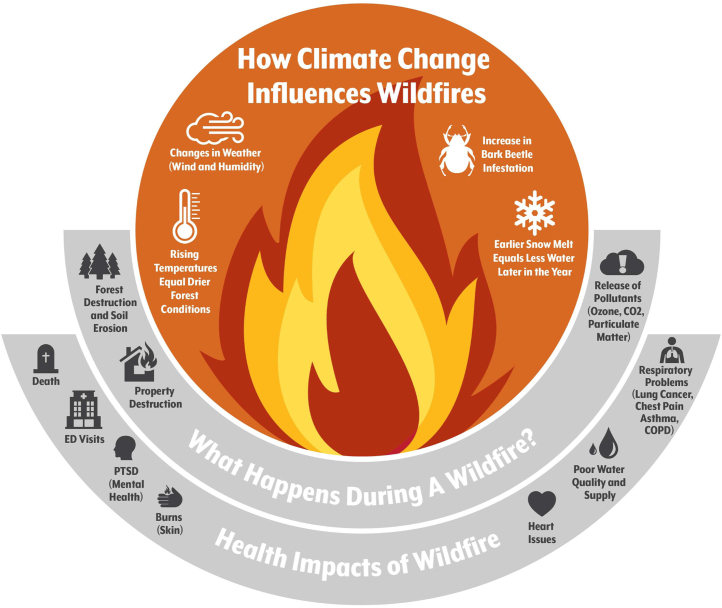
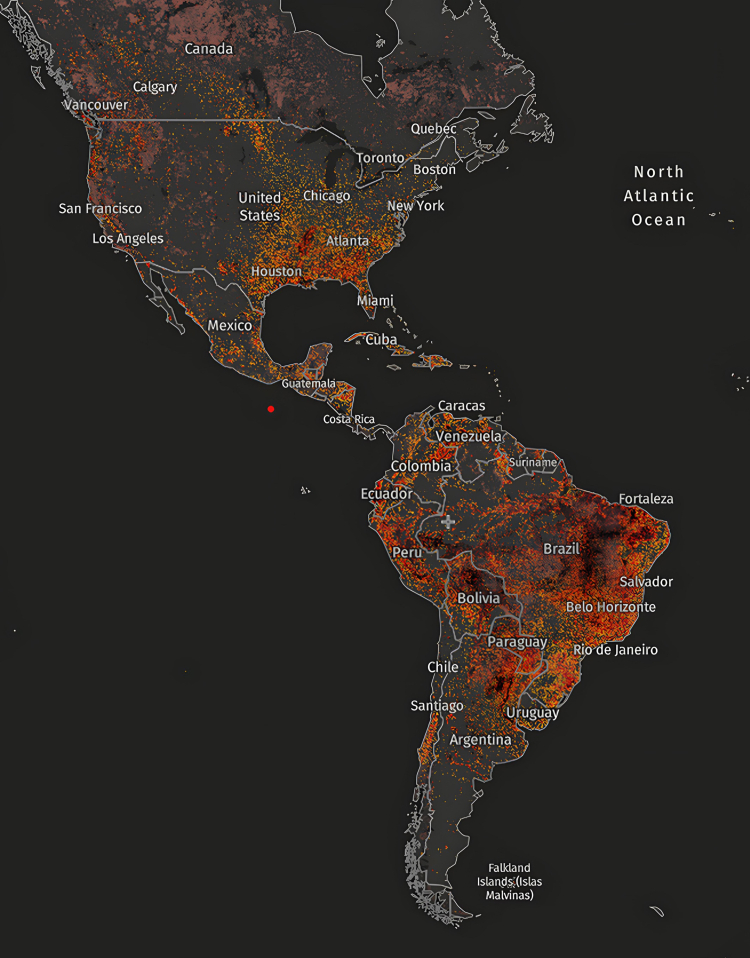
As wildfire risks have elevated due to climate change, the health risks that toxicants from fire smoke pose to wildland firefighters have been exacerbated. Recently, the International Agency for Research on Cancer (IARC) has reclassified wildland firefighters' occupational exposure as carcinogenic to humans (Group 1). Wildfire smoke contributes to an increased risk of cancer and cardiovascular disease, yet wildland firefighters have inadequate respiratory protection. The economic cost of wildland fires has risen concurrently, as illustrated by the appropriation of $45 billion for wildfire management over FYs 2011-2020 by the U.S. Congress. Occupational epidemiological studies of wildland firefighters are crucial for minimizing health risks; however, they must account for the mixture of exposures in wildfire smoke. This review focuses on four aspects of wildland firefighters' health risks at the wildland-urban interface: 1) economic costs and health impact, 2) respiratory protection, 3) multipollutant mixtures, and 4) proactive management of wildfires.
Keywords: Exposure assessment; Firefighter; Multi-pollutant mixtures of fire smoke; Occupational and environmental health; Prescribed burn; Wildfire; Wildland-urban interface (WUI).
© 2023 The Author(s).
Conflict of interest statement
The authors declare no conflict of interest.
Figures
Similar articles
-
Smoke Exposure and Respirator Use Among Wildland Firefighters: A Narrative Review.Wilderness Environ Med. 2025 Sep;36(3):405-415. doi: 10.1177/10806032251326825. Epub 2025 Apr 23. Wilderness Environ Med. 2025. PMID: 40267327 Review.
-
Wildland firefighter smoke exposure and risk of lung cancer and cardiovascular disease mortality.Environ Res. 2019 Jun;173:462-468. doi: 10.1016/j.envres.2019.03.060. Epub 2019 Mar 26. Environ Res. 2019. PMID: 30981117
-
Exposure to Particulate Matter and Estimation of Volatile Organic Compounds across Wildland Firefighter Job Tasks.Environ Sci Technol. 2021 Sep 7;55(17):11795-11804. doi: 10.1021/acs.est.1c00847. Epub 2021 Aug 17. Environ Sci Technol. 2021. PMID: 34488352 Free PMC article.
-
Wildland firefighter exposure to smoke and COVID-19: A new risk on the fire line.Sci Total Environ. 2021 Mar 15;760:144296. doi: 10.1016/j.scitotenv.2020.144296. Epub 2020 Dec 11. Sci Total Environ. 2021. PMID: 33341613 Free PMC article. Review.
-
Review of the health effects of wildland fire smoke on wildland firefighters and the public.Inhal Toxicol. 2016;28(3):95-139. doi: 10.3109/08958378.2016.1145771. Inhal Toxicol. 2016. PMID: 26915822 Review.
Cited by
-
"Air That Once Was Breath" Part 2: Wildfire Smoke and Airway Disease - "Climate Change, Allergy and Immunology" Special IAAI Article Collection: Collegium Internationale Allergologicum Update 2023.Int Arch Allergy Immunol. 2024;185(6):617-630. doi: 10.1159/000536576. Epub 2024 Mar 25. Int Arch Allergy Immunol. 2024. PMID: 38527432 Free PMC article. Review.
-
Health effects of repeated exposures during wildland firefighting: a data-linkage cohort study from Alberta, Canada.Ann Work Expo Health. 2025 Feb 25;69(2):132-146. doi: 10.1093/annweh/wxae089. Ann Work Expo Health. 2025. PMID: 39607898 Free PMC article.
-
Particulate matter air pollution as a cause of lung cancer: epidemiological and experimental evidence.Br J Cancer. 2025 Jun;132(11):986-996. doi: 10.1038/s41416-025-02999-2. Epub 2025 Apr 4. Br J Cancer. 2025. PMID: 40185876 Free PMC article. Review.
-
Integrated Portable and Stationary Health Impact-Monitoring System for Firefighters.Sensors (Basel). 2024 Apr 2;24(7):2273. doi: 10.3390/s24072273. Sensors (Basel). 2024. PMID: 38610485 Free PMC article.
-
Repeated exposure to eucalyptus wood smoke alters pulmonary gene and metabolic profiles in male Long-Evans rats.Toxicol Sci. 2024 May 28;199(2):332-348. doi: 10.1093/toxsci/kfae040. Toxicol Sci. 2024. PMID: 38544285 Free PMC article.
References
-
- Demers P.A., DeMarini D.M., Fent K.W., et al. Carcinogenicity of occupational exposure as a firefighter. Lancet Oncol. 2022;2045(22):4–5. - PubMed
-
- Pivello V.R., Vieira I., Christianini A.V., et al. Understanding Brazil's catastrophic fires: causes, consequences and policy needed to prevent future tragedies. Perspect Ecol Conserv. 2021;19(3):233–255.
-
- Radeloff V.C., Hammer R.B., Stewart S.I., Fried J.S., Holcomb S.S., McKeefry J.F. The wildland–urban interface in the United States. Ecol Appl. 2005;15(3):799–805.
Publication types
Grants and funding
LinkOut - more resources
Full Text Sources
Research Materials
