Review
. 2023 Apr 2;21(1):240.
doi: 10.1186/s12967-023-04088-5.

The roles of dietary lipids and lipidomics in gut-brain axis in type 2 diabetes mellitus

Affiliations
Review

The roles of dietary lipids and lipidomics in gut-brain axis in type 2 diabetes mellitus

Duygu Ağagündüz et al. J Transl Med. .

Abstract

Type 2 diabetes mellitus (T2DM), one of the main types of Noncommunicable diseases (NCDs), is a systemic inflammatory disease characterized by dysfunctional pancreatic β-cells and/or peripheral insulin resistance, resulting in impaired glucose and lipid metabolism. Genetic, metabolic, multiple lifestyle, and sociodemographic factors are known as related to high T2DM risk. Dietary lipids and lipid metabolism are significant metabolic modulators in T2DM and T2DM-related complications. Besides, accumulated evidence suggests that altered gut microbiota which plays an important role in the metabolic health of the host contributes significantly to T2DM involving impaired or improved glucose and lipid metabolism. At this point, dietary lipids may affect host physiology and health via interaction with the gut microbiota. Besides, increasing evidence in the literature suggests that lipidomics as novel parameters detected with holistic analytical techniques have important roles in the pathogenesis and progression of T2DM, through various mechanisms of action including gut-brain axis modulation. A better understanding of the roles of some nutrients and lipidomics in T2DM through gut microbiota interactions will help develop new strategies for the prevention and treatment of T2DM. However, this issue has not yet been entirely discussed in the literature. The present review provides up-to-date knowledge on the roles of dietary lipids and lipidomics in gut-brain axis in T2DM and some nutritional strategies in T2DM considering lipids- lipidomics and gut microbiota interactions are given.

Keywords: Diet; Gut microbiota; Lipidomics; Lipids; Type 2 diabetes mellitus.


Conflict of interest statement

The authors declare that they have no competing interests.

Figures
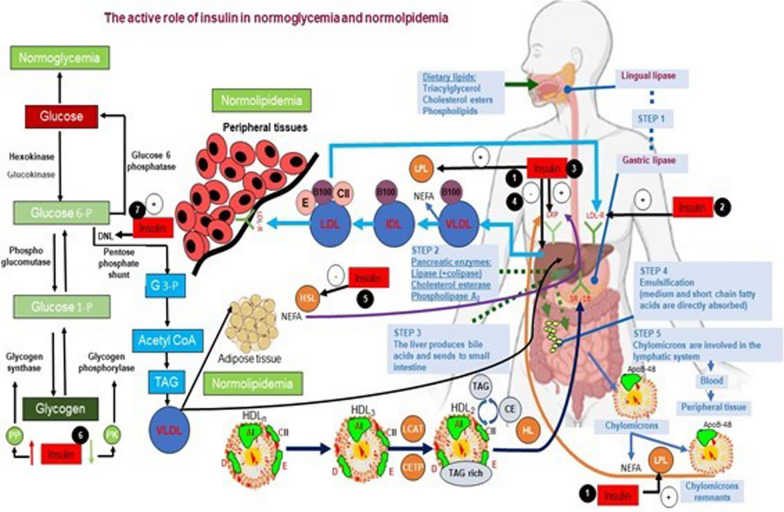
Fig. 1
Fig. 1
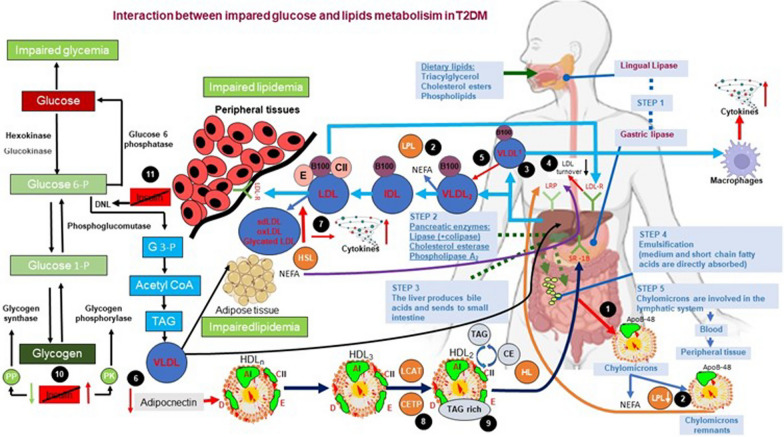
The active role of insulin in normoglycemia and normolipidemia. An overview of Interaction between impared glucose and lipids metabolisim inT2DM. (1) increased chylomicron production, (2) reduced catabolism of both chylomicrons and VLDLs (diminished LPL activity), (3)increased VLDL production (mostly VLDL1), (4) reduced LDL turnover (5) increased production of large VLDL (VLDL1) preferentially taken up by macrophages; LDL (qualitative and kinetic abnormalities): (6) low plasma adiponectin favouring the increase in HDL catabolism. (7) increased number of glycated LDLs, small, dense LDLs (TAG-rich) and oxidised LDLs, which are preferentially taken up by macrophages; (8) increased CETP activity (increased transfer of triacylglycerols from TAG-rich lipoproteins to LDLs and HDLs), (9) increased TAG content of HDLs, promoting HL activity and HDL catabolism, (10) İmpaired glucose metabolisim. (11) İmpaired de novo lipid metabolisim (Acetyl CoA and NADPH inhibit pyruvate dehydrogenase as a result of B oxidation. The lactate and alalnin thus formed increase hyperglycemia because of gluconeogenesis (ketone bodies formation increases) in the liver.) CE cholesterol ester, CETP cholesteryl ester transfer protein, HDLn nascent HDL, HL hepatic lipase, HSL hormone-sensitive lipase, LPL lipoprotein lipase, SR-B1 scavenger receptor B1, TAG triacylglycerol, PP protein phosphatase, PK protein kinase, NEFA non-esterified fatty acids DNL: de novo lipogenesis, LCAT Lesitin-kolesterol acil transferaz, G3P gliserol 3-fosfat protein kinase
Fig. 2
Fig. 2
Interaction between impared glucose and lipids metabolism in T2DM. An overview of Interaction between impared glucose and lipids metabolisim inT2DM. (1) increased chylomicron production, (2) reduced catabolism of both chylomicrons and VLDLs (diminished LPL activity), (3)increased VLDL production (mostly VLDL1), (4) reduced LDL turnover (5) increased production of large VLDL (VLDL1) preferentially taken up by macrophages; LDL (qualitative and kinetic abnormalities): (6) low plasma adiponectin favouring the increase in HDL catabolism. (7) increased number of glycated LDLs, small, dense LDLs (TAG-rich) and oxidised LDLs, which are preferentially taken up by macrophages; (8) increased CETP activity (increased transfer of triacylglycerols from TAG-rich lipoproteins to LDLs and HDLs), (9) increased TAG content of HDLs, promoting HL activity and HDL catabolism, (10) İmpaired glucose metabolisim. (11) İmpaired de novo lipid metabolisim (Acetyl CoA and NADPH inhibit pyruvate dehydrogenase as a result of B oxidation. The lactate and alalnin thus formed increase hyperglycemia because of gluconeogenesis (ketone bodies formation increases) in the liver.) CE, cholesterol ester, CETP cholesteryl ester transfer protein, HDLn nascent HDL, HL hepatic lipase, HSL hormone-sensitive lipase, LPL lipoprotein lipase, SR-B1 scavenger receptor B1, TAG triacylglycerol, PP protein phosphatase, PK protein kinase, NEFA non-esterified fatty acids, DNL de novo lipogenesis, LCAT Lesitin-kolesterol açil transferaz, G3P gliserol 3-fosfat protein kinase
Fig. 3
Fig. 3
Gut-brain axis pathways related to T2DM. ENS enteric nervous system, SCFA short-chain fatty acid, LPS lipopolysaccharide
Fig. 4
Fig. 4
Some nutritional strategies in T2DM considering lipidomics and gut microbiota interaction

References

    1. Roden M, Shulman GI. The integrative biology of type 2 diabetes. Nature. 2019;576(7785):51–60. doi: 10.1038/s41586-019-1797-8. - DOI - PubMed
    1. Chatterjee S, Khunti K, Davies MJ. Type 2 diabetes. The Lancet. 2017;389(10085):2239–2251. doi: 10.1016/S0140-6736(17)30058-2. - DOI - PubMed
    1. Paulson KR, Kamath AM, Alam T, Bienhoff K, Abady GG, Abbas J, et al. Global, regional, and national progress towards Sustainable Development Goal 3.2 for neonatal and child health: all-cause and cause-specific mortality findings from the Global Burden of Disease Study 2019. Lancet. 2021;398(10303):870–905. doi: 10.1016/S0140-6736(21)01207-1. - DOI - PMC - PubMed
    1. American Diabetes Association Professional Practice Committee 2. Classification and diagnosis of diabetes: Standards of medical care in diabetes—2022. Diabetes Care. 2022;45:17–38. doi: 10.2337/dc22-S002. - DOI
    1. International Diabetes Federation. IDF Diabetes Atlas 2021. https://diabetesatlas.org/atlas/tenth-edition/ Accessed 11 November 2022

Publication types