


Allogeneic Hematopoietic Stem Cell Transplantation Activity in Inborn Errors of Immunity in Russian Federation
- PMID: 37009957
- PMCID: PMC10068234
- DOI: 10.1007/s10875-023-01476-w
Allogeneic Hematopoietic Stem Cell Transplantation Activity in Inborn Errors of Immunity in Russian Federation
Abstract
Purpose: Allogeneic hematopoietic stem cell transplantation (HSCT) is an established therapy for many inborn errors of immunity (IEI). The indications for HSCT have expanded over the last decade. The study aimed to collect and analyze the data on HSCT activity in IEI in Russia.
Methods: The data were collected from the Russian Primary Immunodeficiency Registry and complemented with information from five Russian pediatric transplant centers. Patients diagnosed with IEI by the age of 18 years and who received allogeneic HSCT by the end of 2020 were included.
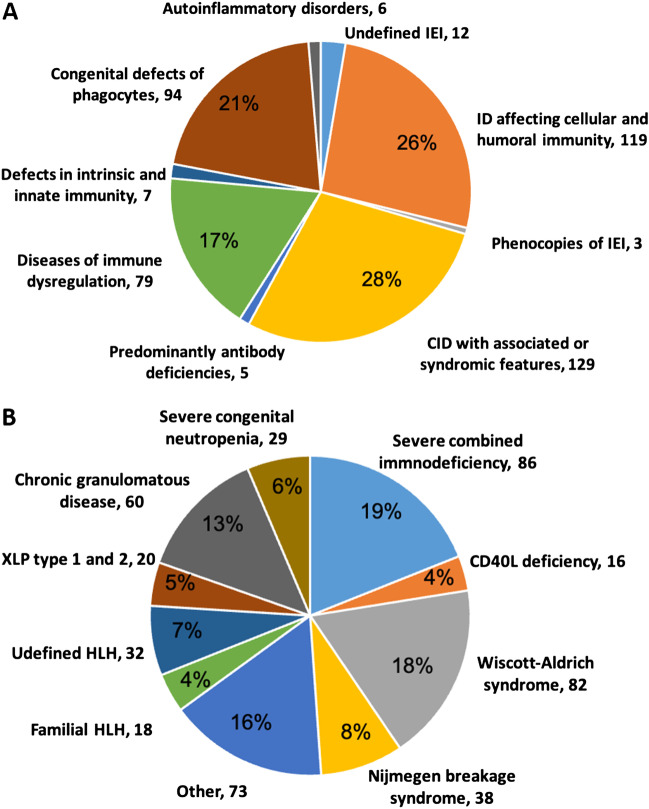
Results: From 1997 to 2020, 454 patients with IEI received 514 allogeneic HSCT. The median number of HSCTs per year has risen from 3 in 1997-2009 to 60 in 2015-2020. The most common groups of IEI were immunodeficiency affecting cellular and humoral immunity (26%), combined immunodeficiency with associated/syndromic features (28%), phagocyte defects (21%), and diseases of immune dysregulation (17%). The distribution of IEI diagnosis has changed: before 2012, the majority (65%) had severe combined immunodeficiency (SCID) and hemophagocytic lymphohistiocytosis (HLH), and after 2012, only 24% had SCID and HLH. Of 513 HSCTs, 48.5% were performed from matched-unrelated, 36.5% from mismatched-related (MMRD), and 15% from matched-related donors. In 349 transplants T-cell depletion was used: 325 TCRαβ/CD19+ depletion, 39 post-transplant cyclophosphamide, and 27 other. The proportion of MMRD has risen over the recent years.
Conclusion: The practice of HSCT in IEI has been changing in Russia. Expanding indications to HSCT and SCID newborn screening implementation may necessitate additional transplant beds for IEI in Russia.
Keywords: Primary immunodeficiency; hematopoietic stem cell transplantation; inborn errors of immunity; transplantation activity.
© 2023. The Author(s), under exclusive licence to Springer Science+Business Media, LLC, part of Springer Nature.
Conflict of interest statement
The authors declare no competing interests.
Figures



References
-
- Barzaghi F, Hernandez LC, Neven B, Ricci S, Kucuk ZY, Bleesing JJ, Nademi Z, Slatter MA, Ulloa ER, Shcherbina A, Roppelt A. Long-term follow-up of IPEX syndrome patients after different therapeutic strategies: an international multicenter retrospective study. J Allergy Clin Immunol. 2018;141(3):1036–1049.e5. doi: 10.1016/j.jaci.2017.10.041. - DOI - PMC - PubMed
-
- Yang L, Booth C, Speckmann C, Seidel MG, Worth AJ, Kindle G, Lankester AC, Grimbacher B, Sediva A, Neven B, Hauck F. Phenotype, genotype, treatment, and survival outcomes in patients with X-linked inhibitor of apoptosis deficiency. J Allergy Clin Immunol. 2021;150(2):456–466. doi: 10.1016/j.jaci.2021.10.037. - DOI - PubMed
-
- Wolska-Kusnierz B, Pastorczak A, Fendler W, Wakulinska A, Dembowska-Baginska B, Heropolitanska-Pliszka E, Piątosa B, Pietrucha B, Kałwak K, Ussowicz M, Pieczonka A. Hematopoietic stem cell transplantation positively affects the natural history of cancer in Nijmegen Breakage Syndrome. Clin Cancer Res. 2021;27(2):575–584. doi: 10.1158/1078-0432.CCR-20-2574. - DOI - PubMed
-
- Passweg JR, Baldomero H, Chabannon C, Basak GW, de La Cámara R, Corbacioglu S, Dolstra H, Duarte R, Glass B, Greco R, Lankester AC. Hematopoietic cell transplantation and cellular therapy survey of the EBMT: monitoring of activities and trends over 30 years. Bone Marrow Transplant. 2021;56(7):1651–1664. doi: 10.1038/s41409-021-01227-8. - DOI - PMC - PubMed
MeSH terms
Substances
LinkOut - more resources
Full Text Sources
