


Interleukin 6 Blockade With Tocilizumab Diminishes Indices of Inflammation That Are Linked to Mortality in Treated Human Immunodeficiency Virus Infection
- PMID: 37011013
- PMCID: PMC10371305
- DOI: 10.1093/cid/ciad199
Interleukin 6 Blockade With Tocilizumab Diminishes Indices of Inflammation That Are Linked to Mortality in Treated Human Immunodeficiency Virus Infection
Abstract
Background: People with human immunodeficiency virus (PWH) are at increased risk for comorbidities, and plasma interleukin 6 (IL-6) levels are among the most robust predictors of these outcomes. Tocilizumab (TCZ) blocks the receptor for IL-6, inhibiting functions of this cytokine.
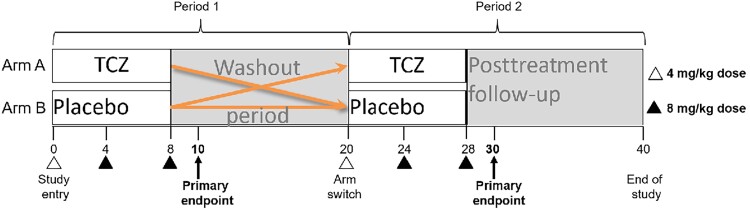
Methods: This was a 40-week, placebo-controlled, crossover trial (NCT02049437) where PWH on stable antiretroviral therapy (ART) were randomized to receive 3 monthly doses of TCZ or matching placebo intravenously. Following a 10-week treatment period and a 12-week washout, participants were switched to the opposite treatment. The primary endpoints were safety and posttreatment levels of C-reactive protein (CRP) and CD4+ T-cell cycling. Secondary endpoints included changes in inflammatory indices and lipid levels.
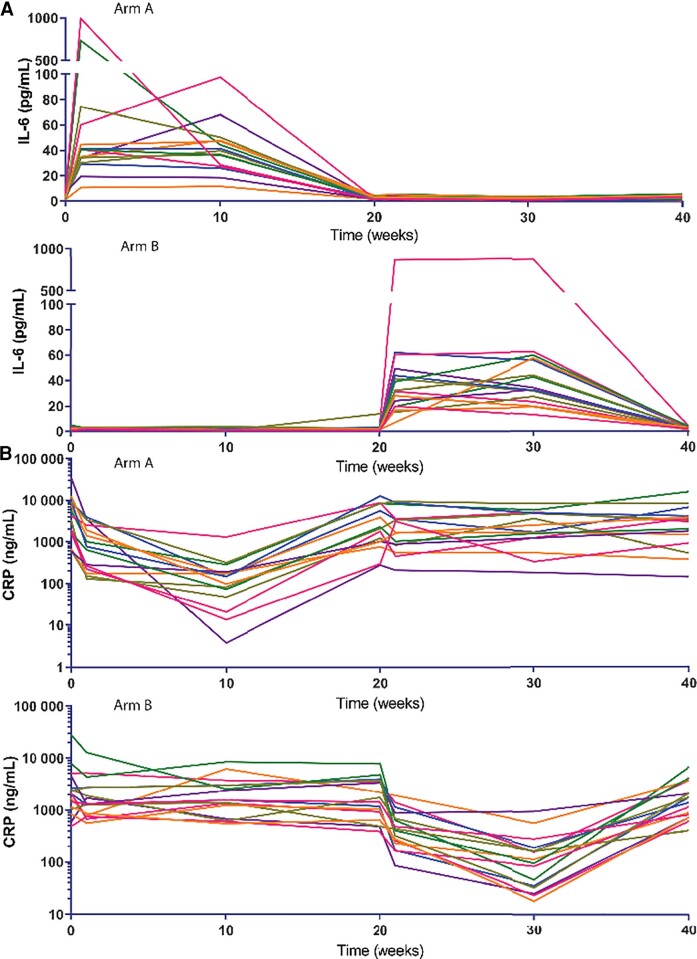
Results: There were 9 treatment-related toxicities of grade 2 or greater during TCZ administration (mostly neutropenia) and 2 during placebo administration. Thirty-one of 34 participants completed the study and were included in a modified intent-to-treat analysis. TCZ reduced levels of CRP (median decrease, 1819.9 ng/mL, P < .0001; effect size, 0.87) and reduced inflammatory markers in PWH, including D-dimer, soluble CD14, and tumor necrosis factor receptors. T-cell cycling tended to decrease in all maturation subsets after TCZ administration, but was only significant among naive CD4 T cells. Lipid levels, including lipid classes that have been related to cardiovascular disease risk, increased during TCZ treatment.
Conclusions: TCZ is safe and decreases inflammation in PWH; IL-6 is a key driver of the inflammatory environment that predicts morbidity and mortality in ART-treated PWH. The clinical significance of lipid elevations during TCZ treatment requires further study. Clinical Trials Registration. NCT02049437.
Keywords: HIV-1; inflammation; interleukin-6; lipid profiling; tocilizumab.
© The Author(s) 2023. Published by Oxford University Press on behalf of Infectious Diseases Society of America. All rights reserved. For permissions, please e-mail: journals.permissions@oup.com.
Conflict of interest statement
Potential conflicts of interest. N. T. F. reports grants or contracts from the NIH and Gilead, and has served as a consultant for Gilead. C. T. L. has received research grants from Gilead Sciences and Medtronic Foundation and has served on an advisory board for Esperion Therapeutics. A. L. has served as a consultant to Abbott. G. A. M. reports grants or contracts from Pfizer, Astellas, Roche, Genentech, Redhill, Cognivue, Vanda, and Tetraphase; served as scientific advisor and consultant for Gilead, Merck, Janssen, Theratechnologies, and GSK/ViiV; and received payment for expert testimony from Gilead. M. M. L. has received competitive grant funding from Gilead and has served as consultant for Merck. C. F. reports serving as a paid consultant for Gilead, Janssen, Merck, American Gene Technologies, Thera Technologies, Shinogi, and ViiV Healthcare; payment or honoraria for speaking engagements from International AIDS Society–USA and Virology Education; payment for expert testimony from Gilead Sciences; 3 issued or pending patents related to long-acting delivery of antiretroviral drugs; and participation on the scientific advisory board for Navigen Corporation and data and safety monitoring board (DSMB) or advisory board for Watermark, LLC. L. H. C. reports consulting fees from Sanofi Genzyme, Genetech, GSK, BMS, Galvani, and UCB; payment or honoraria for nonbranded speaking engagements from Sanofi and AstraZeneca. E. V. C. reports participation on a Melinta Pharmaceuticals data and safety monitoring board for a pediatric antibacterial study. D. D. A. reports a grant from the Department of Defense (grant number 12935153). C. L. S. reports a VA Merit Award and VA Career Development Award. B. R. has received payment or honoraria from Gilead Sciences, ViiV Healthcare, and Theratechnologies (paid to author). All other authors report no potential conflicts. All authors have submitted the ICMJE Form for Disclosure of Potential Conflicts of Interest. Conflicts that the editors consider relevant to the content of the manuscript have been disclosed.
Figures
Comment in
-
Comment on "Interleukin 6 Blockade With Tocilizumab Diminishes Indices of Inflammation That Are Linked to Mortality in Treated Human Immunodeficiency Virus Infection".Clin Infect Dis. 2024 Jun 14;78(6):1775-1776. doi: 10.1093/cid/ciad675. Clin Infect Dis. 2024. PMID: 37946535 No abstract available.
References
-
- Larbi A, Franceschi C, Mazzatti D, Solana R, Wikby A, Pawelec G. Aging of the immune system as a prognostic factor for human longevity. Physiology (Bethesda) 2008; 23:64–74. - PubMed
Publication types
MeSH terms
Substances
Associated data
Grants and funding
LinkOut - more resources
Full Text Sources
Medical
Research Materials
Miscellaneous
